Table of Contents
- Introduction
- Direct Answer
- Quick Comparison Table
- Deep Meanings & Definitions
- Historical Origin & Etymology
- Pronunciation Guide
- The Technical Differences
- Correct Spelling & Common Typos
- Mnemonic Devices (Memory Tricks)
- Regional Variations (US vs. UK English)
- Singular and Plural Forms
- Grammar Rules & Parts of Speech
- Synonyms and Antonyms
- Formal vs. Informal Usage
- Illustrative Examples
- Practice Section (15 MCQs)
- Frequently Asked Questions (FAQs)
- Conclusion
Introduction
I’ve seen even advanced English users hesitate when choosing between “utmost” and “upmost.” At first glance, they seem interchangeable almost twins. But here’s the catch: only one is standard in most contexts, while the other lingers as a rare or outdated variant.
If you’ve ever paused mid-sentence wondering which one to use, you’re not alone. This confusion appears in academic writing, business emails, and even published content.
Mastering this distinction is more than just correctness it’s about clarity, credibility, and confidence. In this guide, I’ll break down everything you need to know, from meaning and origin to usage rules and memory tricks. By the end, you’ll never second-guess yourself again.
Direct Answer
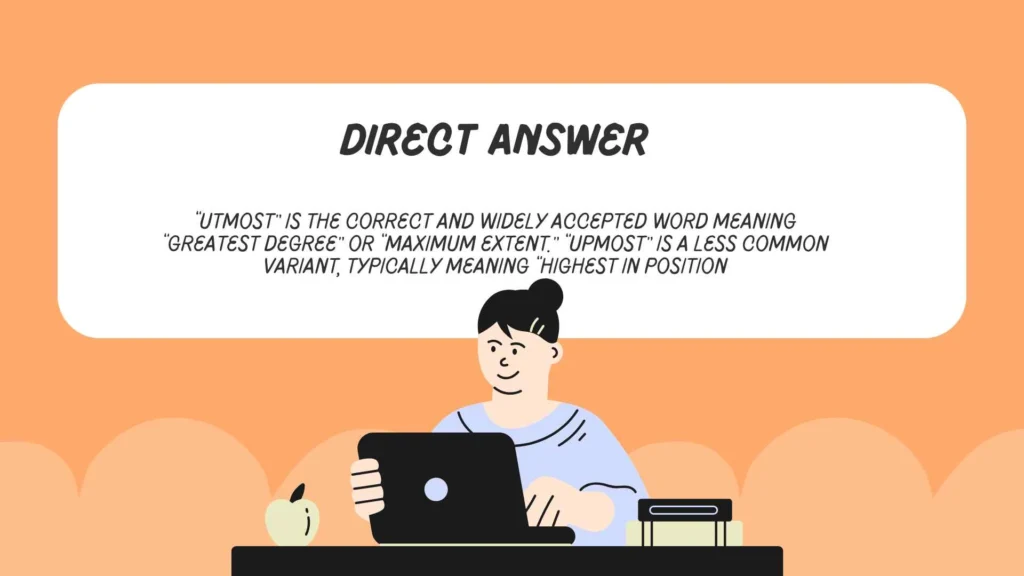
“Utmost” is the correct and widely accepted word meaning “greatest degree” or “maximum extent.” “Upmost” is a less common variant, typically meaning “highest in position,” but it is rarely used in modern English. In most contexts, “utmost” is the correct choice.
Quick Comparison Table
| Feature | Utmost | Upmost |
| Spelling | Standard, correct | Rare, nonstandard in most cases |
| Meaning | Greatest degree or extent | Highest position (rare usage) |
| Usage | Formal and everyday English | Rare, mostly avoided |
Deep Meanings & Definitions
Utmost
Utmost refers to the highest degree, greatest effort, or maximum level of something.
- Example meaning:
- “She showed the utmost dedication.”
- It emphasizes intensity or degree, not physical position.
Upmost
Upmost technically means highest or uppermost in position.
- Example (rare usage):
- “The upmost branch of the tree”
- However, this meaning is already better expressed by “uppermost.”
👉 In modern English, “upmost” is largely obsolete or avoided.
Utmost or upmost vs upmost
- Utmost is like the highest peak on a mountain, reaching the greatest possible level.
- Upmost is like the top branch of a tall tree, referring to the highest physical position.
- Choosing utmost instead of upmost is like using the right key for the right lock, making your writing accurate.
- The difference is like north and south on a compass, small to see but important to follow.
- Utmost shows maximum degree like a cup filled to the very brim.
- Upmost points to location like the highest shelf in a library.
- Learning this comparison is like finding a shortcut through a busy city, saving confusion.
- Remembering the meanings is like keeping a map in your pocket, making every decision easier.
- Understanding both words is like seeing both sides of a coin, giving complete clarity.
- Using the correct word is like wearing perfectly fitted shoes, making every sentence feel natural.
Utmost or upmost reddit
- Reddit discussions are like a crowded town square, where many people share opinions.
- Reading grammar debates is like watching experienced players explain a game, helping you learn faster.
- Most Reddit users recommend utmost like teachers pointing students toward the correct answer.
- Community explanations are like friends comparing travel routes, showing different viewpoints.
- Popular grammar threads are like well-lit paths in a dark forest, making confusing topics clearer.
- Checking Reddit before writing is like asking a knowledgeable neighbor for advice, giving practical help.
- Reddit conversations are like pieces of a puzzle, creating a complete understanding together.
- User examples are like real-life demonstrations in a classroom, making lessons memorable.
- Helpful comments are like guideposts along a hiking trail, keeping readers on track.
- Reading multiple replies is like looking through different windows, offering fresh perspectives.
Utmost or upmost respect
- Showing utmost respect is like standing for someone you deeply admire.
- Real respect is like a strong bridge, connecting people with trust.
- Offering sincere respect is like giving a warm handshake, leaving a positive impression.
- Respect grows like a healthy tree, becoming stronger over time.
- Treating others kindly is like sharing an umbrella in the rain, showing genuine care.
- Respect in communication is like clear glass, leaving no room for misunderstanding.
- Honest appreciation is like sunshine after a storm, lifting someone’s spirit.
- Respectful words are like gentle waves on a calm beach, creating peace.
- Valuing others is like protecting a precious gift, showing responsibility.
- Using “utmost respect” is like placing a crown on someone’s achievements, honoring their value.
Utmost or upmost importance
- Something of utmost importance is like the foundation of a house, supporting everything else.
- A top priority is like the first step on a staircase, leading every action.
- Important decisions are like a compass on a long journey, guiding the right direction.
- Giving something full attention is like watering the roots of a plant, helping everything grow.
- A critical task is like the heart in the human body, keeping everything working.
- Recognizing importance is like turning on a lighthouse, helping others find the way.
- Key information is like a missing puzzle piece, completing the picture.
- Essential planning is like packing before a trip, preventing future problems.
- Major priorities are like anchors for a ship, keeping everything steady.
- Understanding importance is like reading the map before traveling, avoiding unnecessary mistakes.
Utmost or upmost meaning
- Understanding the meaning is like opening a locked door, revealing something useful.
- Knowing the correct definition is like switching on a flashlight, making everything easier to see.
- Learning word meanings is like planting seeds in a garden, growing stronger vocabulary.
- Clear definitions are like road signs on a highway, preventing confusion.
- Correct usage is like following a trusted recipe, producing better results.
- Word meanings are like building blocks, creating stronger communication.
- Understanding vocabulary is like finding the missing page in a book, completing the story.
- Good explanations are like clean mirrors, reflecting ideas clearly.
- Learning grammar is like sharpening a pencil, making writing more precise.
- Remembering meanings is like saving a favorite bookmark, making future learning easier.
Utmost or upmost synonym
- Finding synonyms is like choosing different colors for the same painting, adding variety.
- A good synonym is like another path to the same destination, keeping the meaning clear.
- Expanding vocabulary is like adding tools to a toolbox, making writing stronger.
- Similar words are like different flowers in one garden, each with unique beauty.
- Learning synonyms is like collecting useful keys, opening more writing possibilities.
- Related words are like close friends, sharing many similarities.
- A rich vocabulary is like a full bookshelf, offering more choices.
- Picking the best synonym is like selecting the perfect outfit, matching the occasion.
- Strong word choices are like bright stars in the night sky, making writing stand out.
- Understanding synonyms is like learning several routes home, giving greater flexibility.
Utmost or upmost in a sentence
- Seeing words in a sentence is like watching an actor perform, bringing meaning to life.
- Sentence examples are like practice shots in basketball, building confidence.
- Reading examples is like following footprints in the snow, making the path easier.
- Every sentence is like a small lesson wrapped in words, teaching naturally.
- Correct examples are like traffic lights, guiding proper usage.
- Practice sentences are like training wheels on a bicycle, helping beginners improve.
- Learning through examples is like tasting food before serving it, ensuring quality.
- Good sentence structure is like a well-built bridge, connecting ideas smoothly.
- Real examples are like maps for travelers, showing the correct direction.
- Writing your own sentence is like planting your own tree, strengthening your understanding.
Utmost meaning
- Utmost means the greatest level like the tallest mountain in a range.
- The word expresses maximum effort like running the final mile with all your strength.
- It represents the highest degree like a flame burning at its brightest.
- Using utmost is like giving your best performance on stage, leaving nothing behind.
- Maximum care is like holding a fragile glass with steady hands, showing full attention.
- Full dedication is like a bee working tirelessly in a garden, staying focused.
- Great effort is like rowing across a wide river, refusing to give up.
- Complete commitment is like an oak tree standing firm in strong winds, showing strength.
- The highest quality is like a perfectly polished diamond, shining brilliantly.
- Understanding utmost is like reaching the summit after a long climb, bringing complete clarity.
Historical Origin & Etymology
Utmost
- Originates from Old English “ūtmest”
- Derived from:
- “ūt” (out) + “-mest” (superlative suffix)
- Originally meant “outermost” or “farthest”
- Over time, evolved to mean “greatest degree”
Upmost
- Derived from:
- “up” + “-most”
- Intended to mean “highest”
- However, it lost popularity as “uppermost” became standard
👉 Linguistic evolution favored clarity and consistency, which is why “utmost” survived strongly, while “upmost” faded.
Pronunciation Guide
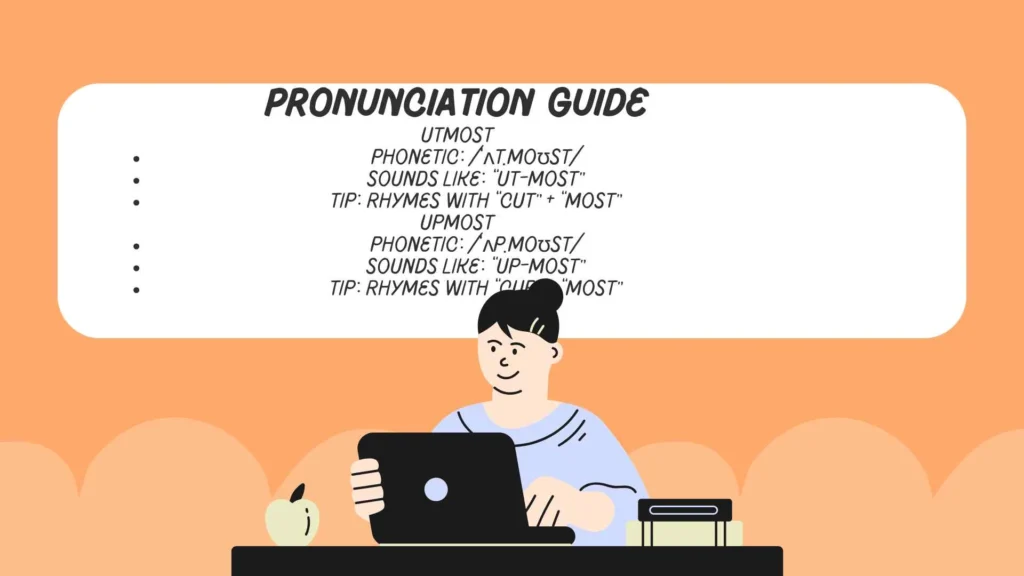
Utmost
- Phonetic: /ˈʌt.moʊst/
- Sounds like: “UT-most”
- Tip: Rhymes with “cut” + “most”
Upmost
- Phonetic: /ˈʌp.moʊst/
- Sounds like: “UP-most”
- Tip: Rhymes with “cup” + “most”
👉 The difference is subtle: “t” vs. “p” sound.
The Technical Differences
This confusion stems from phonetic similarity and historical overlap.
Key Linguistic Reasons:
- Both words follow the superlative suffix “-most”
- Both begin with similar vowel sounds
- Spoken English blurs the distinction
Why “Utmost” is Correct:
- It has semantic clarity: refers to degree/intensity
- It is standardized in dictionaries and style guides
- It dominates modern usage frequency
Why “Upmost” is Avoided:
- Redundant (overlaps with “uppermost”)
- Rare in formal writing
- Often considered a misspelling of “utmost”
Correct Spelling & Common Typos
Common Mistakes:
- ❌ Upmost respect
- ❌ Upmost importance
- ❌ Upmost care
Correct Forms:
- ✅ Utmost respect
- ✅ Utmost importance
- ✅ Utmost care
Why These Errors Happen:
- Pronunciation confusion
- Assumption that “up” = “higher importance”
- Lack of awareness of historical usage
👉 Rule of thumb: If you mean “maximum effort,” always use “utmost.”
Mnemonic Devices (Memory Tricks)
Here’s a simple trick:
👉 “Utmost = Ultimate”
- Both start with “ut”
- Both mean maximum or highest degree
Or:
👉 “Utmost gives your Ultimate effort”
Avoid confusion with:
👉 “Upmost? Just go up… and skip it.”
Regional Variations (US vs. UK English)
Good news—there’s no regional confusion here.
Across All Major English Variants:
- 🇺🇸 American English → Utmost
- 🇬🇧 British English → Utmost
- 🇨🇦 Canadian English → Utmost
- 🇦🇺 Australian English → Utmost
👉 “Upmost” is rare in all regions.
Singular and Plural Forms
Utmost
- Singular: utmost
- Plural: Not applicable (uncountable concept)
Possessive Form:
- Rare, but possible:
- “The utmost’s significance” (awkward, avoid)
👉 Better phrasing:
- “The significance of the utmost effort”
Grammar Rules & Parts of Speech
Part of Speech:
- Noun
- “He did his utmost.”
- Adjective
- “She showed utmost care.”
Usage Rules:
- Often used before nouns:
- “utmost importance”
- “utmost sincerity”
👉 Never use “upmost” in formal grammar unless specifically referring to position (rare).
Synonyms and Antonyms
Synonyms for Utmost:
- Maximum
- Greatest
- Highest
- Extreme
- Supreme
Antonyms:
- Minimum
- Least
- Lowest
- Negligible
Formal vs. Informal Usage
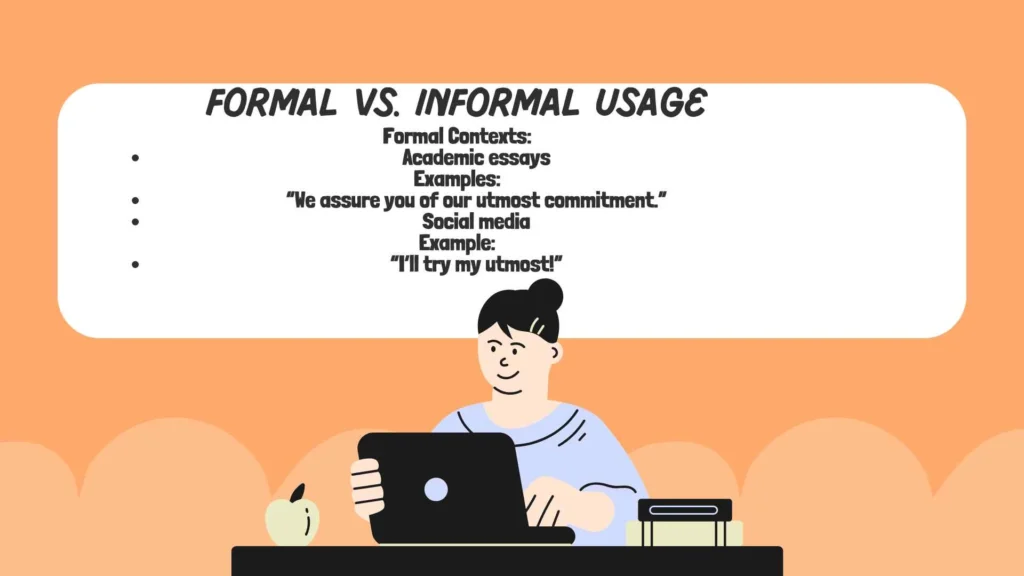
Formal Contexts:
- Business writing
- Academic essays
- Official communication
Examples:
- “We assure you of our utmost commitment.”
Informal Contexts:
- Conversations
- Social media
Example:
- “I’ll try my utmost!”
👉 “Utmost” fits both formal and informal contexts comfortably.
Illustrative Examples
- She treated the matter with the utmost seriousness.
- I have the utmost respect for your work.
- They handled the situation with utmost care.
- He tried his utmost to succeed.
- This issue is of utmost importance.
- The team gave their utmost effort.
- We must act with the utmost urgency.
- She performed her duties with the utmost professionalism.
- I assure you of my utmost support.
- The safety of passengers is of the utmost priority.
- He spoke with the utmost honesty.
- Please handle this document with the utmost confidentiality.
Practice Section (15 MCQs)
Choose the correct word:
- She showed the ___ respect.
a) upmost
b) utmost - This matter is of ___ importance.
a) utmost
b) upmost - He climbed to the ___ branch.
a) upmost
b) utmost - I will try my ___.
a) utmost
b) upmost - They acted with ___ care.
a) utmost
b) upmost - The ___ level of the building
a) upmost
b) utmost - This requires ___ attention.
a) utmost
b) upmost - She gave her ___ effort.
a) utmost
b) upmost - The ___ shelf holds the books.
a) upmost
b) utmost - He has my ___ trust.
a) utmost
b) upmost - This is of ___ concern.
a) utmost
b) upmost - The ___ point of the hill
a) upmost
b) utmost - She handled it with ___ professionalism.
a) utmost
b) upmost - We must show ___ dedication.
a) utmost
b) upmost - The ___ layer of clouds
a) upmost
b) utmost
Answer Key:
1-b, 2-a, 3-a, 4-a, 5-a, 6-a, 7-a, 8-a, 9-a, 10-a, 11-a, 12-a, 13-a, 14-a, 15-a
Frequently Asked Questions (FAQs)
Is “upmost” ever correct?
Yes, but only when referring to physical position, and even then, “uppermost” is preferred.
Why do people confuse “utmost” and “upmost”?
Because they sound similar and both use the “-most” suffix, leading to phonetic confusion.
Which one should I use in professional writing?
Always use “utmost.”
Is “upmost respect” wrong?
Yes, it’s considered incorrect. The correct phrase is “utmost respect.”
What’s the easiest way to remember the difference?
Think: “Utmost = Ultimate effort.”
Why do people say upmost instead of utmost?
People often say upmost because it sounds similar to utmost, making it a common spoken and written mistake. The correct word for meaning “the greatest” or “the highest level” is utmost, while upmost refers only to the highest physical position and is rarely used.
Is it utmost respect or utmost respect?
The correct phrase is utmost respect. It means showing the greatest possible respect, honor, or admiration toward someone. This is the standard expression used in formal and everyday English.
What does my utmost mean?
My utmost means my very best effort or the greatest amount I can give. When someone says, “I’ll do my utmost,” they are promising to try as hard as they possibly can.
What does “upmost” mean?
Upmost means the highest or uppermost physical position. It is a rare word in modern English and is used much less often than utmost, which refers to the greatest degree or effort.
What’s another word for “upmost”?
Some words with a similar meaning to upmost include uppermost, highest, topmost, top, and upper. In many situations, uppermost is the more natural and commonly accepted choice.
Do our utmost or upmost?
The correct expression is do our utmost. It means to make the greatest possible effort to achieve something. Do our upmost is considered incorrect because upmost does not mean “greatest effort.”
Conclusion
The confusion between utmost and upmost is understandable but easily fixable once you know the rule. Utmost is the correct, standard word used to express the highest degree or effort, while upmost is rare and largely unnecessary in modern English.
If you want your writing to sound polished and professional, stick with utmost in almost every case. Remember the simple mnemonic “utmost = ultimate” and you’ll never slip up again.
Language mastery comes from small distinctions like this, and now you’ve got one more advantage in your communication toolkit.

James Anderson is a thriller and mystery author known for his suspenseful plots and unexpected twists. His storytelling keeps readers on the edge of their seats, blending intrigue with psychological depth. James has a talent for creating gripping narratives that captivate audiences from beginning to end.
📚 Books:
- The Hidden Truth
- Shadow Game
- Beyond the Lies
 Ethan Walker
 Olivia Turner