Table of Contents
- Introduction
- Direct Answer: Evening or Afternoon?
- Quick Comparison Table
- What Is Afternoon?
- What Is Evening?
- Key Differences Between Afternoon and Evening
- How Dictionaries Define Afternoon and Evening
- When Does Afternoon End and Evening Begin?
- Is 4 PM Afternoon or Evening?
- Is 5 PM Afternoon or Evening?
- Is 6 PM Afternoon or Evening?
- Is 7 PM Afternoon or Evening?
- Afternoon vs Evening vs Night
- Late Afternoon vs Early Evening
- Afternoon and Evening Greetings
- Good Evening vs Good Night
- Grammar & Usage Rules
- Common Mistakes People Make
- Regional Differences
- Afternoon and Evening in Different Cultures
- Real-Life Situations
- Using Afternoon and Evening in Business Communication
- Memory Tricks
- Practice Quiz
- Frequently Asked Questions
- Conclusion
Introduction
Have you ever looked at the clock and wondered whether 5:00 p.m. is afternoon or evening? You are not alone. Many English learners and even native speakers find these two time expressions confusing because there is no official worldwide rule that says exactly when afternoon ends and evening begins.
I have noticed that this confusion often appears when people choose greetings, write emails, plan events, or describe daily activities. Using the correct word helps your English sound more natural and accurate in conversations, professional communication, and everyday situations.
In this guide, I will explain the difference between afternoon and evening, their meanings, correct usage, greetings, grammar rules, and the common situations where these words overlap. You will also learn practical examples so you can confidently choose the right expression.
Direct Answer: Evening or Afternoon?
Afternoon and evening describe different parts of the day. Afternoon starts at 12:00 p.m. (noon) and usually continues until around 5:00–6:00 p.m. Evening generally begins around 5:00–6:00 p.m. and lasts until night. The exact transition depends on culture, context, and daily routines.
A simple rule:
- 12:00 p.m. to around 5:00 p.m. → Afternoon
- Around 5:00–6:00 p.m. to night → Evening
The time between 5:00 p.m. and 6:00 p.m. can sometimes be called either late afternoon or early evening.
Quick Comparison Table
| Feature | Afternoon | Evening |
| Meaning | The period after noon and before evening | The period after afternoon and before night |
| Typical Time | 12:00 p.m. to around 5:00–6:00 p.m. | Around 5:00–6:00 p.m. until night |
| Comes After | Morning | Afternoon |
| Comes Before | Evening | Night |
| Common Meal | Lunch | Dinner |
| Common Activities | Work, school, meetings, errands | Dinner, relaxation, entertainment, social events |
| Greeting | Good Afternoon | Good Evening |
| Workplace Use | Common during working hours | Common after work hours or evening events |
What Is Afternoon?
The afternoon is the part of the day that begins immediately after noon (12:00 p.m.) and continues until the beginning of evening.
Unlike morning, which is connected with the start of the day, afternoon represents the middle portion of the daytime.
The afternoon is not determined by sunlight alone. Even if the sun is still bright, English speakers usually use the word based on the clock and social habits.
Common Afternoon Activities
People often use “afternoon” when talking about:
- Office work
- School classes
- Business meetings
- Shopping
- Medical appointments
- Travel
- Exercise
- Lunch breaks
- Daily tasks
Examples of Afternoon in Sentences
- We have a meeting this afternoon.
- I will send the report this afternoon.
- She usually goes for a walk every afternoon.
- The children came home in the late afternoon.
- Our flight leaves tomorrow afternoon.
What Is Evening?
The evening is the period between the afternoon and the night. It usually begins when the day starts moving away from regular daytime activities and people begin their personal or social time.
For many people, evening starts around 5:00 or 6:00 p.m., but this can change depending on location, lifestyle, and social situations.
Evening is commonly connected with:
- Dinner
- Family time
- Entertainment
- Relaxation
- Social gatherings
- Events and celebrations
Common Evening Activities
Examples include:
- Having dinner
- Watching movies
- Meeting friends
- Going to restaurants
- Attending concerts
- Reading
- Relaxing after work
Examples of Evening in Sentences
- We are having dinner this evening.
- Good evening, everyone.
- The event begins at 7:30 this evening.
- She studies in the evening after work.
- They enjoyed a walk in the evening.
Key Differences Between Afternoon and Evening
Although afternoon and evening come one after another, they represent different parts of the daily timeline.
| Afternoon | Evening |
| Starts after noon | Starts after late afternoon |
| Usually connected with daytime activities | Usually connected with personal or social time |
| Work and school are common | Relaxation and entertainment are common |
| Lunch is associated with this period | Dinner is associated with this period |
| Uses “Good Afternoon” | Uses “Good Evening” |
The easiest way to remember the difference is to think about the purpose of the time.
If people are usually working, studying, or completing daytime tasks, it is likely afternoon.
If people are usually finishing work, eating dinner, or relaxing, it is likely evening.
How Dictionaries Define Afternoon and Evening
Afternoon generally means the period after noon and before evening. It begins at 12:00 p.m. and covers the later part of the daytime.
Evening generally refers to the later part of the day before night. It is commonly associated with the time after daily work activities and before people go to sleep.
However, dictionaries also recognize that the exact boundary between afternoon and evening can vary depending on:
- Social customs
- Location
- Season
- Personal routine
- Context
For example, a business meeting at 5:00 p.m. may still be described as an afternoon meeting, while a dinner event at the same time may be called an evening event.
When Does Afternoon End and Evening Begin?
There is no official international time when afternoon changes into evening. English speakers usually depend on common social convention.
A general timeline looks like this:
| Time | Common Description |
| 12:00 p.m.–4:59 p.m. | Afternoon |
| 5:00 p.m.–5:59 p.m. | Late afternoon or early evening |
| 6:00 p.m.–9:00 p.m. | Evening |
| After 9:00 p.m. | Night |
Examples:
- 2:00 p.m. → Afternoon
- 4:30 p.m. → Late afternoon
- 5:30 p.m. → Late afternoon or early evening
- 7:00 p.m. → Evening
- 10:00 p.m. → Night
The beginning of evening is not based only on sunset. In summer, the sun may still be visible at 8:00 p.m., but people will still usually call that time evening.
Is 4 PM Afternoon or Evening?
4:00 p.m. is generally considered afternoon.
At this time, most people are still finishing work, attending classes, or completing daytime activities.
Examples:
- I have a doctor’s appointment at 4 PM this afternoon.
- We will discuss the project at 4 PM this afternoon.
However, if an event begins at 4 PM and has an evening theme, some people may describe it differently.
Is 5 PM Afternoon or Evening?
5:00 p.m. can be either late afternoon or early evening depending on the situation.
This is the main transition period where both terms may sound natural.
Examples:
- A work meeting at 5 PM → often called late afternoon.
- A dinner party at 5 PM → often called early evening.
Both can be correct because there is no fixed rule.
Is 6 PM Afternoon or Evening?
6:00 p.m. is usually considered evening.
Most English speakers would use “Good Evening” at this time.
Examples:
- Good evening, everyone. Welcome to the event.
- We are having dinner at 6 PM this evening.
In most professional and social situations, evening is the more natural choice.
Is 7 PM Afternoon or Evening?
7:00 p.m. is clearly considered evening.
At this time, people are usually having dinner, relaxing, attending events, or spending time with family.
Examples:
- The movie starts at 7 PM this evening.
- We usually eat dinner at 7 PM.
Calling 7 PM “afternoon” would sound unusual to most English speakers.
Afternoon vs Evening vs Night
Understanding the difference between afternoon, evening, and night helps you describe time more naturally in English. These three periods follow each other, but they are not interchangeable.
| Time Period | General Meaning | Common Activities | Example |
| Afternoon | The period after noon before evening | Work, school, meetings, shopping | I have a meeting this afternoon. |
| Evening | The period after afternoon before night | Dinner, social events, relaxation | We are going out this evening. |
| Night | The darker and later part of the day when people usually sleep | Sleeping, resting, nighttime activities | I usually read at night. |
Simple Timeline
Morning → Afternoon → Evening → Night
Example:
- 10:00 a.m. → Morning
- 2:00 p.m. → Afternoon
- 7:00 p.m. → Evening
- 11:00 p.m. → Night
Late Afternoon vs Early Evening
The biggest confusion between these words happens during the transition period between afternoon and evening.
What Is Late Afternoon?
Late afternoon refers to the final part of the afternoon, usually around 4:00 p.m. to 5:30 p.m.
It is still considered daytime, but it is approaching evening.
Examples:
- I will finish my work in the late afternoon.
- The temperature becomes cooler in the late afternoon.
- We went for a walk in the late afternoon.
Common activities:
- Leaving work
- Finishing school
- Running last errands
- Preparing for evening plans
What Is Early Evening?
Early evening refers to the beginning part of evening, usually around 5:00 p.m. to 7:00 p.m.
It often represents the transition from daytime activities to personal time.
Examples:
- We are meeting friends in the early evening.
- The restaurant gets busy in the early evening.
- She takes her exercise class in the early evening.
Late Afternoon vs Early Evening Comparison
| Feature | Late Afternoon | Early Evening |
| Approximate Time | 4:00–5:30 p.m. | 5:00–7:00 p.m. |
| Light | Usually daylight | Daylight or sunset |
| Common Activities | Work, school, errands | Dinner, events, relaxation |
| Feeling | End of daytime | Beginning of personal time |
The overlap between these two expressions is normal. Around 5:00 p.m., either term may be correct depending on the situation.
Afternoon and Evening Greetings
Choosing the correct greeting makes your English sound more natural and polite.
When to Say “Good Afternoon”
Use Good Afternoon after noon and before evening begins.
Usually:
12:00 p.m. to around 5:00–6:00 p.m.
Common situations:
- Office meetings
- Schools
- Customer service
- Professional conversations
- Afternoon appointments
Examples:
- Good afternoon, everyone.
- Good afternoon, Mr. Smith.
- Good afternoon. How can I help you?
When to Say “Good Evening”
Use Good Evening when evening has started.
Usually:
Around 5:00–6:00 p.m. onward
Common situations:
- Restaurants
- Hotels
- Formal events
- Conferences
- Evening meetings
Examples:
- Good evening, ladies and gentlemen.
- Good evening, welcome to our event.
- Good evening, Professor Johnson.
Good Evening vs Good Night
Many English learners confuse Good Evening and Good Night, but they have different purposes.
| Expression | Meaning | When to Use |
| Good Evening | A greeting | When meeting someone in the evening |
| Good Night | A goodbye or sleep wish | When leaving or going to bed |
Examples:
Correct:
✅ Good evening! It is nice to meet you.
(You are greeting someone)
✅ Good night! See you tomorrow.
(You are leaving)
Incorrect:
❌ Good night, everyone!
(When arriving at an event)
Grammar & Usage Rules
Both afternoon and evening are nouns that describe parts of the day. They are used in common time expressions, greetings, and compound words.
Using “In the Afternoon” and “In the Evening”
Use in the afternoon and in the evening when talking generally.
Examples:
- I usually exercise in the afternoon.
- She studies in the evening.
- We often go shopping in the afternoon.
- They watch movies in the evening.
Using “This Afternoon” and “This Evening”
Use this afternoon and this evening when talking about the current day.
Examples:
- I will call you this afternoon.
- We have a meeting this evening.
- She is visiting her friend this afternoon.
- They are attending a concert this evening.
Do not add “in” before “this.”
Incorrect:
❌ I will call you in this afternoon.
Correct:
✅ I will call you this afternoon.
Using Yesterday and Tomorrow
Both words can be combined with afternoon and evening.
Examples:
- We visited the museum yesterday afternoon.
- I received your email yesterday evening.
- The meeting is scheduled for tomorrow afternoon.
- We will attend the event tomorrow evening.
Afternoon and Evening as Adjectives
Both words can describe another noun.
Examples:
Afternoon + Noun
- afternoon meeting
- afternoon class
- afternoon appointment
- afternoon flight
Evening + Noun
- evening event
- evening news
- evening dress
- evening reception
These forms are common in:
- Business communication
- Travel
- Education
- Daily conversations
Examples:
- The afternoon meeting starts at 2 PM.
- The evening event begins at 7 PM.
Common Mistakes People Make
Even advanced English speakers sometimes confuse afternoon and evening, especially around 5 PM and 6 PM.
Mistake 1: Calling 2 PM Evening
Incorrect:
❌ We have an evening meeting at 2 PM.
Correct:
✅ We have an afternoon meeting at 2 PM.
Why?
Because 2 PM is clearly within the afternoon period.
Mistake 2: Using Good Afternoon at Night
Incorrect:
❌ Good afternoon, everyone. (at 8 PM)
Correct:
✅ Good evening, everyone.
Why?
Because 8 PM is generally considered evening or night.
Mistake 3: Thinking Sunset Defines Evening
Many people believe evening begins exactly when the sun goes down.
This is not always true.
For example:
- In summer, sunset may happen after 8 PM.
- People still call that time evening.
English speakers usually follow:
- Clock time
- Social situation
- Daily routine
rather than sunlight alone.
Mistake 4: Confusing Evening and Night
Incorrect idea:
“Evening and night mean the same thing.”
They are related but different.
Examples:
- We had dinner in the evening.
- We slept at night.
Evening usually comes before night.
Mistake 5: Using Greetings Without Considering Time Zone
In professional communication, consider the recipient’s local time.
Example:
You are sending an email from the US to someone in Australia.
Your afternoon may be their evening.
A professional greeting should match the receiver’s local time when possible.
Regional Differences (US vs UK vs Canada vs Australia)
The meaning of afternoon and evening is almost the same in American, British, Canadian, and Australian English.
There are no spelling differences.
The main difference is not grammar but social habits and daily routines.
American English
In the United States:
- Afternoon commonly covers noon until around 5 PM.
- Evening often begins around 5 or 6 PM.
Examples:
- I have a meeting this afternoon.
- We are having dinner this evening.
British English
British speakers use these words in a very similar way.
Examples:
- We will meet this afternoon.
- We are going out this evening.
In some situations, British speakers may use “evening” slightly earlier depending on social events.
Canadian English
Canadian English follows similar patterns:
- Afternoon for daytime activities.
- Evening for later social activities.
Example:
- The appointment is this afternoon.
- The concert is this evening.
Australian English
Australian speakers also follow the same general pattern.
Seasonal daylight changes may affect perception, but people usually rely on routine rather than sunset.
Afternoon and Evening in Different Cultures
Although English usage is similar worldwide, different cultures may have slightly different ideas about when evening begins.
Factors that influence the transition include:
- Working hours
- Meal times
- Climate
- Social traditions
- Local lifestyle
For example:
- In places where people eat dinner later, evening activities may start later.
- In areas where people finish work early, evening may begin earlier.
This is why there is no single universal time for the change from afternoon to evening.
Real-Life Situations: Afternoon or Evening?
Situation 1: Office Meeting at 3 PM
Correct:
Afternoon meeting
Reason:
3 PM is clearly afternoon.
Situation 2: Dinner Event at 6 PM
Correct:
Evening event
Reason:
Dinner and social events are usually connected with evening.
Situation 3: School Ends at 4 PM
Correct:
Afternoon
Reason:
School and daytime activities usually happen during the afternoon.
Situation 4: Wedding Starts at 7 PM
Correct:
Evening wedding
Reason:
7 PM is clearly evening.
Situation 5: Appointment at 5:30 PM
Possible:
- Late afternoon appointment
- Early evening appointment
Reason:
5:30 PM is a transition time.
Using Afternoon and Evening in Business Communication
Professional communication often requires choosing the right time expression because greetings and schedules should match the situation. Using afternoon and evening correctly makes emails, meetings, invitations, and customer interactions sound more natural.
Business Emails
When writing professional emails, the greeting should usually match the recipient’s local time.
Examples:
Afternoon email:
- Good afternoon, Ms. Carter,
- I hope you are doing well. I am sending the updated report this afternoon.
Evening email:
- Good evening, Mr. Wilson,
- Thank you for joining our meeting this evening.
If you communicate with people in different countries, always consider their local time zone before choosing a greeting.
Example:
A person sending an email at 2 PM from the United States may be contacting someone who is already experiencing evening hours in another country.
Meeting Invitations
The words afternoon and evening help people understand the expected timing of an event.
Examples:
- The training session will take place this afternoon at 2:30 PM.
- The networking event will begin this evening at 6:30 PM.
- The conference dinner is scheduled for tomorrow evening.
Using the correct term prevents confusion and gives the reader a clearer idea about the event.
Customer Service Communication
Many businesses change greetings throughout the day.
Examples:
Afternoon:
- Good afternoon. How may I assist you today?
Evening:
- Good evening. Welcome to our hotel.
These expressions are commonly used in:
- Hotels
- Restaurants
- Banks
- Customer support centers
- Reception desks
What Time Is Considered Evening?
There is no official clock time that marks the beginning of evening. However, in everyday English, most people consider evening to start around 5:00–6:00 PM.
A general guide:
| Time | Common Description |
| 12 PM–5 PM | Afternoon |
| 5 PM–6 PM | Late afternoon or early evening |
| 6 PM–9 PM | Evening |
| After 9 PM | Night |
The exact meaning can change depending on:
- Location
- Season
- Social activity
- Work schedule
- Cultural habits
For example:
A meeting at 5 PM may be called an afternoon meeting, but a dinner event at the same time may be called an evening event.
What Time Does Afternoon End?
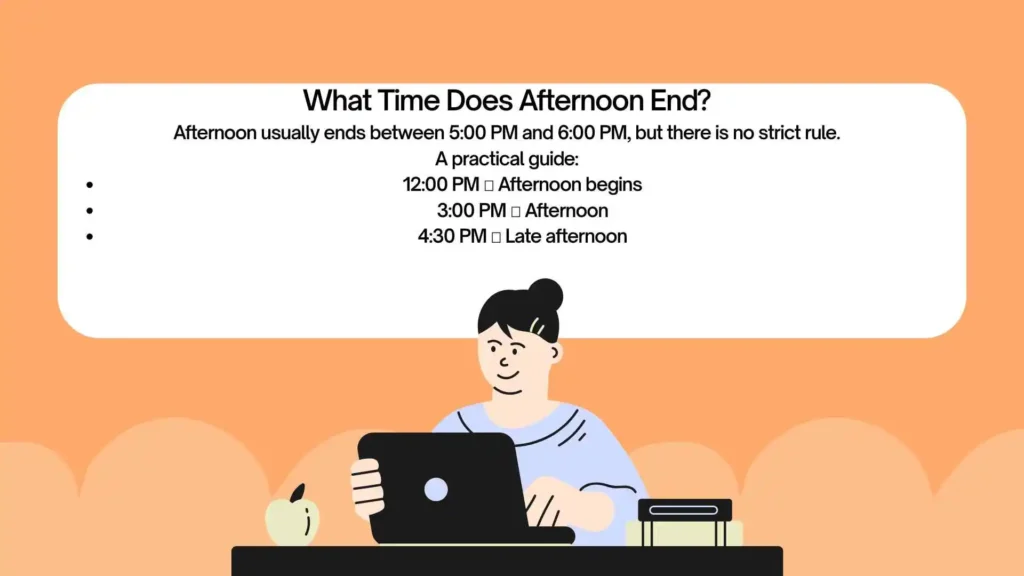
Afternoon usually ends between 5:00 PM and 6:00 PM, but there is no strict rule.
A practical guide:
- 12:00 PM → Afternoon begins
- 3:00 PM → Afternoon
- 4:30 PM → Late afternoon
- 5:30 PM → Late afternoon or early evening
- 6:30 PM → Evening
The transition depends more on social context than the exact clock.
When Does Evening Start?
Evening generally starts around 5:00–6:00 PM.
However, people may use the word earlier or later depending on the situation.
Examples:
Workplace
A person may say:
“Let’s schedule the meeting for late afternoon.”
Meaning:
Around 4 PM or 5 PM.
Social Event
A person may say:
“The party starts in the evening.”
Meaning:
Usually after 5 PM.
Is Afternoon After Lunch?
Yes, afternoon begins after noon, and lunch often happens during the afternoon.
However, afternoon does not mean only after eating lunch.
Examples:
Correct:
- I have a meeting this afternoon.
- She goes shopping in the afternoon.
Not every afternoon activity happens after lunch.
The word refers to a time period, not a meal.
Does Sunset Mean Evening?
No, sunset does not always determine when evening begins.
Many people think:
“Sunset = Evening”
but this is not always true.
The beginning of evening depends on common language usage.
Examples:
- In summer, sunset may happen at 8 PM, but people still say “Good evening.”
- In winter, sunset may happen much earlier, but people may still describe 4 PM as late afternoon.
English speakers usually consider:
- Time of day
- Social setting
- Daily routine
rather than sunlight alone.
Can Afternoon and Evening Overlap?
Yes. The period around 5 PM to 6 PM can overlap.
This happens because language does not always follow exact clock boundaries.
Examples:
5 PM Office Meeting
Possible:
- Late afternoon meeting
- Early evening meeting
5 PM Dinner Invitation
More natural:
- Evening dinner
5 PM Work Appointment
More natural:
- Afternoon appointment
The correct choice depends on the purpose and context.
Afternoon and Evening Vocabulary
Learning related words helps you understand these time expressions better.
Words Related to Afternoon
- Noon
- Midday
- Daytime
- Late afternoon
- Working hours
- Business hours
Examples:
- The store is busy during midday.
- We have a meeting during business hours.
Words Related to Evening
- Early evening
- Sunset
- Dusk
- Twilight
- Evening hours
- Nighttime
Examples:
- The sky looked beautiful at dusk.
- We went for a walk in the evening.
Synonyms and Similar Expressions
Synonyms for Afternoon
Depending on context:
- After noon
- Midday period
- Daytime hours
- Later part of the day
Synonyms for Evening
Depending on context:
- Early night
- Nightfall period
- Dusk hours
- Late-day period
Note:
These words are not always exact replacements because each has a slightly different meaning.
Memory Tricks to Remember Afternoon vs Evening
Memory Trick 1: Follow the Daily Timeline
Remember:
Morning → Afternoon → Evening → Night
If you know the order, you can easily place the correct word.
Memory Trick 2: Lunch vs Dinner
Think about meals:
Lunch = Afternoon
Dinner = Evening
Examples:
- Lunch meeting → Afternoon
- Dinner event → Evening
Memory Trick 3: Work vs Relaxation
Think about daily routines:
Work and school → Afternoon
Relaxation and social activities → Evening
Memory Trick 4: Greeting Method
Remember:
- Good Afternoon → After noon
- Good Evening → Later part of the day
- Good Night → Goodbye or sleep
Memory Trick 5: Use the Clock as a Backup
When you are unsure:
- 12:00 PM–5:00 PM → Afternoon
- 5:00 PM–6:00 PM → Late afternoon or early evening
- 6:00 PM onward → Evening
Remember that the 5 PM–6 PM period can change depending on the situation.
More Everyday Examples
Afternoon Examples
- I will finish the project this afternoon.
- We have a doctor’s appointment tomorrow afternoon.
- She usually drinks coffee in the afternoon.
- The children play outside in the afternoon.
- The flight arrives in the afternoon.
- We discussed the plan yesterday afternoon.
- The store is crowded during the afternoon.
- He takes a short break every afternoon.
Evening Examples
- We are having dinner this evening.
- Good evening, everyone.
- The movie starts at 8 PM this evening.
- She enjoys reading in the evening.
- They visited their friends yesterday evening.
- The restaurant is busy in the evening.
- We usually exercise in the early evening.
- The event will happen tomorrow evening.
Practice Quiz (15 MCQs): Afternoon or Evening?
Test your understanding of the difference between afternoon and evening by choosing the correct answer. The answer key is provided at the end.
1. Which part of the day begins immediately after noon?
A. Morning
B. Afternoon
C. Evening
D. Night
2. Which greeting is appropriate at 2:30 p.m.?
A. Good Morning
B. Good Night
C. Good Afternoon
D. Good Evening
3. Which time is most commonly considered evening?
A. 9:00 a.m.
B. 12:00 p.m.
C. 7:00 p.m.
D. 3:00 p.m.
4. Which meal is most closely associated with the evening?
A. Breakfast
B. Brunch
C. Lunch
D. Dinner
5. Which sentence is correct?
A. We had dinner this afternoon at 7:00 p.m.
B. We had dinner this evening at 7:00 p.m.
C. Good afternoon, everyone! (at 8:00 p.m.)
D. Good night! (when greeting guests at 6:00 p.m.)
6. Afternoon normally starts at:
A. Sunrise
B. Noon
C. Sunset
D. Midnight
7. Which greeting is most appropriate when a meeting begins at 6:30 p.m.?
A. Good Morning
B. Good Afternoon
C. Good Evening
D. Good Day
8. Which part of the day comes directly before evening?
A. Night
B. Morning
C. Afternoon
D. Midnight
9. Which sentence is grammatically correct?
A. She studies at evening.
B. She studies on evening.
C. She studies in the evening after dinner.
D. She studies by evening every day.
10. Which preposition is correct?
A. In the afternoon
B. At the afternoon
C. On the afternoon
D. Into afternoon
11. Around 4:30 p.m. is commonly described as:
A. Early morning
B. Midnight
C. Late afternoon
D. Late night
12. Which statement is true?
A. Evening comes before afternoon.
B. Afternoon comes before evening.
C. Night comes before afternoon.
D. Morning comes after evening.
13. Which greeting is used when arriving at an evening event?
A. Good Morning
B. Good Afternoon
C. Good Evening
D. Good Night
14. Which sentence uses the correct time expression?
A. I’ll call you tomorrow evening.
B. I’ll call you at tomorrow evening.
C. I’ll call you on tomorrow evening.
D. I’ll call you by tomorrow evening the.
15. Which sequence is correct?
A. Morning → Evening → Afternoon → Night
B. Afternoon → Morning → Evening → Night
C. Morning → Afternoon → Evening → Night
D. Night → Morning → Afternoon → Evening
Answer Key
- B — Afternoon
- C — Good Afternoon
- C — 7:00 p.m.
- D — Dinner
- B — We had dinner this evening at 7:00 p.m.
- B — Noon
- C — Good Evening
- C — Afternoon
- C — She studies in the evening after dinner.
- A — In the afternoon
- C — Late afternoon
- B — Afternoon comes before evening.
- C — Good Evening
- A — I’ll call you tomorrow evening.
- C — Morning → Afternoon → Evening → Night
Frequently Asked Questions (FAQs)
Is 4 PM afternoon or evening?
4 PM is generally considered afternoon. It is usually described as late afternoon because it comes before the common evening transition.
Can you say Good Evening at 5 PM?
Yes. At 5 PM, Good Evening can be acceptable, especially for social events or formal gatherings. However, some people may still consider it late afternoon.
Is 12 PM afternoon or noon?
12 PM is called noon, but it also marks the beginning of the afternoon period.
Is 6 PM afternoon or evening?
6 PM is generally considered evening in most English-speaking countries.
Is 7 PM afternoon or evening?
7 PM is clearly evening. Calling it afternoon would sound unusual to most speakers.
Does dinner always mean evening?
Usually, dinner is associated with evening, but some cultures have earlier dinner times. The meal itself does not create the time period.
Is sunset the beginning of evening?
No. Sunset can happen at different times throughout the year. People usually use social convention and clock time instead.
Do American and British speakers use afternoon and evening differently?
No major difference exists. Both use these words in almost the same way.
Why is there no exact time between afternoon and evening?
Because language develops through everyday use. People choose words based on habits, culture, and context rather than strict clock rules.
What comes after afternoon?
Evening comes after afternoon, followed by night.
Is 5:30 PM afternoon or evening?
5:30 PM can be called either late afternoon or early evening. The choice depends on the situation. A work meeting may be called an afternoon meeting, while a dinner event may be called an evening event.
Conclusion
The difference between afternoon and evening is mainly based on time, routine, and social context. Afternoon begins at noon and usually covers the middle part of the day, while evening begins later and leads into night.
Although there is no exact worldwide boundary, most English speakers consider 12 PM to around 5–6 PM as afternoon and 5–6 PM onward as evening.
When choosing between the two, think about the clock, the activity, and the situation. Work, school, and daytime tasks usually belong to the afternoon, while dinner, relaxation, and social events usually belong to the evening.
Understanding these small differences will help your English sound more natural in conversations, greetings, emails, and everyday communication.
Discover More Topics:
- Sempai or Senpai: Which Spelling Is Correct? Meaning, Origin, and Real Usage Explained
- Nineth or Ninth? Which One Is Correct? Stop Making This Common Mistake

Ethan Walker is a non-fiction author and thought leader who writes about personal growth, productivity, and modern life challenges. His work focuses on helping readers simplify their lives, make better decisions, and achieve meaningful success. With a clear and practical writing style, Ethan provides valuable insights that inspire positive change and long-term improvement.
📚 Books:
- The Road to Clarity
- Moments of Truth
- Breaking the Limits
 Olivia Turner
 James Anderson