Table of Contents
- Introduction
- Direct Answer
- Quick Comparison Table
- Deep Meanings & Definitions
- Historical Origin & Etymology
- Pronunciation Guide
- The Technical Differences
- Correct Spelling & Common Typos
- Mnemonic Devices (Memory Tricks)
- Regional Variations (US vs. UK English)
- Singular and Plural Forms
- Grammar Rules & Parts of Speech
- Synonyms and Antonyms
- Formal vs Informal Usage
- Illustrative Examples
- Practice Section (15 MCQs)
- Frequently Asked Questions (FAQs)
- Conclusion
Introduction
I’ve seen even advanced English learners pause when deciding whether to place a comma before “or.” It seems simple, yet the rules shift depending on structure, meaning, and style.
If you’ve ever wondered, “Do I always need a comma before or?” you’re not alone.
This tiny punctuation mark can completely change clarity and tone.
In professional writing, the wrong comma can make your sentence ambiguous or even incorrect.
That’s why mastering this rule is essential for clear communication.
In this guide, I’ll break down every scenario so you never hesitate again.
Direct Answer
A comma before “or” is used when connecting two independent clauses or separating items in a list (especially before the final item in some styles). It is not used when joining simple alternatives within a sentence. The rule depends on sentence structure and clarity.
Quick Comparison Table
| Situation | Comma Before “Or”? | Example |
| Two independent clauses | Yes | I will call you, or I will email you. |
| Simple alternatives | No | Do you want tea or coffee? |
| Lists (Oxford comma) | Optional (style-based) | Apples, oranges, or bananas |
| Clarifying meaning | Yes (if needed) | Leave now, or you’ll be late |
Deep Meanings & Definitions
What is a comma?
A comma is a punctuation mark used to:
- Separate elements in a sentence
- Clarify meaning
- Indicate pauses in speech
What is “or”?
“Or” is a coordinating conjunction used to:
- Present alternatives
- Show choices
- Indicate consequences (in some contexts)
Combined function
When used together, comma + or helps:
- Prevent ambiguity
- Separate complete thoughts
- Improve readability
Comma before or in list
- Think of the comma as a traffic signal that keeps each item separate and easy to read.
- Picture it like spaces between books on a shelf so every item stands out clearly.
- Use it like stepping stones across a stream that guide readers from one item to the next.
- Treat it like labels on storage boxes that prevent confusion.
- Imagine it as breaks in a song that make every part easier to follow.
- See it like dividers in a toolbox that organize everything neatly.
- Think of it as fence posts in a garden that separate each section.
- Use it like pauses during a speech that help listeners understand.
- Picture it as lanes on a road that keep every item in order.
- View it like chapters in a book that make information simple to scan.
Comma before or in a sentence
- A comma works like a short breath that gives your sentence a natural rhythm.
- Think of it as a speed bump that slows readers just enough to understand.
- Use it like a bridge that connects related ideas smoothly.
- Picture it as a doorway that leads from one thought to another.
- See it like a stoplight that prevents ideas from crashing together.
- Imagine it as a gentle wave that keeps the sentence flowing.
- Treat it like stitching in fabric that holds ideas together.
- Think of it as a signpost that points readers in the right direction.
- Use it like a bookmark that helps readers keep their place.
- Picture it as a guide rope that keeps every idea connected.
Comma before or in a question
- A comma acts like a friendly pause before extra information in a question.
- Think of it as a hand gesture that adds clarity while speaking.
- Use it like a checkpoint that keeps the question easy to understand.
- Picture it as a spotlight that highlights important words.
- See it like a conversation break that sounds natural.
- Imagine it as a small bridge connecting ideas inside the question.
- Treat it like a map marker that guides readers smoothly.
- Think of it as a pause in music that improves the rhythm.
- Use it like a signal flag that separates different parts of the question.
- Picture it as a soft tap that prepares readers for the next idea.
Comma before or in a list of 3
- A comma separates items like fence lines dividing three neighboring fields.
- Think of it as stepping stones leading through three clear points.
- Use it like shelf dividers that organize every item.
- Picture it as traffic lanes keeping each part in order.
- See it like branches on a tree where every branch has space.
- Imagine it as beads on a string that stay neatly arranged.
- Treat it like puzzle pieces that fit together without confusion.
- Think of it as markers on a trail guiding readers from one item to the next.
- Use it like drawers in a cabinet that separate different things.
- Picture it as pages in a notebook that keep information organized.
Comma before or if
- A comma works like a safety net when “if” introduces extra information.
- Think of it as a gate that separates conditions from the main idea.
- Use it like a road sign warning readers about a change in direction.
- Picture it as a pause before a decision that makes meaning clearer.
- See it like a fork in the road where readers choose the correct path.
- Imagine it as a bridge rail that keeps ideas connected safely.
- Treat it like a flashlight that highlights the condition.
- Think of it as a seatbelt that keeps the sentence secure.
- Use it like a guide arrow pointing toward the next idea.
- Picture it as a pause before a promise that sounds natural.
Comma before or usage
- Using a comma is like following a recipe that keeps every step clear.
- Think of it as a compass that guides readers through the sentence.
- Use it like road markings that prevent confusion.
- Picture it as a frame around a picture that adds structure.
- See it like a coach helping every word stay in position.
- Imagine it as building blocks that create a strong sentence.
- Treat it like a bookmark that keeps readers on track.
- Think of it as a guide rail supporting smooth reading.
- Use it like a clean pathway leading readers forward.
- Picture it as a helpful friend that explains where to pause.
Comma before or after quotation marks
- A comma works like a door hinge connecting quoted words with the sentence.
- Think of it as a movie subtitle that keeps dialogue clear.
- Use it like stage directions guiding readers through speech.
- Picture it as a handshake between the quotation and the sentence.
- See it like a ribbon tying spoken words together.
- Imagine it as a bookmark inside dialogue that keeps everything organized.
- Treat it like a bridge linking the speaker and the quote.
- Think of it as a speech bubble tail pointing to the speaker.
- Use it like a microphone stand supporting clear dialogue.
- Picture it as a spotlight helping readers follow the conversation.
Comma before or after conjunction
- A comma acts like a bridge connecting two complete ideas smoothly.
- Think of it as a traffic officer directing ideas without confusion.
- Use it like a zipper joining two parts neatly.
- Picture it as a doorway leading from one clause to another.
- See it like a knot in a rope that keeps ideas together.
- Imagine it as a pause in conversation that sounds natural.
- Treat it like a connecting puzzle piece joining matching thoughts.
- Think of it as a guidepost showing where the next idea begins.
- Use it like train tracks linking two destinations.
- Picture it as a smooth curve in a road that makes reading effortless.
Historical Origin & Etymology
Comma
- From Greek komma meaning “cut” or “short clause”
- Adopted into Latin as comma
- Entered English in the 16th century
Or
- From Old English oþþe (meaning “either/or”)
- Related to Germanic roots
- Used for logical alternatives in early texts
Evolution
Early English writing lacked standardized punctuation. Over time, commas became essential for clarity, especially when conjunctions like “or” introduced multiple interpretations.
Pronunciation Guide
- Comma → /ˈkɒmə/ (KOM-uh) — sounds like “comma” in “comma pause”
- Or → /ɔːr/ (aw-r) — rhymes with “more”
Quick tip:
Say the sentence aloud—if you naturally pause, a comma might be needed.
The Technical Differences
This is where most confusion happens. The rule depends on sentence structure, not preference.
1. Independent Clauses
Use a comma before “or” when both parts can stand alone.
✔ Example:
- I can drive you, or you can take a taxi.
2. Dependent Structures
No comma if the second part cannot stand alone.
✔ Example:
- I will call or text you.
3. Lists (Oxford Comma Debate)
- US English: often uses comma before “or” in lists
- UK English: often omits it
✔ Example:
- With comma: apples, oranges, or bananas
- Without: apples, oranges or bananas
4. Contrast or Consequence
Comma adds emphasis or warning.
✔ Example:
- Hurry, or we’ll miss the train.
Correct Spelling & Common Typos
Common mistakes:
- Missing comma in compound sentences
- Overusing commas unnecessarily
- Confusing “or” with “and” rules
Examples:
❌ I will go or I will stay.
✔ I will go, or I will stay.
❌ Tea, or coffee?
✔ Tea or coffee?
Why errors happen:
- Misunderstanding clause structure
- Overgeneralizing rules
- Influence of informal writing
Mnemonic Devices (Memory Tricks)
Trick 1:
“Two full thoughts? Add a comma before ‘or.’”
Trick 2:
“Short choice, no comma voice.”
Trick 3:
“Pause equals comma—if both sides can stand.”
These help you instantly decide.
Regional Variations (US vs. UK English)
American English
- Prefers the Oxford comma
- More consistent use before “or” in lists
British English
- Often omits the Oxford comma
- Uses comma only when needed for clarity
Canadian & Australian English
- Mixed usage depending on style guides
Key takeaway:
- Grammar rules stay the same
- Style preferences differ
Singular and Plural Forms
Comma
- Singular: comma
- Plural: commas
Possessive:
- Singular: comma’s role
- Plural: commas’ placement
“Or”
- Does not change form
- Always remains the same
Grammar Rules & Parts of Speech
Comma
- Punctuation mark (not a word class)
Or
- Coordinating conjunction
Function in sentences:
- Links words, phrases, or clauses
- Signals alternatives or consequences
Structure types:
- Word + or + word
- Phrase + or + phrase
- Clause + comma + or + clause
Synonyms and Antonyms
Synonyms for “or”:
- Either
- Alternatively
- Otherwise
Antonyms:
- And
- As well as
- Also
Related punctuation:
- Semicolon
- Colon
- Dash
Formal vs Informal Usage
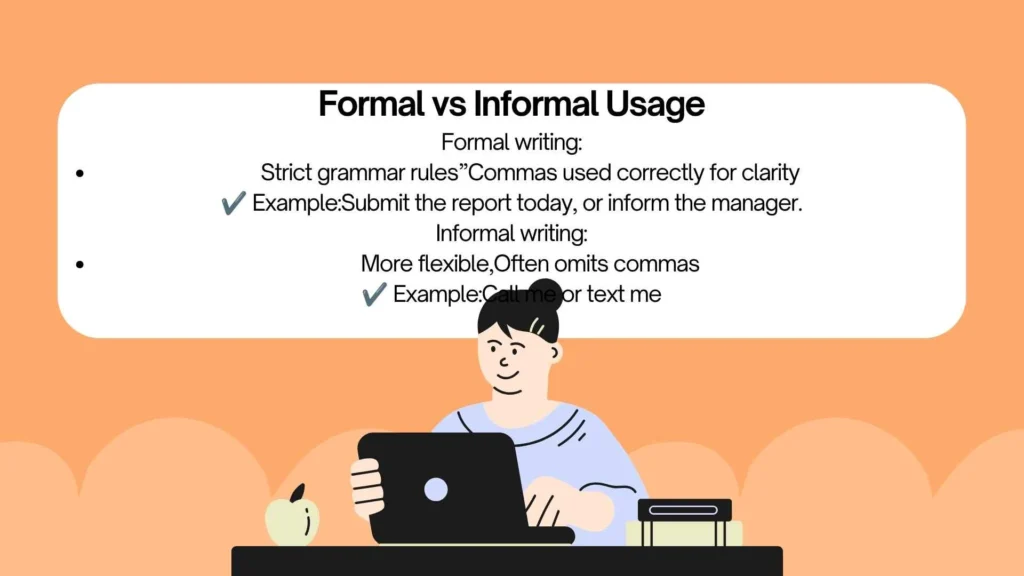
Formal writing:
- Strict grammar rules
- Commas used correctly for clarity
✔ Example:
- Submit the report today, or inform the manager.
Informal writing:
- More flexible
- Often omits commas
✔ Example:
- Call me or text me
Professional tip:
Always follow formal rules in:
- Academic writing
- Business communication
- SEO content
Illustrative Examples
- I will finish the project, or I will ask for help.
- Do you prefer coffee or tea?
- You can stay here, or you can leave now.
- Choose red, blue, or green.
- Hurry, or we’ll miss the flight.
- Should I email or call you?
- We can eat now, or wait until later.
- Bring a pen or pencil.
- Study hard, or you might fail.
- Do you want pizza, pasta, or salad?
- Leave early, or traffic will delay you.
- You may accept or decline the offer.
Practice Section (15 MCQs)
1. Choose the correct sentence:
A) I will go or I will stay.
B) I will go, or I will stay.
C) I will go or, I will stay.
D) I will go or stay,
2. Do you need a comma?
“Tea or coffee?”
A) Yes
B) No
3. Identify correct usage:
A) Run, or walk fast.
B) Run or walk fast.
C) Run or, walk fast.
D) Run, or, walk fast.
4. Independent clauses require:
A) No comma
B) A comma before “or”
C) A semicolon only
D) Nothing
5. Oxford comma is:
A) Mandatory everywhere
B) Style-dependent
C) Incorrect
D) Rare
6. “Or” is a:
A) Verb
B) Noun
C) Conjunction
D) Adjective
7. Choose correct:
A) Apples oranges or bananas
B) Apples, oranges or bananas
C) Apples, oranges, or bananas
D) Both B and C
8. “Hurry or we’ll be late” needs:
A) No comma
B) A comma
C) Two commas
D) Semicolon
9. Correct form:
A) Call me, or text me.
B) Call me or text me.
C) Both are correct depending on structure
D) Neither
10. “Comma” comes from:
A) Latin
B) Greek
C) French
D) German
11. The plural of comma:
A) Commaes
B) Commas
C) Commi
D) Commans
12. Choose correct:
A) Leave now or you’ll miss it.
B) Leave now, or you’ll miss it.
C) Leave, now or you’ll miss it.
D) Leave now or, you’ll miss it.
13. Informal writing:
A) Always uses commas
B) Often omits commas
C) Never uses commas
D) Uses only semicolons
14. “Or” shows:
A) Addition
B) Contrast/choice
C) Time
D) Place
15. Best rule:
A) Always use comma
B) Never use comma
C) Depends on structure
D) Guess
Answer Key:
1-B, 2-B, 3-B, 4-B, 5-B, 6-C, 7-D, 8-B, 9-C, 10-B, 11-B, 12-B, 13-B, 14-B, 15-C
Frequently Asked Questions (FAQs)
Do you always put a comma before “or”?
No. Only when connecting independent clauses or for clarity in lists.
Is the Oxford comma required?
It depends on style (required in US, optional in UK).
Can a comma change meaning?
Yes, it can prevent ambiguity and clarify intent.
Should I use commas in simple choices?
No, not in short alternatives like “tea or coffee.”
What is the easiest rule to remember?
Use a comma if both parts can stand alone as sentences.
Should I use a comma before or?
Use a comma before or only when it joins two independent clauses that can each stand as complete sentences. In a simple list or between two words or phrases, a comma is usually not needed unless it improves clarity.
What is the most common comma mistake?
The most common comma mistake is adding commas where they are not needed or leaving them out where they are required. Comma splices, where two complete sentences are joined with only a comma, are also a frequent writing error.
What is the rule for a comma before and?
A comma before and is used when it connects two independent clauses. In a list, the final comma before and (known as the Oxford comma) is optional unless your style guide or context recommends it for clarity.
What are 5 rules for using commas?
Five basic comma rules include separating items in a list, joining independent clauses with a coordinating conjunction, setting off introductory words or phrases, separating nonessential information, and separating coordinate adjectives before a noun.
What is the 3 comma rule?
The “3 comma rule” usually refers to using commas to separate three or more items in a series. For example, each item is separated by a comma, with the final comma before the last item depending on the writing style being used.
What are the 10 comma rules?
The ten common comma rules cover lists, independent clauses, introductory elements, nonessential clauses, coordinate adjectives, direct address, dates, places, quotations, and transitional words or phrases. Following these rules helps make writing clearer, more accurate, and easier to read.
Conclusion
The rule for using a comma before “or” is not arbitrary it is structural.
Once you understand clause types, the confusion disappears.
Remember that commas exist to improve clarity, not complicate writing.
Use them when connecting complete thoughts, but avoid them in simple alternatives.
Style differences may influence usage, but the core grammar remains consistent.
With practice, this rule becomes second nature.
Master it, and your writing will instantly become clearer and more professional.

Ethan Walker is a non-fiction author and thought leader who writes about personal growth, productivity, and modern life challenges. His work focuses on helping readers simplify their lives, make better decisions, and achieve meaningful success. With a clear and practical writing style, Ethan provides valuable insights that inspire positive change and long-term improvement.
📚 Books:
- The Road to Clarity
- Moments of Truth
- Breaking the Limits
 Olivia Turner