Table of Contents
- Direct Answer: The Quick Definition
- Quick Comparison Table
- Deep Meanings & Definitions
- Historical Origin & Etymology
- Pronunciation Guide
- The Technical Differences
- Correct Spelling & Common Typos
- Mnemonic Devices (Memory Tricks)
- Regional Variations (US vs. UK English)
- Singular and Plural Forms
- Grammar Rules & Parts of Speech
- Synonyms and Antonyms
- Formal vs. Informal Usage
- Illustrative Examples
- Practice Section (15 MCQs)
- Frequently Asked Questions (FAQs)
- Conclusion
Introduction
I’ve spent years watching brilliant writers stumble over this seemingly simple choice. You’re crafting an important document, and suddenly your cursor hovers between “imbed” and “embed” – a moment of hesitation that can shake anyone’s confidence. The truth is, this confusion has plagued writers, editors, and professionals for decades, and I’m here to settle it once and for all. Mastering this distinction isn’t just about being correct; it’s about projecting authority and precision in your writing, whether you’re drafting technical documentation, academic papers, or business communications. By the end of this comprehensive guide, you’ll never second-guess yourself again.
Direct Answer: The Quick Definition
Embed is the standard, preferred spelling in modern English, while imbed is an acceptable but increasingly rare variant. Both words mean to fix something firmly and deeply within a surrounding substance or to integrate something into a larger whole. For all professional, academic, and digital contexts, always choose embed.
Quick Comparison Table
| Aspect | Embed | Imbed |
| Preferred Status | ✓ Standard spelling | Variant spelling |
| Frequency of Use | Extremely common (90%+ usage) | Rare (less than 10% usage) |
| Core Meaning | To fix firmly within | Same meaning |
| Primary Context | All contexts, especially digital/technical | Rare, mostly older texts |
| UK/US Acceptance | Accepted globally | Accepted but archaic |
| Stylistic Perception | Professional, modern | Outdated, distracting |
Deep Meanings & Definitions
Embed
As a verb, embed refers to the act of inserting, fixing, or enclosing something firmly within a surrounding mass, substance, or larger entity. The term carries connotations of permanence, integration, and deep attachment. In technical contexts, it specifically describes the insertion of one object, code, or media file into another system or document.
Imbed
Imbed carries the identical definition but represents an older orthographic variant. It appears most frequently in historical texts, certain regional publications, and occasionally in established scientific literature published before the mid-twentieth century. The ‘im-‘ prefix reflects the Latin preposition “in” (meaning “in” or “into”) combined with a root word beginning with ‘b,’ creating a phonetic assimilation that some writers have historically preferred.
Imbed or embed meaning
- Like two puzzle pieces fitting together, imbed and embed both describe placing something firmly inside something else.
- Like planting a seed in soil, the words show the idea of becoming part of a larger whole.
- Like a gemstone set in a ring, they describe something fixed securely in place.
- Like chocolate chips inside a cookie, they explain that one thing sits within another.
- Like words written in a diary, the meaning stays connected to its context.
- Like roots growing into the ground, the action suggests becoming firmly established.
- Like a memory staying in your mind, the idea remains deeply connected.
- Like a picture inside a frame, the object becomes part of its surroundings.
- Like a key fitting into a lock, both words express a close and secure connection.
- Like a brick in a wall, the meaning focuses on something becoming an essential part of something else.
Imbed or embed synonym
- Like close friends standing together, synonyms such as insert and implant share a similar meaning.
- Like books on the same shelf, embed and imbed belong to the same word family.
- Like different paths leading to one place, words like fix and set express related ideas.
- Like tools in the same toolbox, each synonym helps explain the same action.
- Like branches from one tree, these similar words grow from the same concept.
- Like teammates working together, every synonym supports clear communication.
- Like colors in the same palette, each word adds a slightly different shade of meaning.
- Like songs with the same rhythm, the synonyms work well in similar situations.
- Like pieces of one puzzle, each synonym fits the idea of placing something firmly.
- Like stars in one constellation, these related words connect around one central meaning.
Imbed or embed in a sentence
- Like learning to ride a bicycle, using the word in a sentence becomes easier with practice.
- Like a recipe showing every step, examples help you understand correct usage.
- Like a map guiding a traveler, sentences show where the word naturally fits.
- Like a mirror reflecting reality, a sentence reveals the true meaning.
- Like a teacher giving examples, each sentence builds confidence.
- Like building blocks forming a tower, every example strengthens understanding.
- Like footprints on a trail, sentences guide you toward correct grammar.
- Like a flashlight in the dark, examples remove confusion.
- Like a bridge across a river, a sentence connects the word with real-life situations.
- Like a window opening to fresh air, practical examples make the meaning clear.
Imbed meaning
- Like ink soaking into paper, imbed means placing something deeply inside another thing.
- Like a shell resting in the sand, it describes something securely positioned.
- Like a pearl inside an oyster, the meaning centers on being enclosed.
- Like a thread woven into fabric, it suggests becoming part of something larger.
- Like a nail driven into wood, it shows a firm and lasting position.
- Like rain soaking into the earth, the idea involves deep placement.
- Like a bookmark inside a novel, it remains within something else.
- Like a photo kept in an album, it becomes part of a collection.
- Like a spark inside a flame, it exists within a larger structure.
- Like a treasure hidden in a cave, it stays enclosed and protected.
Imbed or embed uk
- Like two spellings of the same destination, UK English usually prefers embed over imbed.
- Like one road used more often than another, embed appears more frequently in British writing.
- Like a favorite cup for morning tea, UK writers commonly choose embed.
- Like a familiar landmark in a town, embed feels more standard in British English.
- Like a well-worn path through a park, embed is the spelling most readers expect.
- Like a trusted dictionary on a shelf, UK references generally recommend embed.
- Like a common greeting between neighbors, embed sounds more natural in everyday British usage.
- Like a train arriving on its usual platform, embed fits standard UK style.
- Like a classic novel in a library, embed remains the preferred choice.
- Like sunshine after rain, choosing embed often makes your writing clearer for UK readers.
Imbed or embed examples
- Like watching a live demonstration, examples make the difference easier to understand.
- Like practice before a big game, sample sentences build confidence.
- Like trying on shoes before buying them, examples show the best fit.
- Like tasting food before serving it, examples help you judge correct usage.
- Like a guide leading a tour, they point you in the right direction.
- Like a picture telling a story, examples explain more than definitions alone.
- Like a compass during a journey, they keep your writing on track.
- Like a friend offering helpful advice, examples remove uncertainty.
- Like a sketch before a painting, they prepare you for real writing.
- Like a rehearsal before a performance, examples improve your understanding.
Imbed synonym
- Like matching keys on a keyring, synonyms help you choose the right word.
- Like members of one family, related words share a similar purpose.
- Like different recipes for the same meal, each synonym offers a slight variation.
- Like roads connecting nearby towns, they lead to the same basic meaning.
- Like flowers in one garden, the words belong together naturally.
- Like instruments in an orchestra, each synonym plays its own role.
- Like windows in one house, they provide different ways to express the same idea.
- Like pages in one notebook, they support clear communication.
- Like stepping stones across a stream, synonyms make writing smoother.
- Like puzzle pieces forming one picture, they complete the meaning together.
Is imbed a word
- Like an older nickname that still exists, imbed is a real word, although embed is more common.
- Like an old road still open to travelers, the spelling remains correct in some contexts.
- Like a vintage book on a shelf, it appears less often today.
- Like a classic song still remembered, the word continues to have valid usage.
- Like an old photograph with lasting value, it remains recognized by dictionaries.
- Like a tree with deep roots, the word has a long history.
- Like a quiet café beside a busy street, it is less common but still genuine.
- Like an older version of a favorite tool, it still works correctly.
- Like a handwritten letter in the digital age, it appears less frequently but keeps its place.
- Like a hidden gem waiting to be found, imbed remains a valid English word despite the popularity of embed.
Historical Origin & Etymology
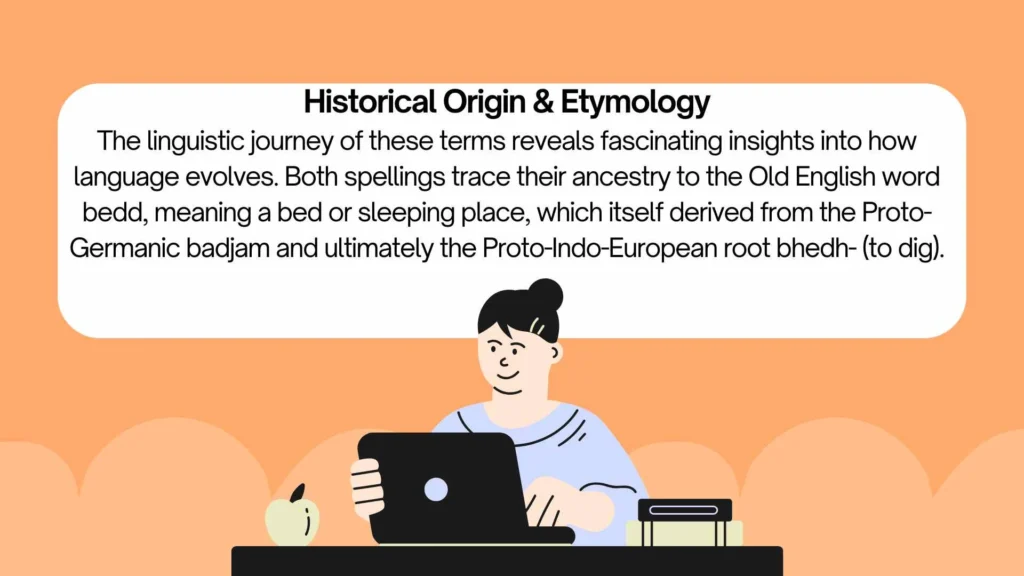
The linguistic journey of these terms reveals fascinating insights into how language evolves. Both spellings trace their ancestry to the Old English word bedd, meaning a bed or sleeping place, which itself derived from the Proto-Germanic badjam and ultimately the Proto-Indo-European root bhedh- (to dig).
The transformative moment occurred when the prefix em- (a variant of en-, meaning “to put into”) combined with bed to create embed – literally, “to put into a bed.” This formation followed the same pattern as other words with the em- prefix, such as empower, embrace, and employ.
The variant imbed emerged as a legitimate alternative because the Latin prefix in- commonly assimilated to im- before labial consonants (b, m, p). In Classical Latin, you would see *im-* before these letters, as in imprimere (to impress) or imponere (to impose). When English writers began applying this same assimilation pattern to “embed,” the im- variant naturally arose.
Throughout the seventeenth and eighteenth centuries, both spellings coexisted without significant controversy. However, by the late nineteenth century, embed had begun to assert its dominance, driven largely by consistent usage in American and British technical writing. The twentieth century witnessed embed cementing its position as the standard form, with imbed gradually relegated to the status of an archaic variant.
Pronunciation Guide
Embed
- Phonetic spelling: /ɪmˈbɛd/
- Syllables: em-BED
- Rhymes with: fed, led, red
- Stress: Second syllable (BED)
- Audio-style description: “Im” as in “him” + “BED” as in the piece of furniture
Imbed
- Phonetic spelling: /ɪmˈbɛd/
- Syllables: im-BED
- Rhymes with: fed, led, red
- Stress: Second syllable (BED)
- Audio-style description: Identical pronunciation to “embed” – the two words are indistinguishable in speech
The Technical Differences
The confusion between imbed and embed stems from a fascinating linguistic phenomenon called morphological variation. Despite appearing different on the page, these words function as perfect synonyms with identical pronunciations and meanings. Their divergence exists purely at the orthographic (spelling) level.
The Linguistic Logic
Language operates on patterns, and the em- prefix represents the standard English pattern for “put into” when the root word begins with a labial consonant (b, p, m). However, the im- prefix follows the Latin pattern of assimilation before the same consonants. This creates a situation where both forms are technically correct but one has become more conventional over time.
Why Embed Won
The victory of embed over imbed reflects several factors:
- Consistency with other words: The em- prefix already appears in numerous common words (embrace, empower, employ). Writers naturally gravitated toward this familiar pattern.
- Standardization in technology: As computing terminology emerged in the mid-twentieth century, technical writers consistently chose embed to describe the insertion of code or media, establishing a professional standard.
- Global publishing trends: Major style guides, including the Chicago Manual of Style and the Associated Press Stylebook, recommended embed, influencing millions of writers worldwide.
Correct Spelling & Common Typos
Most Frequent Mistakes
- Imbed – While acceptable, this spelling is considered outdated in modern writing and may cause readers to perceive your work as old-fashioned or error-ridden.
- Embbed – Adding an extra ‘b’ is a surprisingly common error resulting from uncertainty about whether the spelling should match the base word “bed” (which has one ‘b’) or require doubling.
- Imbeded – Misspelling the past tense by omitting the doubled consonant in the past tense form “embedded.”
- Embbeded – Combining both errors by adding an extra ‘b’ and then another when forming the past tense.
- Imbead – Confusing the word with “bead” (a small decorative object), indicating a misunderstanding of the word’s origins.
Why These Mistakes Happen
The doubling rule in English creates particular difficulty here. When a verb ending in a single consonant preceded by a single vowel takes a suffix beginning with a vowel, you generally double the final consonant (e.g., stop → stopped). This rule applies to “embed” → “embedding” and “embedded.” However, many writers mistakenly apply this logic to the base spelling itself, creating the nonexistent “embbed.”
Mnemonic Devices (Memory Tricks)
The “M” Stands for “Mistake”
Remember: Imbed starts with “Im,” and “Im” is wrong. Just think: “I’m making a mistake with an ‘M’ – it’s always Embed.”
Embedded in Your Memory
Picture a diamond embedded in a ring. The word embed itself has the letters E-M-B-E-D. If you imagine those five letters as the diamond, they’re “embedded” in the ring – and there’s no extra ‘i’ or ‘b’ to confuse things.
The Bed Trick
Think about the base word: “bed.” When you embed something, you’re putting it in a bed. The word “bed” appears clearly in “embed” – just add “em” at the front. The “im” variant obscures this helpful connection.
Consistency Rule
If you can remember that em- is the standard prefix for “put into” (as in embrace, empower, employ), you’ll never need to question the spelling again.
Regional Variations (US vs. UK English)
American English
In the United States, embed is overwhelmingly preferred. Major publications, academic journals, and technical documentation consistently use this spelling. The Chicago Manual of Style specifies embed as the correct form, while Merriam-Webster lists imbed only as a variant spelling.
British English
The preference is even more pronounced in British English. The Oxford English Dictionary recognizes both spellings but notes that embed is now the standard. British publishers and academic institutions have largely abandoned imbed, considering it archaic.
Canadian and Australian English
Both Canadian and Australian English follow the British standard, strongly favoring embed. Canadian English, with its blend of American and British influences, nonetheless aligns with the global preference.
Minority Usage
Some scientific and medical fields continue to use imbed in historical contexts. For instance, older anatomical texts might refer to “imbedded teeth” or “imbedded fragments,” reflecting the terminology prevalent at the time of publication. However, modern updates to these texts consistently adopt embed.
Singular and Plural Forms
Verb Forms
| Form | Spelling |
| Base | embed |
| Third person singular | embeds |
| Past tense | embedded |
| Past participle | embedded |
| Present participle | embedding |
Noun Forms
- Embed (singular noun): Refers to a piece of code, media, or content inserted into a larger document.
- Example: “The video embed works properly on mobile devices.”
- Embeds (plural noun): Refers to multiple instances or pieces of inserted content.
- Example: “The page contains several embeds from various platforms.”
Possessive Forms
- Embed’s (singular possessive): Indicates something belonging to or associated with a single embed.
- Example: “The embed’s dimensions were incorrectly set.”
- Embeds’ (plural possessive): Indicates something belonging to or associated with multiple embeds.
- Example: “All of the embeds’ source codes needed updating.”
Grammar Rules & Parts of Speech
As a Verb (Primary Usage)
Embed functions primarily as a transitive verb – it requires a direct object to complete its meaning. You embed something (the object) into something else (the location).
- Structure: embed + [direct object] + in/into + [location]
- Example: “The technician embedded the sensor in the concrete.”
As a Noun (Technical Context)
In modern digital contexts, embed has gained acceptance as a noun, referring to content that has been inserted into another document or webpage.
- Example: “Please add the video embed to the homepage.”
As an Adjective (Technical Context)
The term can function as an attributive adjective in technical documentation.
- Example: “The system supports embedded analytics for enhanced reporting.”
Tense Usage Examples
| Tense | Example |
| Simple Present | I always embed images when writing blog posts. |
| Present Continuous | The team is embedding new features into the platform. |
| Past Simple | The journalist embedded herself with the military unit. |
| Past Continuous | The developers were embedding the payment system when the error occurred. |
| Future Simple | The committee will embed sustainability into all future planning. |
| Present Perfect | The organization has embedded these values into its culture. |
| Past Perfect | The system had embedded the updates before the user logged in. |
Synonyms and Antonyms
Synonyms
| Synonym | Definition | Usage Context |
| Implant | To insert or fix firmly | Medical, metaphorical |
| Insert | To place within something | General, neutral |
| Incorporate | To make something part of a whole | Business, formal |
| Integrate | To combine into a unified whole | Professional, technical |
| Enclose | To surround or contain within | Physical, spatial |
| Fix | To attach firmly | General, versatile |
| Infuse | To fill with a quality or substance | Metaphorical, creative |
| Ingrain | To fix deeply in the mind or habit | Psychological, behavioral |
| Intrench | To establish firmly (variant of entrench) | Military, legal |
| Sink | To go down into or penetrate | Physical, metaphorical |
Antonyms
| Antonym | Definition | Usage Context |
| Extract | To remove from a larger whole | General, technical |
| Remove | To take away from a position | General, versatile |
| Detach | To disconnect or separate | Physical, technical |
| Dislodge | To remove from a fixed position | Physical, literal |
| Exclude | To keep out or not include | General, formal |
| Eject | To force out or expel | Mechanical, formal |
| Omit | To leave out or exclude | Writing, editing |
| Disconnect | To break connection | Technical, general |
| Extricate | To free from entanglement | Metaphorical, formal |
| Uproot | To remove from a fixed position | Physical, metaphorical |
Formal vs. Informal Usage
Formal Contexts
- Academic writing: Always use “embed.” The spelling “imbed” will be flagged as archaic or incorrect in scholarly submissions.
- Legal documents: Use “embed” for clarity and to ensure your terminology aligns with standard legal drafting conventions.
- Technical documentation: “Embed” is the industry standard. Using “imbed” may suggest outdated or unfamiliar practices.
- Business communications: Professional standards dictate “embed” in emails, reports, and presentations.
Informal Contexts
- Social media: While “embed” is preferred, the casual nature of social media means occasional use of “imbed” is not problematic.
- Creative writing: Both forms might appear in literature, though “embed” remains more common.
- Personal communication: Both spellings are acceptable, though “imbed” might be perceived as quirky or old-fashioned.
Professional Recommendation
Unless you are deliberately invoking an archaic tone for stylistic effect, always choose embed across all contexts. This approach ensures consistency, professionalism, and alignment with current standards.
Illustrative Examples
Technology and Digital Media
- “The content management system allows you to embed videos directly into blog posts.”
- “The developer had to embed the third-party API code before the application would function properly.”
- “Social media platforms simplify the process of embedding interactive content.”
Physical and Scientific Applications
- “The archaeologist discovered arrowheads embedded in the ancient riverbed.”
- “During the construction process, workers embedded steel reinforcement bars in the concrete foundation.”
- “Microplastics have become embedded in marine ecosystems worldwide.”
Business and Professional
- “Our corporate values are deeply embedded in everything we do as an organization.”
- “The project manager sought to embed safety protocols into daily operations.”
- “We’ve embedded quality assurance checkpoints throughout our workflow.”
Metaphorical and Psychological
- “The traumatic experience became embedded in her memory, influencing her decision-making for years.”
- “Effective education should embed critical thinking skills in students from an early age.”
- “Cultural biases can become unconsciously embedded in organizational practices.”
Journalistic Contexts
- “The correspondent was embedded with the military unit during the conflict.”
- “The documentary features embedded footage captured by local journalists during the protests.”
Technical and Design
- “The interior designer suggested embedding the lighting fixtures into the ceiling for a cleaner look.”
- “The engineer recommended embedding the sensors directly into the roadway surface.”
Practice Section (15 MCQs)
Question 1
Which spelling is preferred in professional writing?
- A) Imbed
- B) Embed
- C) Embbede
- D) Imbeded
Question 2
What is the primary part of speech for “embed”?
- A) Noun only
- B) Adjective only
- C) Verb (transitive)
- D) Preposition
Question 3
The word “embed” etymologically derives from which base word?
- A) Bed
- B) Bead
- C) Bind
- D) Bind
Question 4
Which of the following is a synonym for “embed”?
- A) Extract
- B) Dislodge
- C) Integrate
- D) Omit
Question 5
How should “embed” be pronounced?
- A) Em-bayed
- B) Im-bead
- C) Em-BED
- D) Em-BEAD
Question 6
What is the correct past tense of “embed”?
- A) Embeded
- B) Embbeded
- C) Embedded
- D) Imbeded
Question 7
Which region predominantly uses the spelling “imbed”?
- A) United States
- B) United Kingdom
- C) Canada
- D) None of the above (it’s rare everywhere)
Question 8
The “em-” prefix in “embed” generally means:
- A) To remove
- B) To surround
- C) To put into
- D) To divide
Question 9
In technical contexts, “embed” can function as a:
- A) Verb only
- B) Noun only
- C) Both noun and verb
- D) Adjective only
Question 10
What is the plural possessive form of the noun “embed”?
- A) Embed’s
- B) Embeds
- C) Embeds’
- D) Embedes’
Question 11
Which is the correct present participle form?
- A) Embedding
- B) Embedding
- C) Imbedding
- D) Embbeding
Question 12
The variant spelling “imbed” represents:
- A) A misspelling
- B) A valid but rare variant
- C) The only correct spelling
- D) A recent invention
Question 13
“Mnemonic devices” help with:
- A) Spelling mistakes
- B) Pronunciation
- C) Memory and recall
- D) Grammar rules
Question 14
A journalist “embedded” with a military unit means:
- A) They were removed from the unit
- B) They were integrated into the unit
- C) They worked remotely
- D) They visited briefly
Question 15
The base word “bed” appears clearly in:
- A) Imbed
- B) Embed
- C) Both
- D) Neither
Answer Key
- B) Embed – This is the standard spelling in modern English.
- C) Verb (transitive) – It requires a direct object.
- A) Bed – From Old English bedd, meaning a bed or sleeping place.
- C) Integrate – To combine into a unified whole.
- C) Em-BED – Stress on the second syllable.
- C) Embedded – Follows the standard doubling rule.
- D) None of the above – “Imbed” is rare everywhere.
- C) To put into – The “em-” prefix indicates insertion.
- C) Both noun and verb – In technical contexts, “embed” functions as both.
- C) Embeds’ – Plural possessive is formed with an apostrophe after the ‘s’.
- A) Embedding – Correct spelling with double ‘d’ in the present participle.
- B) A valid but rare variant – Acceptable but outdated.
- C) Memory and recall – Mnemonic devices aid memory.
- B) They were integrated into the unit – A journalist accompanied the unit.
- B) Embed – The word “bed” appears clearly in the spelling.
Frequently Asked Questions (FAQs)
1. Is “imbed” a word or a misspelling?
“Imbed” is a legitimate word but is now considered an archaic variant of “embed.” While it appears in some dictionaries, its usage has declined dramatically since the mid-twentieth century. For contemporary writing, always choose “embed” to ensure your work appears professional and current.
2. Will I be penalized for using “imbed” in a job application?
Yes, using “imbed” in a resume, cover letter, or other professional document may create a negative impression. Recruiters and hiring managers often view nonstandard spellings as indicators of poor attention to detail or outdated writing habits. Always use “embed” in professional contexts.
3. Why do both versions exist if they mean the same thing?
The existence of both spellings reflects the historical evolution of English and the influence of both Germanic and Latin prefix patterns. “Embed” follows the English pattern of the “em-” prefix, while “imbed” follows the Latin pattern of assimilation before labial consonants. Over time, “embed” became standard through widespread usage.
4. When should I use “imbed” instead of “embed”?
You should rarely, if ever, use “imbed” in modern writing. The only potential exceptions include:
- Quoting historical documents or literary works from before 1900
- Deliberately evoking an archaic or antiquated tone in creative writing
- Replicating language found in older scientific or medical texts
In all other contexts, “embed” is the appropriate choice.
5. What does “embed” mean in computer science?
In computer science, “embed” refers to the integration of one system, code segment, or media file within another. Specifically, it describes:
- Inserting interactive content (videos, social media posts) into webpages
- Integrating code libraries or APIs into software applications
- Incorporating machine learning models into larger systems
- Using “embeddings” to represent categorical data in high-dimensional space
The term is fundamental to modern development practices, particularly in JavaScript, Python, and web development frameworks.
Is there a difference between imbed and embed?
Yes. Embed is the modern and preferred spelling in English, while imbed is an older alternative spelling that means the same thing. Most dictionaries and style guides recommend using embed in both everyday and professional writing because it is more widely accepted.
What does “imbed” mean?
Imbed means to fix, place, or set something firmly into another object or material. Although it has the same meaning as embed, it is an older spelling and is used much less often in modern English.
What does “embed” mean?
Embed means to place or fix something firmly within another object, surface, or material. It can also refer to inserting digital content, such as a video or image, into a webpage or document so it appears directly on the page.
How do you use imbed in a sentence?
You can use imbed in a sentence when referring to something being firmly set into another object. For example: The workers decided to imbed the stone into the wall. Although correct, most writers today would use embed instead.
How to use embed in a sentence?
Use embed when describing something that is firmly placed inside another object or inserted into digital content. For example: Please embed the video into the article so readers can watch it without leaving the page. This is the preferred spelling in modern English.
What does embed mean in English?
In English, embed means to place something securely within another thing so it becomes part of it. The word is commonly used for physical objects, computer technology, education, journalism, and online content where text, images, or videos are inserted into another platform.
Conclusion
The distinction between imbed and embed is clear: embed is the standard, preferred spelling in modern English across all contexts and regions. While imbed remains a technically valid variant, its usage has become so rare that it often draws unwanted attention and may create negative perceptions about your writing quality.
By consistently choosing embed, you align with current professional standards and demonstrate attention to detail that will serve you well in all your writing endeavors. The key takeaway is simple: when in doubt, embed it – and when you’re typing, remember that ‘im’ is a mistake. You now have the complete linguistic toolkit to write with confidence, authority, and precision on this topic. Happy writing!

Ethan Walker is a non-fiction author and thought leader who writes about personal growth, productivity, and modern life challenges. His work focuses on helping readers simplify their lives, make better decisions, and achieve meaningful success. With a clear and practical writing style, Ethan provides valuable insights that inspire positive change and long-term improvement.
📚 Books:
- The Road to Clarity
- Moments of Truth
- Breaking the Limits
 Olivia Turner