Table of Contents
- Introduction
- Quick Comparison Table
- Deep Understanding What “Sexing Baby Chicks” Means
- Historical Background of Chick Sexing
- Pronunciation Guide (Key Terms)
- Why It’s Difficult to Sex Baby Chicks
- The Main Methods Used to Identify Male vs Female Chicks
- Vent Sexing
- Feather Sexing
- Color Sexing
- Behavioral Clues
- DNA Sexing
- Common Mistakes Beginners Make
- Memory Tricks to Identify Chick Sexing Methods
- Breed Differences (Why Not All Chicks Can Be Sexed Easily)
- Singular and Plural Usage of Key Terms
- Grammar & Terminology Breakdown
- Related Terms: Synonyms and Industry Vocabulary
- Formal vs Informal Usage in Poultry Context
- Illustrative Examples (Practical Scenarios)
- Practice Section (15 MCQs)
- Frequently Asked Questions (FAQs)
- Conclusion
Introduction
I still remember the first time I tried to figure out whether a baby chick was male or female—it felt almost impossible. The fluffy yellow bodies all looked identical, and I kept guessing wrong.
If you’ve ever raised chicks or are planning to start poultry farming, this confusion is completely normal.
Knowing how to distinguish between male and female chicks is not just a curiosity—it directly affects egg production, breeding decisions, and long-term farm management.
In this guide, I’ll break everything down in a clear, practical way so you can confidently understand the science and techniques behind chick sexing.
We’ll explore traditional methods, modern scientific approaches, and even beginner-friendly tips used by poultry experts worldwide.
By the end, you’ll know exactly what works—and what doesn’t.
Quick Comparison Table
| Method | Accuracy | Age Applicable | Skill Level | Core Idea |
| Vent Sexing | Very High | 1 day old | Expert | Examining reproductive openings |
| Feather Sexing | High (specific breeds) | 1–3 days old | Moderate | Wing feather length differences |
| Color Sexing | High (hybrid breeds) | At hatch | Easy | Breed-based color differences |
| Behavioral Clues | Low early / better later | 2+ weeks | Easy | Activity & dominance behavior |
| DNA Sexing | Very High | Any age | Professional | Lab-based genetic testing |
Deep Understanding: What “Sexing Baby Chicks” Means
Chick sexing is the process of identifying whether a newly hatched chicken is male (cockerel) or female (pullet).
This identification is crucial because:
- Females grow into egg-laying hens
- Males are typically raised for meat or breeding
The challenge lies in the fact that baby chicks look almost identical externally, especially in non-specialized breeds.
Baby chick gender guide 2022
- Like a detective solving a mystery, the Baby chick gender guide 2022 helps people understand the signs used to identify male and female chicks.
- Like reading a map, it explains each step in a clear and simple way.
- Like sorting colored marbles, it focuses on finding small differences.
- Like watching flowers bloom, some signs become clearer as chicks grow.
- Like putting together a puzzle, every clue adds to the final answer.
- Like learning a new skill, experience improves accuracy over time.
- Like using a flashlight in the dark, it highlights details that people may miss.
- Like comparing two pictures, careful observation makes identification easier.
- Like following a recipe, each step should happen in the correct order.
- Like building confidence through practice, regular observation helps improve results.
Baby chick gender guide calculator
- Like a helpful assistant, a Baby chick gender guide calculator organizes information into an easy-to-follow result.
- Like a calculator solving numbers, it works with the details entered by the user.
- Like checking a weather forecast, it provides guidance rather than certainty.
- Like filling out a simple form, every answer supports the final prediction.
- Like using a measuring tape, accurate information leads to better estimates.
- Like following road signs, each input directs the next step.
- Like arranging books on a shelf, it keeps information organized.
- Like using a checklist, it helps users avoid missing important details.
- Like matching puzzle pieces, it connects different factors together.
- Like reading instructions before starting, understanding the process improves the experience.
100 percent accurate baby gender predictor
- Like a dream that sounds perfect, a 100 percent accurate baby gender predictor is a phrase people often search for, even though no prediction tool can guarantee complete accuracy.
- Like flipping a coin, guesses without medical testing remain uncertain.
- Like reading tomorrow’s weather today, predictions have natural limits.
- Like following clues in a mystery novel, every hint adds interest but not certainty.
- Like looking through a window with light fog, some details stay unclear.
- Like solving a riddle, predictions rely on available information.
- Like watching clouds change shape, expectations should stay realistic.
- Like reading a horoscope for fun, many prediction methods entertain rather than confirm.
- Like exploring a new path, curiosity drives people to try different methods.
- Like keeping an open mind, it is wise to treat predictions as possibilities instead of facts.
Female chick at 4 weeks
- Like a child growing quickly, a Female chick at 4 weeks begins showing more noticeable features.
- Like leaves appearing in spring, changes become easier to see with time.
- Like comparing siblings, small differences can stand out with careful observation.
- Like watching a young tree grow, development happens gradually.
- Like reading the next chapter of a story, each week reveals something new.
- Like observing birds in nature, patience improves understanding.
- Like noticing tiny brushstrokes in a painting, details matter.
- Like tracking a growing puppy, regular checks show progress.
- Like learning a familiar face, repeated observation builds confidence.
- Like waiting for fruit to ripen, some traits become clear only with time.
Baby gender prediction calculator
- Like a digital guide, a Baby gender prediction calculator gives users an estimated prediction based on selected information.
- Like answering a fun quiz, it creates results from the details provided.
- Like following a simple chart, every input has a purpose.
- Like checking a travel planner, it offers guidance instead of certainty.
- Like assembling building blocks, each answer contributes to the final outcome.
- Like reading a calendar, timing often plays a role in the calculation.
- Like connecting dots on paper, different pieces of information come together.
- Like organizing files in folders, it keeps data structured.
- Like using a compass, it points toward a possible answer.
- Like solving a brain teaser, the process is part of the enjoyment.
Chinese calendar for baby gender 2026

- Like an old family tradition, the Chinese calendar for baby gender 2026 remains popular with many curious parents.
- Like opening a history book, it reflects beliefs passed through generations.
- Like following a cultural custom, many people enjoy using it for fun.
- Like reading an ancient map, it connects modern users with historical ideas.
- Like celebrating a holiday tradition, it has cultural value for many families.
- Like looking through a family album, it carries a sense of heritage.
- Like enjoying a classic story, its popularity continues over time.
- Like exploring a museum, it introduces people to historical practices.
- Like trying a traditional recipe, it reflects customs from the past.
- Like joining a long-standing celebration, many families enjoy the experience while understanding it is not scientifically proven.
Astrology baby gender prediction
- Like reading the stars for inspiration, Astrology baby gender prediction attracts people who enjoy astrology.
- Like following constellations in the night sky, it is based on traditional beliefs.
- Like listening to an old legend, it offers an interesting perspective.
- Like exploring a different culture, it introduces unique ideas.
- Like reading personality traits from zodiac signs, it is meant for curiosity rather than proof.
- Like watching the moon change phases, it follows symbolic patterns.
- Like collecting meaningful stories, many people enjoy the tradition.
- Like exploring ancient wisdom, it reflects historical beliefs.
- Like reading a fortune for entertainment, expectations should remain balanced.
- Like admiring the stars, the experience often brings enjoyment more than certainty.
Free baby gender predictor by due date
- Like a free online helper, a Free baby gender predictor by due date gives users an easy way to explore possible predictions.
- Like entering details into a simple form, the process is quick and convenient.
- Like using a calendar reminder, the due date becomes the key detail.
- Like checking a fun online quiz, the result is for interest rather than confirmation.
- Like opening a pocket guide, it provides an easy starting point.
- Like following a step-by-step worksheet, every answer supports the estimate.
- Like exploring a family tradition, many people try it for curiosity.
- Like reading an informative brochure, it explains the prediction in a simple way.
- Like using a travel planner before a trip, it helps organize expectations.
- Like enjoying a friendly guessing game, it adds excitement while waiting for the baby’s arrival.
Historical Background of Chick Sexing
Chick sexing is a relatively modern agricultural skill that developed in the early 20th century, particularly in Japan.
Key developments:
- Early poultry farms struggled with unknown chick genders
- Japanese experts refined vent sexing techniques
- The method later spread globally through commercial poultry industries
Today, chick sexing is a specialized profession requiring years of training.
Pronunciation Guide (Key Terms)
- Chick → /chik/ (rhymes with “thick”)
- Sexing → /sek-sing/ (rhymes with “mixing”)
- Pullet → /poo-lit/
- Cockerel → /kok-er-uhl/
Why It’s Difficult to Sex Baby Chicks
Baby chicks are difficult to identify because:
- No visible external reproductive differences
- Similar size and fluff in early life
- Breed variations mask physical cues
- Behavioral traits develop later
This is why professionals rely on technical sexing methods rather than visual guessing.
The Main Methods Used to Identify Male vs Female Chicks
Vent Sexing
Vent sexing involves examining the chick’s cloaca (vent area).
Key points:
- Requires extreme skill
- Can identify gender within 24 hours of hatching
- Used in commercial hatcheries
⚠️ Highly accurate but not beginner-friendly.
Feather Sexing
This method compares wing feather development:
- Females → uneven feather lengths
- Males → more uniform feather growth
Works best in specific hybrid breeds.
Color Sexing
Some genetically engineered or hybrid breeds are designed for visible differences:
- Males and females hatch in different colors
- Very easy for beginners
However, this only works in controlled breeding systems.
Behavioral Clues
As chicks grow (2–4 weeks):
- Males become more dominant
- Females tend to be calmer
- Males may attempt early crowing behavior
Not reliable in early stages but useful later.
DNA Sexing
The most accurate modern method:
- Lab testing of feather or blood samples
- Identifies genetic sex markers
- Works at any age
Downside: More expensive than other methods.
Common Mistakes Beginners Make
- Assuming size determines gender
- Relying only on behavior in early days
- Confusing breed traits with sex traits
- Misinterpreting feather patterns
Most errors happen because beginners expect visible certainty too early.
Memory Tricks to Identify Chick Sexing Methods
Use this simple mnemonic:
“V-F-C-B-D System”
- V = Vent (expert method)
- F = Feather
- C = Color
- B = Behavior
- D = DNA
Think: “Very Fast Chick Biology Detects.”
Breed Differences (Why Not All Chicks Can Be Sexed Easily)
Different chicken breeds behave differently:
- Auto-sexing breeds → easy identification at hatch
- Hybrid breeds → color-based sexing works
- Traditional breeds → require vent sexing or DNA tests
This is why poultry farmers choose breeds based on production goals.
Singular and Plural Usage of Key Terms
- Chick → Chicks
- Male chick → Male chicks
- Female chick → Female chicks
- Vent → Vents
- Hatchery → Hatcheries
Possessive examples:
- Chick’s feather pattern
- Chicks’ development stage
Grammar & Terminology Breakdown
- Chick → noun (young chicken)
- Sexing → gerund (verb form acting as noun)
- Male/Female → adjectives describing gender
- Pullet/Cockerel → nouns used in poultry classification
Sentence structure example:
- “Sexing chicks requires specialized training.”
Related Terms: Synonyms and Industry Vocabulary
Synonyms
- Poultry sex identification
- Chick gender determination
- Hatchling classification
Industry Terms
- Poultry technician
- Hatchery specialist
- Avian sexing
Formal vs Informal Usage in Poultry Context
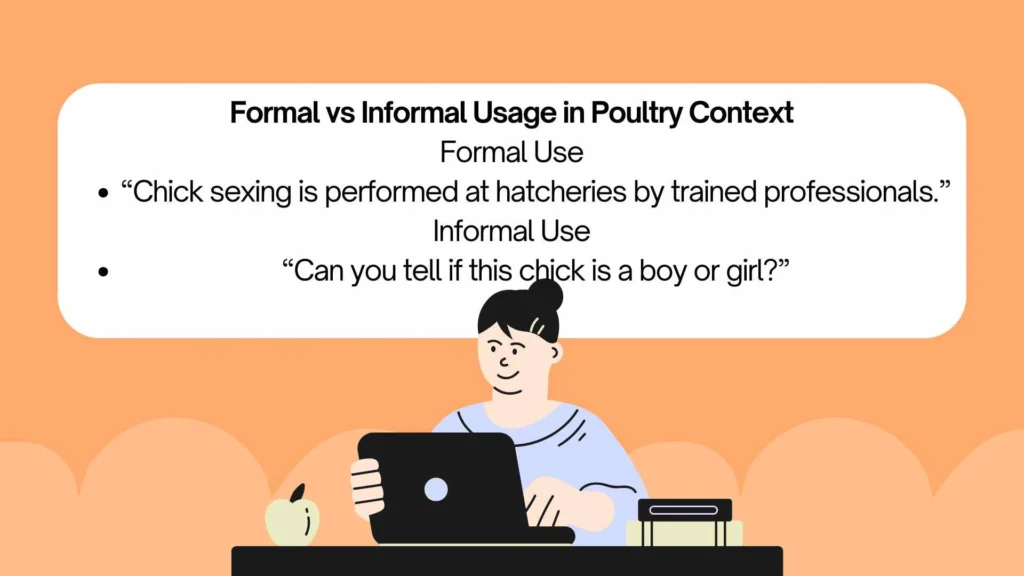
Formal Use
- “Chick sexing is performed at hatcheries by trained professionals.”
Informal Use
- “Can you tell if this chick is a boy or girl?”
Illustrative Examples
- Chick sexing is essential in commercial poultry farming.
- The hatchery uses vent sexing for accuracy.
- Female chicks are separated for egg production.
- Feather patterns can indicate gender in hybrid breeds.
- DNA testing confirms the chick’s sex.
- Beginners often misidentify male chicks.
- Color sexing simplifies early sorting.
- Vent sexing requires professional training.
- Farmers rely on behavior only after a few weeks.
- Not all breeds allow easy chick sexing.
- Male chicks grow faster in some breeds.
- Female chicks are prioritized for egg farms.
Practice Section (15 MCQs)
- What is chick sexing used for?
A) Feeding chicks
B) Identifying gender
C) Vaccinating chicks - Vent sexing is performed on:
A) Adult chickens
B) Baby chicks
C) Eggs only - Which method uses genetics?
A) Feather sexing
B) DNA sexing
C) Color sexing - Female chicks grow into:
A) Roosters
B) Hens
C) Ducks - Feather sexing depends on:
A) Weight
B) Wing feathers
C) Beak shape - Color sexing works mainly in:
A) Wild birds
B) Hybrid breeds
C) All chickens - Vent sexing requires:
A) Beginner skill
B) Expert skill
C) No training - Male chick is also called:
A) Pullet
B) Cockerel
C) Hen - DNA sexing is:
A) Least accurate
B) Most accurate
C) Optional guesswork - Chick sexing is important for:
A) Cooking
B) Poultry farming
C) Fishing - Behavior-based sexing is reliable:
A) Immediately after hatching
B) After a few weeks
C) Never - Female chicks are mainly used for:
A) Egg production
B) Fighting
C) Racing - Which is NOT a sexing method?
A) Vent
B) Feather
C) Feeding - Chick sexing originated mainly in:
A) Japan
B) Africa
C) Antarctica - Male chicks are called:
A) Pullets
B) Cockerels
C) Ducklings
Answer Key
1-B, 2-B, 3-B, 4-B, 5-B, 6-B, 7-B, 8-B, 9-B, 10-B, 11-B, 12-A, 13-C, 14-A, 15-B
Frequently Asked Questions (FAQs)
Can you tell chick gender at birth?
Yes, but only using specialized methods like vent or DNA sexing.
What is the easiest method for beginners?
Color sexing (if breed supports it).
Is chick sexing always accurate?
Only DNA sexing and expert vent sexing are highly accurate.
Why do farmers separate chicks by gender?
To manage egg production and breeding efficiency.
Can behavior determine chick gender early?
No, behavior becomes useful only after a few weeks.
How can you tell a baby chick if it’s male or female?
It is difficult to tell the sex of most baby chicks just by looking at them. Some breeds have special color or feather patterns that reveal gender at hatching, while others require vent sexing or waiting for physical traits to develop as the chick grows.
How old does a chick have to be to tell the gender?
For many backyard chickens, gender becomes easier to identify between 6 and 12 weeks of age. At this stage, differences in comb size, feather shape, body posture, and behavior become more noticeable.
How can you tell if a baby chick is going to be a rooster?
A baby chick that develops a larger, redder comb early, grows thicker legs, stands more upright, and later begins crowing is likely to be a rooster. However, these signs become more reliable as the chick matures.
At what age can a chicken be sexed?
A chicken can be sexed at hatch by trained professionals using vent sexing or by feather sexing in certain breeds. For most owners, accurate identification is usually possible between 6 and 12 weeks, with greater certainty by 16 to 20 weeks.
How many times a day will a rooster try to mate?
A healthy rooster may attempt to mate 10 to 30 times a day, depending on his age, breed, health, and the number of hens in the flock. Frequent mating is normal behavior during the breeding season.
What age can you tell if your chicken is a rooster?
Most roosters can be identified between 8 and 12 weeks as they develop larger combs, wattles, pointed saddle feathers, and more confident behavior. By 4 to 6 months, crowing and other male traits usually confirm the gender.
Conclusion
Identifying whether a baby chick is male or female is both a science and a skill. While chicks may look identical at birth, specialized techniques like vent sexing, feather analysis, and DNA testing make accurate identification possible.
Understanding these methods helps farmers make better decisions in poultry management.
With practice and the right knowledge, what once seemed confusing becomes surprisingly logical.

James Anderson is a thriller and mystery author known for his suspenseful plots and unexpected twists. His storytelling keeps readers on the edge of their seats, blending intrigue with psychological depth. James has a talent for creating gripping narratives that captivate audiences from beginning to end.
📚 Books:
- The Hidden Truth
- Shadow Game
- Beyond the Lies
 Ethan Walker
 Olivia Turner