
Table of Contents
- Introduction
- Direct Answer
- Quick Comparison Table
- Deep Meanings & Definitions
- Historical Origin & Etymology
- Pronunciation Guide
- The Technical Differences
- Correct Spelling & Common Typos
- Mnemonic Devices
- Regional Variations
- Singular and Plural Forms
- Grammar Rules
- Synonyms and Antonyms
- Formal vs. Informal Usage
- Illustrative Examples
- Practice Section (15 MCQs)
- Frequently Asked Questions
- Conclusion
Introduction
I have observed that few word pairs cause as much confusion among writers as “infeasible” or “unfeasible.” Both sound correct, both appear in dictionaries, and yet choosing one over the other can feel like a guessing game. This dilemma becomes particularly acute in business writing, academic papers, and professional communication. In this guide, I will clarify the distinctions, preferences, and usage patterns so you can choose confidently every time.
Direct Answer
“Infeasible” and “unfeasible” are synonyms meaning “not feasible” or “impractical.” Both are correct and interchangeable. “Infeasible” is currently more common in both American and British English, while “unfeasible” was more popular historically and remains widely accepted .
Quick Comparison Table
| Feature | Infeasible | Unfeasible |
| Spelling | I-N-F-E-A-S-I-B-L-E | U-N-F-E-A-S-I-B-L-E |
| Status | Correct, more common today | Correct, historically more common |
| Prefix Origin | Latin “in-“ | Germanic “un-“ |
| Word Origin | Pure French/Latin roots | Hybrid (Germanic + Latin) |
| Regional Preference | Slightly more common in US | Slightly more common in UK |
| First Known Use | 1530s | 1520s |
Deep Meanings & Definitions
Infeasible (Adjective):
- Not capable of being accomplished or carried out
- Impractical or impossible to implement
- Antonym: feasible
Unfeasible (Adjective):
- Same meaning: not feasible or impractical
- Cannot be done or accomplished
- Formerly also spelled “unfeasable”
Both terms describe situations, plans, or projects that cannot be successfully completed with available resources or within constraints.
Historical Origin & Etymology
Feasible (The Root):
- Derived from Anglo-French “faisible” (mid-15th century)
- From Old French “faisable” meaning “possible, that can be done”
- Ultimately from Latin “facere” meaning “to make, do, perform”
Infeasible:
- First used in the 1530s
- From Latin prefix “in-” (not) + “feasible”
- Etymologically pure: all roots are French/Latin
Unfeasible:
- First appeared in the 1520s
- From Germanic prefix “un-” (not) + “feasible”
- A hybrid word combining Germanic and Latinate roots
Usage History:
- Both words were in moderate use until the 1940s
- “Unfeasible” was more common until the mid-1970s
- “Infeasible” became more common in the late 1970s in both America and Britain
Pronunciation Guide
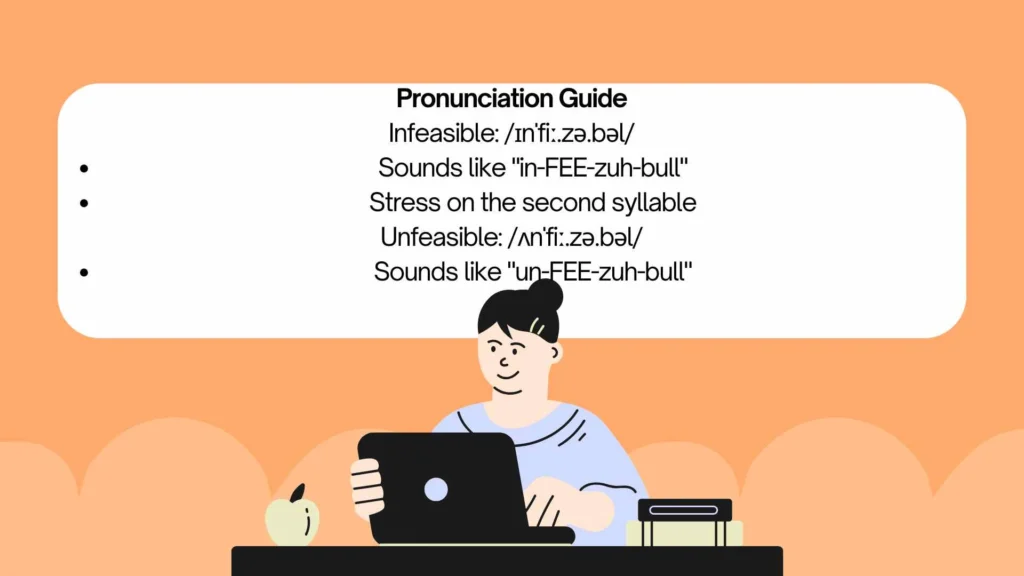
Infeasible: /ɪnˈfiː.zə.bəl/
- Sounds like “in-FEE-zuh-bull”
- Stress on the second syllable
Unfeasible: /ʌnˈfiː.zə.bəl/
- Sounds like “un-FEE-zuh-bull”
- Stress on the second syllable
Both words rhyme with “feasible” and are pronounced the same except for the initial prefix.
The Technical Differences
Prefix Distinction:
- “In-” is the Latin prefix meaning “not”
- “Un-” is the Germanic prefix meaning “not”
Etymological Purity:
- “Infeasible” uses a Latin prefix with a Latin root (facere) → pure derivation
- “Unfeasible” uses a Germanic prefix with a Latin root → hybrid derivation
The Preference Shift:
From the 1940s to mid-1970s, “unfeasible” was more common. In the late 1970s, “infeasible” surpassed it and has remained more common since .
Correct Spelling & Common Typos
Correct Spellings:
- Infeasible
- Unfeasible
Common Typos:
- Infeasable
- Unfeasable (historical variant)
- Infeazible
- Unfeazible
- Infesible
Memory Tip: Both contain “feasible” with a negative prefix. The base word “feasible” is the key to remembering both.
Mnemonic Devices
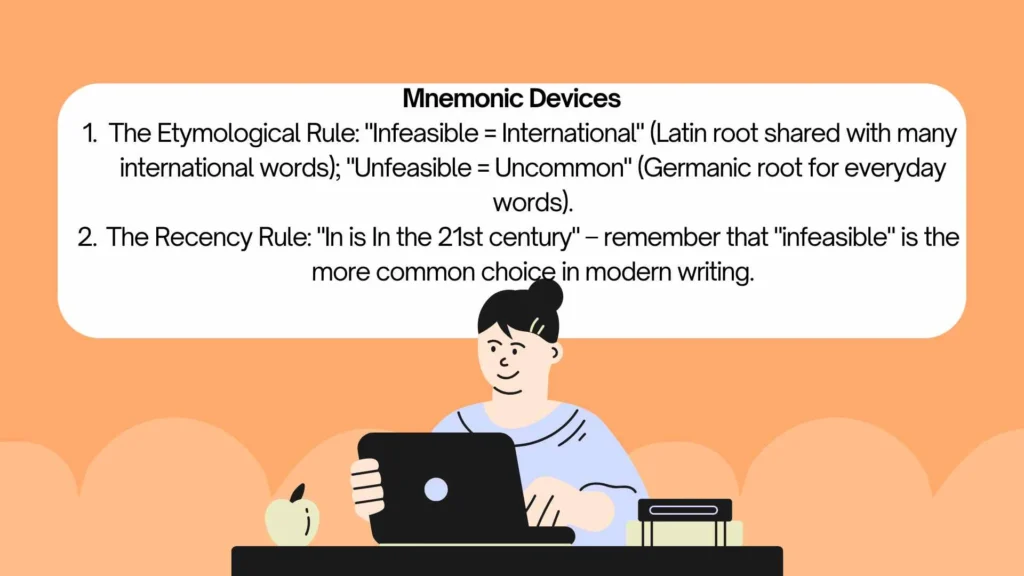
- The Etymological Rule: “Infeasible = International” (Latin root shared with many international words); “Unfeasible = Uncommon” (Germanic root for everyday words).
- The Recency Rule: “In is In the 21st century” – remember that “infeasible” is the more common choice in modern writing.
- The Pronunciation Rhyme: “If you’re in doubt, use infeasible; if you’re unsure, use unfeasible” – both are right, so you can’t lose.
Regional Variations
American English:
- “Infeasible” is slightly more common
- Both are used and understood
British English:
- “Infeasible” has become more common but “unfeasible” is also accepted
- Some speakers report “unfeasible” sounds more natural
Canadian and Australian English:
- Follow British patterns generally
- Both forms are acceptable
Key Point: There is no regional correctness – both words are valid in all English varieties.
Singular and Plural Forms
Adjective Forms:
- No plural variations (adjectives remain the same)
- Singular: “an infeasible plan”
- Plural: “infeasible plans” (adjective unchanged)
Noun Forms:
- Infeasibility (noun) – “The project’s infeasibility was clear”
- Infeasibleness (noun) – less common
- Unfeasibility (noun) – “The unfeasibility of the proposal”
- Unfeasibleness (noun) – less common
Possessive Forms:
- As adjectives, no possessive forms
- For nouns: “the project’s infeasibility”
Grammar Rules
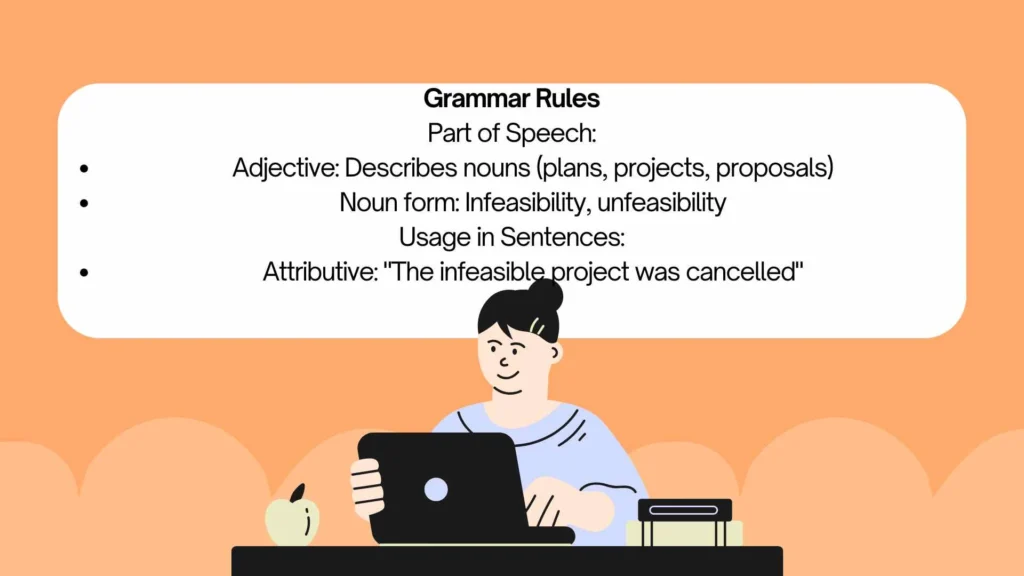
Part of Speech:
- Adjective: Describes nouns (plans, projects, proposals)
- Noun form: Infeasibility, unfeasibility
Usage in Sentences:
- Attributive: “The infeasible project was cancelled”
- Predicative: “The plan proved infeasible”
Common Collocations:
- Infeasible/unfeasible plan
- Infeasible/unfeasible proposal
- Infeasible/unfeasible project
- Infeasible/unfeasible solution
Synonyms and Antonyms
Synonyms:
- Impracticable
- Impossible
- Unworkable
- Impractical
- Unrealizable
- Unattainable
- Implausible
Antonyms:
- Feasible
- Practical
- Achievable
- Viable
- Realizable
- Workable
- Attainable
Formal vs. Informal Usage
Formal Contexts:
- “Infeasible” is preferred in academic and technical writing
- Used in business reports, legal documents, research papers
- Example: “The committee deemed the proposal infeasible”
Informal Contexts:
- “Unfeasible” is equally acceptable in casual writing
- Both can be used in everyday conversation
- Many people simply say “not feasible” to avoid the choice
Professional Recommendation:
“Not feasible” is always safe and often the clearest choice in any context.
Illustrative Examples
- The project was deemed infeasible due to budget constraints.
- Building a bridge across the canyon is unfeasible with current technology.
- The plan to double production in one month was infeasible.
- Many goals seem unfeasible until innovative solutions are found.
- The government declared the proposal infeasible after reviewing the costs.
- A complete redesign of the system is unfeasible at this stage.
- The infeasibility of the project became apparent during the analysis.
- Some targets are unfeasible given the available resources.
- The consultant called the timeline infeasible for the scope of work.
- The old building renovation was unfeasible without major structural changes.
- They abandoned the plan due to its infeasible nature.
- The court found the demands infeasible for the defendant.
Practice Section (15 MCQs)
- Which word means “not feasible”?
- a) Infeasible
- b) Unfeasible
- c) Both a and b
- d) Neither
- Which prefix is Latin for “not”?
- a) Un-
- b) In-
- c) Non-
- d) Dis-
- Which prefix is Germanic for “not”?
- a) Un-
- b) In-
- c) Non-
- d) A-
- “Infeasible” has roots from which languages?
- a) Pure French/Latin
- b) Pure Germanic
- c) Hybrid (Germanic + Latin)
- d) Pure English
- “Unfeasible” has roots from which languages?
- a) Pure French/Latin
- b) Pure Germanic
- c) Hybrid (Germanic + Latin)
- d) Pure English
- Which word was more common before the 1970s?
- a) Infeasible
- b) Unfeasible
- c) Both were equal
- d) Neither
- Which word is currently more common?
- a) Infeasible
- b) Unfeasible
- c) Both are equally common
- d) Neither
- “Feasible” is derived from:
- a) Greek
- b) Latin
- c) German
- d) Old English
- The noun form of “infeasible” is:
- a) Infeasibility
- b) Infeasibleness
- c) Both a and b
- d) Neither
- Which sentence uses “infeasible” correctly?
- a) The plan is complete infeasible.
- b) The plan was deemed infeasible.
- c) The infeasible were obvious.
- d) She infeasible the proposal.
- “Infeasible” first appeared in:
- a) 1520s
- b) 1530s
- c) 1620s
- d) 1720s
- “Unfeasible” first appeared in:
- a) 1520s
- b) 1530s
- c) 1620s
- d) 1720s
- Which form is a safer choice in formal writing?
- a) Infeasible
- b) Unfeasible
- c) Either is acceptable
- d) Neither
- Which is NOT a synonym for “infeasible”?
- a) Impracticable
- b) Unworkable
- c) Achievable
- d) Impossible
- The antonym of “infeasible” is:
- a) Unfeasible
- b) Feasible
- c) Impractical
- d) Unworkable
Answer Key:
- c
- b
- a
- a
- c
- b
- a
- b
- c
- b
- b
- a
- c
- c
- b
Frequently Asked Questions
Q1: Which is more correct, “infeasible” or “unfeasible”?
Both are equally correct. There is no grammatically preferred form, and both appear in all major dictionaries . The choice largely comes down to personal preference and regional habit.
Q2: Is there any difference in meaning between the two?
No, there is no difference in meaning. Both mean “not feasible” or “impractical.” They are perfect synonyms .
Q3: Which one should I use in academic writing?
“Infeasible” is often preferred in formal and academic writing, but both are acceptable. Many style guides recommend simply using “not feasible” to avoid the dilemma entirely .
Q4: Why are both words used if they mean the same thing?
The existence of both forms reflects English’s hybrid nature—the Germanic “un-” prefix and the Latin “in-” prefix both serve the same function (negation). The preference has shifted over time, with “infeasible” becoming more common since the 1970s .
Q5: Is one more common in the US or UK?
Both words are used in both regions. However, some research suggests “infeasible” is slightly more common in American English, while “unfeasible” is sometimes perceived as more British . Nevertheless, the difference is minimal, and both are understood universally.
Conclusion
I hope this guide has resolved the confusion between “infeasible” and “unfeasible.” Remember that both are correct, both mean “not feasible,” and the choice is largely a matter of personal preference. While “infeasible” has become more common since the 1970s, “unfeasible” remains perfectly valid and is used by many writers. If you are ever uncertain, “not feasible” is always a safe and clear alternative. Armed with this knowledge, you can now choose your word with confidence, knowing that either choice is linguistically sound.

Ethan Walker is a non-fiction author and thought leader who writes about personal growth, productivity, and modern life challenges. His work focuses on helping readers simplify their lives, make better decisions, and achieve meaningful success. With a clear and practical writing style, Ethan provides valuable insights that inspire positive change and long-term improvement.
📚 Books:
- The Road to Clarity
- Moments of Truth
- Breaking the Limits
 Olivia Turner