Table of Contents
- Introduction
- Direct Answer
- Quick Comparison Table
- Deep Meanings & Definitions
- Historical Origin & Etymology
- Pronunciation Guide
- The Technical Differences
- Correct Spelling & Common Typos
- Mnemonic Devices
- Regional Variations
- Singular and Plural Forms
- Grammar Rules
- Synonyms and Antonyms
- Formal vs. Informal Usage
- Illustrative Examples
- Practice Section (15 MCQs)
- Frequently Asked Questions
- Conclusion
Introduction
I have observed that one of the most persistent spelling dilemmas in English revolves around the famous Roman name. Is it “Caesar” or “Ceasar”? This question trips up students, writers, and even history enthusiasts. The confusion stems from the unusual combination of vowels in this ancient name. Mastering this spelling is crucial for academic writing, historical references, and even culinary contexts. In this guide, I will clarify this once and for all.
Direct Answer
The correct spelling is Caesar (C-A-E-S-A-R). The spelling Ceasar is a common misspelling. The name follows the Latin spelling “Caesar” and is universally accepted as the standard form in all varieties of English.
Quick Comparison Table
| Feature | Caesar (Correct) | Ceasar (Incorrect) |
| Spelling | C-A-E-S-A-R | C-E-A-S-A-R |
| Status | Standard, correct | Common misspelling |
| Origin | Latin | Misspelling |
| Usage | Historical figure, titles | Never used |
| Regional Acceptance | All English varieties | None |
Deep Meanings & Definitions
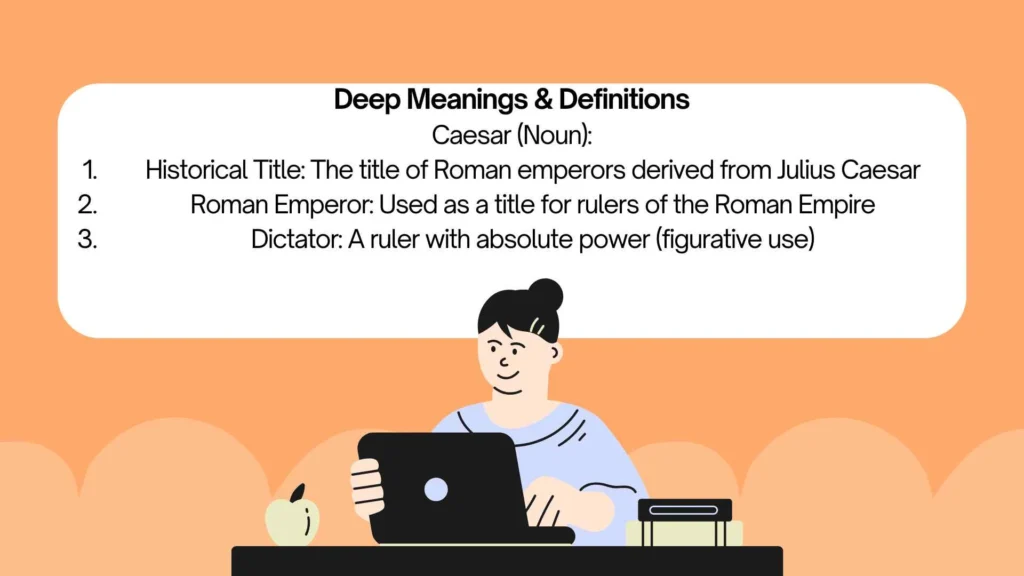
Caesar (Noun):
- Historical Title: The title of Roman emperors derived from Julius Caesar
- Roman Emperor: Used as a title for rulers of the Roman Empire
- Dictator: A ruler with absolute power (figurative use)
- Salad: Caesar salad (dish named after Caesar Cardini)
- Culinary: Caesar dressing, Caesar salad
Historical Origin & Etymology
Latin Origin:
- From Latin “Caesar”
- Possibly derived from “caesaries” (hair) or “caedere” (to cut)
- The name of the famous Roman general Julius Caesar
Evolution:
- Latin: Caesar
- Old English: Cāsere
- Modern German: Kaiser
- Modern Russian: Tsar (Czar)
- All derived from the same Latin root
Interesting Fact: The title “Caesar” has evolved into various forms across different languages, including “Kaiser” in German and “Tsar” in Russian.
Pronunciation Guide
Caesar: Pronounced /ˈsiː.zər/ (US) or /ˈsiː.zə/ (UK)
- Sounds like “SEE-zer”
- First syllable: rhymes with “see,” “bee,” or “tea”
- Second syllable: rhymes with “her” (US) or “uh” (UK)
The Technical Differences
The confusion between “Caesar” and “Ceasar” is purely orthographic—a spelling issue.
Why “Ceasar” is Incorrect:
- It violates the established Latin spelling
- The sequence “ae” in Latin is a common diphthong
- “Ceasar” would be pronounced differently if following English rules
Common Error Pattern:
- Similar to “sieve” vs. “seive” (vowel order confusion)
- The placement of “a” and “e” creates the error
Correct Spelling & Common Typos
Correct:
- Caesar
Common Typos:
- Ceasar (most common error)
- Cesear (another common misspelling)
- Cesar (missing ‘a’)
- Ceaser (incorrect order)
Mnemonic Devices
- “A comes before E in Caesar”: Remember the order is A then E – “CAESAR”
- Historical Connection: “Julius Caesar” – associate the correct spelling with the famous historical figure
- Rhyme: “The Roman Emperor’s name has an ‘A’ before ‘E’ – that’s the key!”
- Visual: Picture the correct spelling “CAESAR” – the “AE” appears together in order
Regional Variations
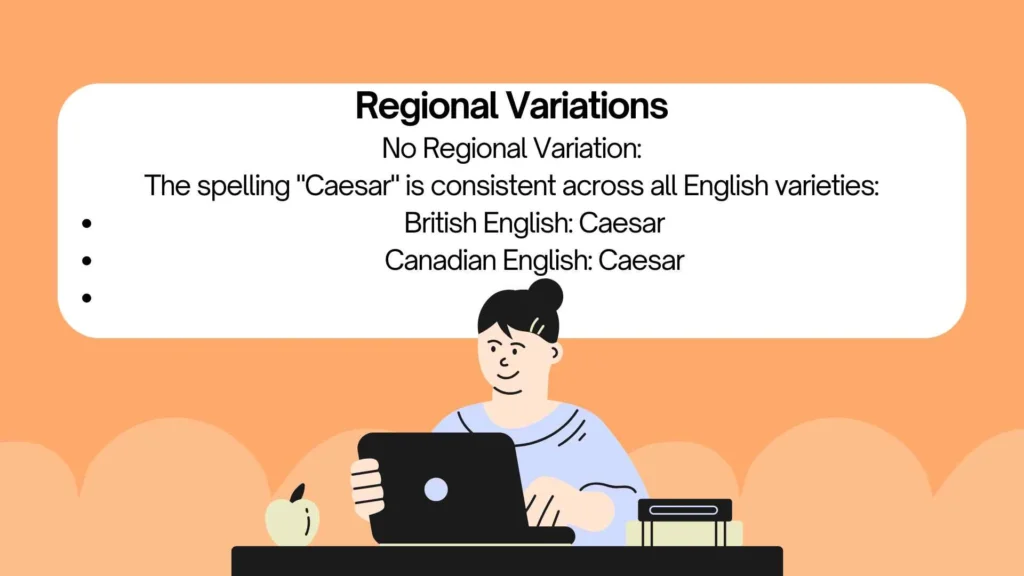
No Regional Variation:
The spelling “Caesar” is consistent across all English varieties:
- American English: Caesar
- British English: Caesar
- Canadian English: Caesar
- Australian English: Caesar
The misspelling “Ceasar” is universally incorrect.
Singular and Plural Forms
Singular:
- Caesar
Plural:
- Caesars
- Example: “The Caesars of Rome ruled for centuries”
Possessive:
- Caesar’s (singular possessive)
- Example: “Caesar’s legion”
- Caesars’ (plural possessive)
- Example: “The Caesars’ influence”
Grammar Rules
Part of Speech: Noun
Grammar Functions:
- Proper Noun: Referring to the historical figure
- “Julius Caesar was a Roman general”
- Common Noun: Referring to rulers or dictators
- “He acted like a petty Caesar”
- Modifier: Used as adjective in culinary contexts
- “Caesar salad” or “Caesar dressing”
Synonyms and Antonyms
Synonyms:
- Emperor
- Ruler
- Dictator
- Monarch
- Sovereign
- Imperator (Latin)
Antonyms:
- Subject
- Citizen
- Commoner
- Peasant
Derived Words:
- Caesarean (relating to Caesar)
- Caesarean section (C-section – childbirth method)
- Kaiser (German emperor)
- Tsar/Czar (Russian emperor)
Formal vs. Informal Usage

Formal Contexts:
- Academic writing, historical texts, scholarly works
- Example: “The reign of Caesar marked a turning point in Roman history”
Informal Contexts:
- Everyday conversation, culinary references
- Example: “Let’s order a Caesar salad”
Culinary Context:
Always use “Caesar” for the salad and dressing
- Example: “I love Caesar salad with extra dressing”
Illustrative Examples
- Julius Caesar was assassinated in 44 BC .
- The title of Caesar was used by Roman emperors .
- She ordered a Caesar salad for lunch .
- The restaurant is famous for its Caesar dressing .
- The Roman Caesars ruled for centuries .
- He was compared to a modern Caesar .
- The Caesar salad was invented in Mexico .
- The Caesar’s legacy continues to influence culture .
- The phrase “Beware the Ides of March” relates to Caesar .
- The Caesar cipher is a famous encryption method .
- Many works of Shakespeare feature Caesar .
- The Caesar was a powerful title in ancient Rome .
Practice Section (15 MCQs)
- What is the correct spelling?
- a) Caesar
- b) Ceasar
- c) Cesear
- d) Cesar
- The name “Caesar” originated from:
- a) Greek
- b) Latin
- c) French
- d) German
- Julius Caesar was a:
- a) Roman emperor
- b) Greek philosopher
- c) Egyptian pharaoh
- d) Persian king
- Which is a common misspelling of Caesar?
- a) Caesar
- b) Ceasar
- c) Kaiser
- d) Tsar
- The German equivalent of Caesar is:
- a) King
- b) Kaiser
- c) Tsar
- d) Emperor
- The Russian equivalent of Caesar is:
- a) Kaiser
- b) Tsar
- c) Emperor
- d) King
- Caesar salad is named after:
- a) Julius Caesar
- b) Caesar Cardini
- c) Roman Caesar
- d) German Caesar
- The correct spelling order is:
- a) C-E-A-S-A-R
- b) C-A-E-S-A-R
- c) C-E-S-A-R
- d) C-A-E-S-R
- “Caesar” is what part of speech?
- a) Verb
- b) Noun
- c) Adverb
- d) Adjective
- Which sentence uses “Caesar” correctly?
- a) The Ceasar ruled Rome
- b) The Caesar ruled Rome
- c) The Cesear ruled Rome
- d) The Cesar ruled Rome
- The plural of Caesar is:
- a) Caesar
- b) Caesars
- c) Caesares
- d) Ceasars
- Which culinary item is spelled with “Caesar”?
- a) Ceasar salad
- b) Caesar salad
- c) Cesear salad
- d) Cesar salad
- The proper possessive form of Caesar is:
- a) Caesars
- b) Caesar’s
- c) Caesars’
- d) Caesares’
- The misspelling “Ceasar” is:
- a) Accepted in British English
- b) Accepted in American English
- c) Incorrect in all English varieties
- d) Accepted in informal writing
- Which word is NOT related to Caesar?
- a) Kaiser
- b) Tsar
- c) Emperor
- d) Pharaoh
Answer Key:
- a
- b
- a
- b
- b
- b
- b
- b
- b
- b
- b
- b
- b
- c
- d
Frequently Asked Questions
Q1: Is it spelled “Caesar” or “Ceasar”?
The correct spelling is Caesar . “Ceasar” is a common misspelling .
Q2: Why is “Caesar” spelled with “AE”?
The spelling comes from the Latin “Caesar” . The “ae” combination is a common Latin diphthong .
Q3: Where did the name Caesar come from?
The name originated from Latin and was famously held by Julius Caesar . It later became a title for Roman emperors .
Q4: Is “Caesar” related to “Kaiser” and “Tsar”?
Yes, both “Kaiser” (German) and “Tsar” (Russian) are derived from the Latin “Caesar” and mean “emperor” .
Q5: Why do people misspell Caesar?
People often confuse the order of “a” and “e,” writing “Ceasar” instead of “Caesar.” This is a common spelling error due to the unusual vowel combination.
Conclusion
I hope this guide has resolved the confusion between “Caesar” and “Ceasar” once and for all. Remember that “Caesar” with “AE” is the only correct spelling. This name has given us not only historical titles but also culinary terms like Caesar salad and the medical term Caesarean section. Whether you are writing about Roman history, ordering a salad, or discussing medical procedures, the correct spelling is essential. With these memory tricks and clear rules, you can now spell “Caesar” with absolute confidence.

Olivia Turner is a lifestyle and contemporary romance writer who focuses on positivity and everyday inspiration. Her stories are light, relatable, and filled with warmth, making them perfect for readers looking for uplifting content. Olivia draws inspiration from daily life and simple joyful moments.
📚 Books:
- Love & Coffee
- Chasing Happiness
- Moments That Matter
 James Anderson
 Ethan Walker