Table of Contents
- Introduction
- Direct Answer
- Quick Comparison Table
- Deep Meanings & Definitions
- Historical Origin & Etymology
- Pronunciation Guide
- The Technical Differences
- Correct Spelling & Common Typos
- Mnemonic Devices
- Regional Variations
- Singular and Plural Forms
- Grammar Rules
- Synonyms and Antonyms
- Formal vs. Informal Usage
- Illustrative Examples
- Practice Section (15 MCQs)
- Frequently Asked Questions
- Conclusion
Introduction
I have noticed that one of the most persistent spelling dilemmas in English revolves around the word “enclosed.” Is it “enclosed” or “inclosed”? This question trips up even native speakers. The confusion stems from historical spelling variations that have since evolved. Mastering this distinction is crucial for clear, professional communication. In this guide, I will unravel the mystery once and for all.
Direct Answer
The correct spelling is enclosed (E-N-C-L-O-S-E-D). The spelling inclosed is an archaic variant that was once accepted but is now considered outdated and nonstandard . Always use “enclosed” in modern English.
Quick Comparison Table
| Feature | Enclosed (Correct) | Inclosed (Incorrect) |
| Spelling | E-N-C-L-O-S-E-D | I-N-C-L-O-S-E-D |
| Status | Standard, correct | Archaic, outdated |
| Meaning | Surrounded or placed within | Same meaning (historical) |
| Modern Usage | Widely used | Rarely used |
| Regional Acceptance | All English varieties | None in modern usage |
Deep Meanings & Definitions
Enclosed (Adjective/Verb):
- Surrounded or shut in on all sides
- Placed inside something, such as a letter in an envelope
- Included with a document or package
Examples:
- “The enclosed documents require your signature.”
- “The garden is enclosed by a stone wall.”
Inclosed: Has the same meaning but is an outdated spelling
Historical Origin & Etymology
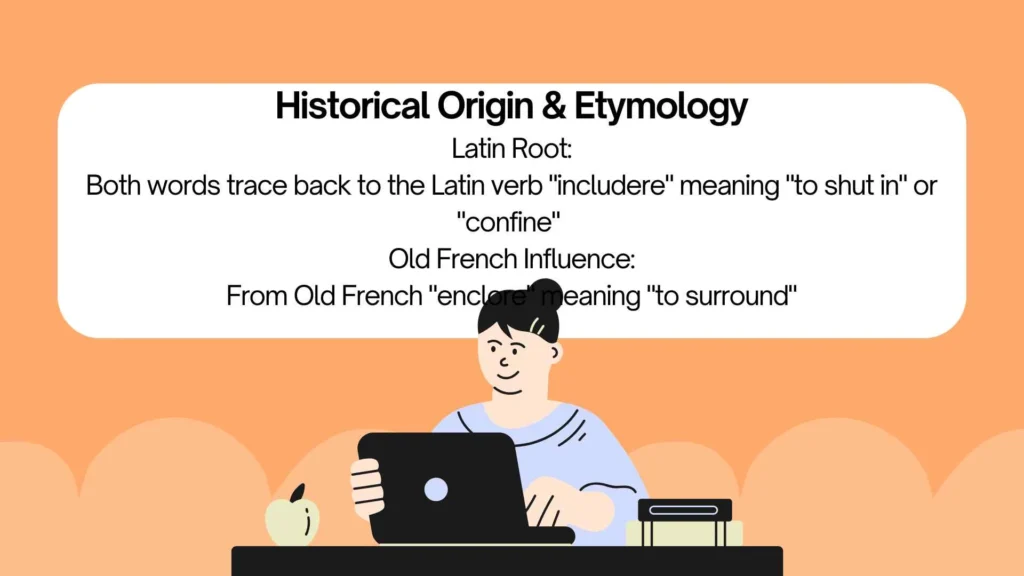
Latin Root:
Both words trace back to the Latin verb “includere” meaning “to shut in” or “confine”
Old French Influence:
From Old French “enclore” meaning “to surround”
Evolution:
- Latin: includere → in + claudere (shut)
- Old French: enclore
- Middle English: enclosen
- Historical variants: “inclosed” common in 16th-17th centuries
Why the Change:
By the 18th century, “enclosed” became preferred due to:
- Simpler, more consistent morphology
- Influence of standard dictionaries
- Increased literacy and standardization
Pronunciation Guide
Enclosed: Pronounced /ɪnˈkloʊzd/ (US) or /ɪnˈkləʊzd/ (UK)
- Sounds like “in-KLOHZD”
- Rhymes with “closed” and “posed”
Inclosed: Pronounced the same way
The Technical Differences
Historical Variant:
“Inclosed” was once an accepted variant, particularly in British English
Modern Standard:
Today, “enclosed” is the only standard spelling
Why the Confusion:
The words sound identical, and both share the same Latin root. The prefix “en-” and “in-” were often interchangeable in older English
Correct Spelling & Common Typos
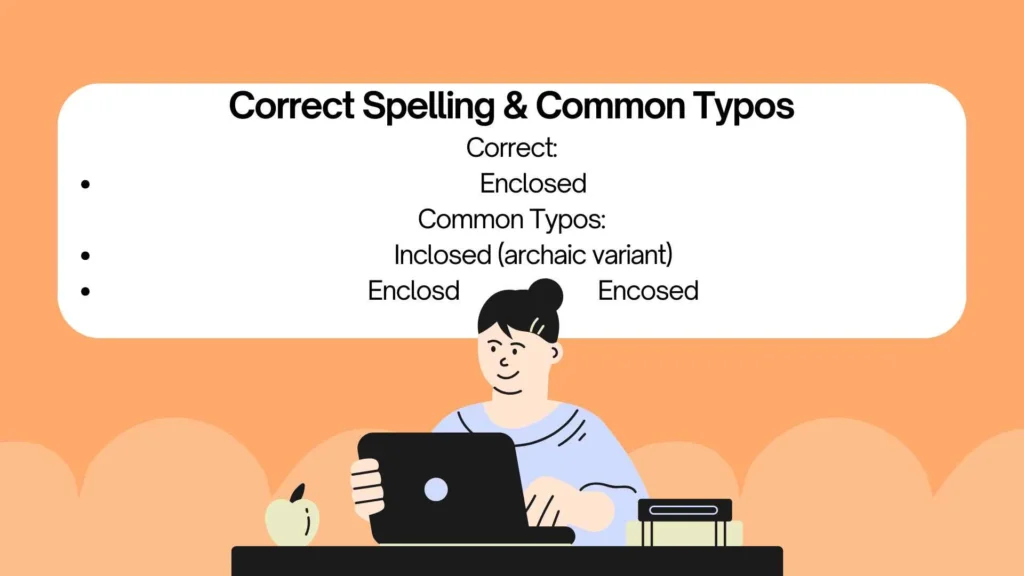
Correct:
- Enclosed
Common Typos:
- Inclosed (archaic variant)
- Enclosd
- Encosed
- Enclossed
- Inclosde
Mnemonic Devices
- “Enclosed has an E for Envelope”: Remember that things are enclosed in envelopes. Both start with “en-“!
- “Modern is with E”: Today’s English uses “e,” not “i” for this word.
- “The ‘E’ is for Everyone”: “Enclosed” is used by everyone in modern English.
Regional Variations
Consistent Across Regions:
“Enclosed” is the standard spelling in all English varieties:
- American English: Enclosed
- British English: Enclosed
- Canadian English: Enclosed
- Australian English: Enclosed
Historical Note:
“Inclosed” was once more common in British English but has been obsolete since the 19th century
Singular and Plural Forms
Adjective:
- No plural forms (remains “enclosed”)
Verb Forms:
- Base: enclose
- Past: enclosed
- Present Participle: enclosing
- 3rd Person: encloses
Noun Form (Enclosure):
- Singular: enclosure
- Plural: enclosures
Grammar Rules
Part of Speech:
- Adjective: Modifies nouns
- “The enclosed package arrived today.”
- Verb (Past Participle): Forms past tense
- “She enclosed a photo in the letter.”
- Verb (Past Tense): Actions completed
- “He enclosed the documents yesterday.”
Examples:
- Adjective: “Please review the enclosed contract.”
- Verb: “I have enclosed my resume.”
Synonyms and Antonyms
Synonyms:
- Included
- Contained
- Surrounded
- Encircled
- Immured
- Shut in
Antonyms:
- Open
- Exposed
- Unbounded
- Unrestricted
- Excluded
Related Words:
- Enclosure
- Cloistered
- Confined
Formal vs. Informal Usage
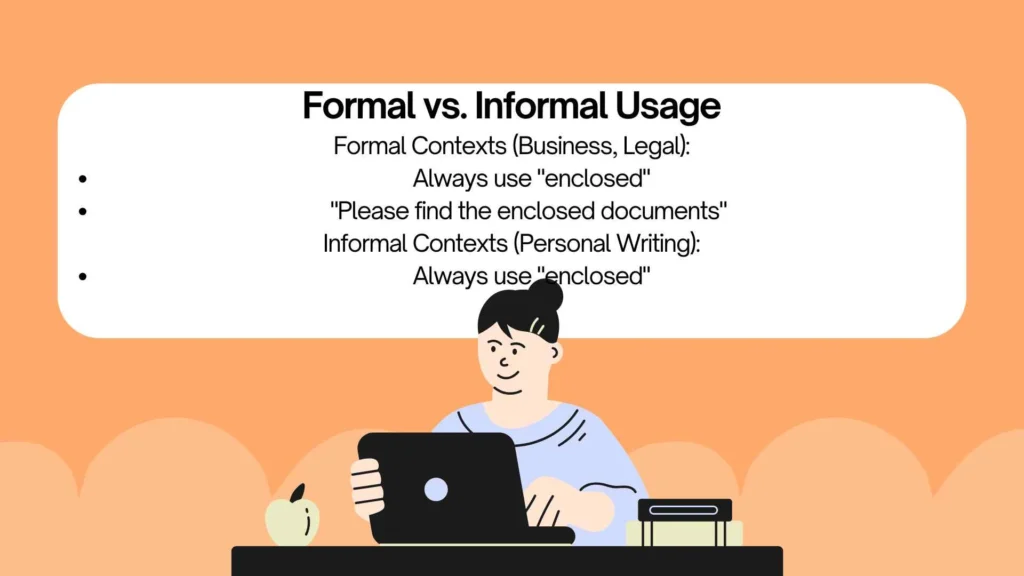
Formal Contexts (Business, Legal):
- Always use “enclosed”
- “Please find the enclosed documents”
Informal Contexts (Personal Writing):
- Always use “enclosed”
- “I’ve enclosed a gift for you”
Professional Recommendations:
- Never use “inclosed” in modern writing
- It is considered a misspelling
Illustrative Examples
- Please find the enclosed documents for your review .
- The garden is enclosed by a tall wooden fence.
- I have enclosed a check with this letter .
- The enclosed space felt cramped and stuffy.
- She enclosed her resume in the application.
- The enclosed terms and conditions apply to this agreement .
- He enclosed the fragile item in bubble wrap.
- The enclosed area was reserved for VIP guests.
- They enclosed the patio for winter use .
- The enclosed invoice must be paid by Friday.
- The valley was enclosed by towering mountains .
- I enclosed a photo from our trip.
Practice Section (15 MCQs)
- Which spelling is correct in modern English?
- a) Inclosed
- b) Enclosed
- c) Enclosd
- d) Inclosde
- “Please find the ___ documents.” Which completes correctly?
- a) Inclosed
- b) Enclosed
- c) Enclossed
- d) Inclossed
- “Inclosed” is considered:
- a) Modern spelling
- b) Archaic variant
- c) American English
- d) British English
- Both words share which Latin root?
- a) Includere
- b) Enclosere
- c) Inclaudere
- d) Enclaudere
- The correct past tense of “enclose” is:
- a) Inclosed
- b) Enclosded
- c) Enclosed
- d) Enclosd
- When referring to a letter in an envelope, use:
- a) Inclosed
- b) Enclosed
- c) Both
- d) Neither
- What does “enclosed” mean?
- a) Surrounded or placed within
- b) Opened or exposed
- c) Removed or excluded
- d) Broken or damaged
- By which century did “enclosed” become standard?
- a) 16th
- b) 17th
- c) 18th
- d) 20th
- The noun form of “enclosed” is:
- a) Enclosement
- b) Enclosure
- c) Enclosion
- d) Enclosation
- “The ___ check represents payment.” Which is correct?
- a) Inclosed
- b) Enclosed
- c) Inclosd
- d) Enclosd
- Which is NOT a synonym for “enclosed”?
- a) Contained
- b) Surrounded
- c) Exposed
- d) Included
- The modern spelling is preferred because:
- a) It sounds better
- b) Dictionaries endorse “enclosed”
- c) “Inclosed” is longer
- d) It came from French
- “Inclosed” was historically more common in:
- a) American English
- b) British English
- c) Australian English
- d) Canadian English
- The prefix “en-” in “enclosed” means:
- a) Away from
- b) In or into
- c) Under
- d) Over
- “The estate was ___ by a high wall.” (historical context)
- a) Enclosed
- b) Inclosed
- c) Both
- d) Neither
Answer Key:
- b
- b
- b
- a
- c
- b
- a
- c
- b
- b
- c
- b
- b
- b
- c (both can work in historical context)
Frequently Asked Questions
Q1: Is “inclosed” ever correct?
“Inclosed” is an archaic spelling no longer used in modern English. Always use “enclosed” .
Q2: Why do people spell it “inclosed”?
People may use “inclosed” because it was historically correct or due to confusion with the “in-” prefix used in similar words .
Q3: Is “inclosed” used in British English?
Historically yes, but today “enclosed” is standard in all varieties of English, including British English .
Q4: What is the difference between “enclosed” and “inclosed”?
There is no difference in meaning. “Inclosed” is simply an outdated spelling variant of “enclosed” .
Q5: When should I use “enclosed” in writing?
Use “enclosed” in all modern writing, whether formal or informal. It is the standard spelling for referring to something contained or surrounded .
Conclusion
I hope this guide has resolved the confusion between “inclosed” and “enclosed” once and for all. Remember that “enclosed” is the only correct spelling in modern English, while “inclosed” is an archaic variant that has fallen out of use . This distinction is important for professional communication. Whether you’re enclosing documents in an email or describing a surrounded space, use “enclosed” with complete confidence . Keep this guide handy, and soon the correct spelling will become second nature!

Olivia Turner is a lifestyle and contemporary romance writer who focuses on positivity and everyday inspiration. Her stories are light, relatable, and filled with warmth, making them perfect for readers looking for uplifting content. Olivia draws inspiration from daily life and simple joyful moments.
📚 Books:
- Love & Coffee
- Chasing Happiness
- Moments That Matter
 Ethan Walker