Table of Contents
- Introduction
- Direct Answer
- Quick Comparison Table
- Deep Meanings & Definitions
- Historical Origin & Etymology
- Pronunciation Guide
- The Technical Differences
- Correct Spelling & Common Typos
- Mnemonic Devices
- Regional Variations
- Singular and Plural Forms
- Grammar Rules
- Synonyms and Antonyms
- Formal vs. Informal Usage
- Illustrative Examples
- Practice Section (15 MCQs)
- Frequently Asked Questions
- Conclusion
Introduction
I have noticed that one of the most enduring linguistic debates in American English is whether to call carbonated beverages “soda” or “pop.” This question can instantly reveal where someone grew up. Understanding this regional divide is fascinating for anyone interested in language, culture, or even just ordering a drink while traveling. In this guide, I will explore the origins, regional patterns, and cultural significance of both terms.
Direct Answer
“Soda” and “pop” refer to the exact same beverage —a carbonated, flavored, and sweetened soft drink . The difference is purely regional: “soda” dominates the Northeast and West Coast, while “pop” is preferred in the Midwest and Northwest .
Quick Comparison Table
| Feature | Soda | Pop |
| Meaning | Carbonated soft drink | Carbonated soft drink |
| Primary Region | Northeast, West Coast | Midwest, Northwest |
| Etymology | From “soda water” (1834) | Imitative of “pop” sound (1812) |
| First Recorded | 1834 | 1812 |
| Preference | Team Soda (coastal) | Team Pop (inland) |
Deep Meanings & Definitions
Soda:
- A carbonated, flavored, and sweetened beverage
- Short for “soda water” (carbonated water)
- Also refers to sodium compounds (baking soda, washing soda)
Pop:
- A carbonated, flavored soft drink
- Named for the sound made when opening a bottle
- Often used in the Midwest and Northwest
Other Regional Terms:
- Coke: Generic term for all soft drinks in the South, regardless of brand
- Tonic: Older term used in parts of Boston and New England
Historical Origin & Etymology
Soda:
- Late 15c: “sode” meant sodium carbonate from saltwort ashes
- From Italian “sida” or Medieval Latin “soda,” origin uncertain
- 1834: First recorded use for “carbonated water”
- Soda fountains appeared in Baltimore and NYC by the 1830s
Pop:
- c. 1400: “pop” was imitative of a sharp, explosive sound
- 1812: First recorded use for carbonated beverages in a letter by Robert Southey
- Southey wrote: “called pop, because ‘pop goes the cork’ when it is drawn”
- Midwestern use spread through Detroit-based Faygo, which called their product “pop”
Pronunciation Guide
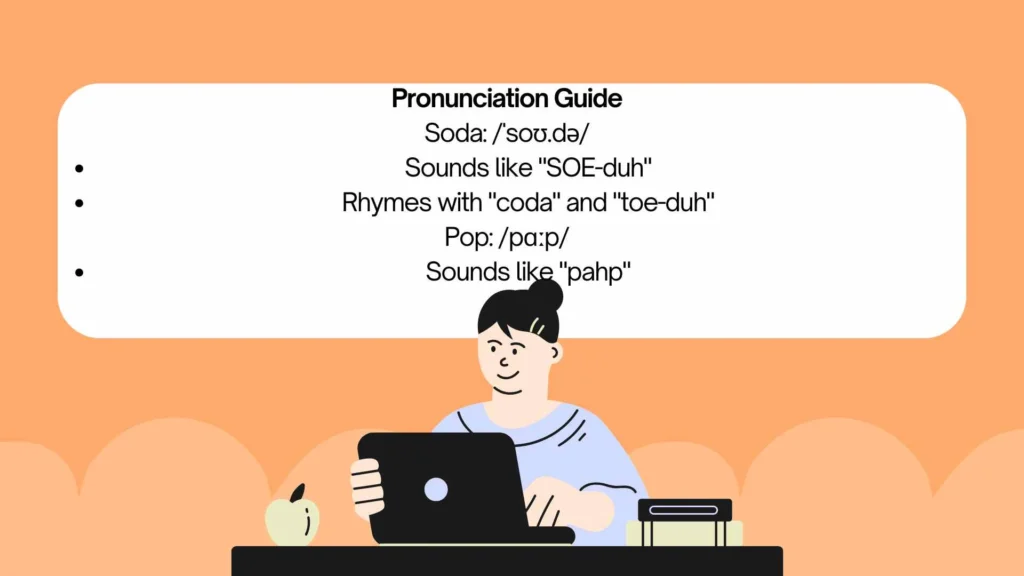
Soda: /ˈsoʊ.də/
- Sounds like “SOE-duh”
- Rhymes with “coda” and “toe-duh”
Pop: /pɑːp/
- Sounds like “pahp”
- Rhymes with “stop” and “top”
The Technical Differences
No Technical Difference:
- Both refer to the same beverage type
- Both are carbonated, sweetened, and flavored
The Real Difference: Regional Dialect
- Soda: Northeast (NY, Boston) and West Coast (CA, OR, WA)
- Pop: Midwest (MI, IL, OH, MN) and Northwest
- Coke: South (GA, TX, SC, MS)
Why These Patterns?
- Soda fountains introduced “soda water” to the Northeast early on
- Midwestern bottlers like Faygo popularized “pop”
- Southerners adopted “Coke” due to Coca-Cola’s Atlanta origins
Correct Spelling & Common Typos
Correct:
- Soda
- Pop
Common Typos:
- Sode (confusing pronunciation)
- Sodda (extra ‘d’)
- Popp (extra ‘p’)
- Pops (plural or possessive confusion)
Mnemonic Devices
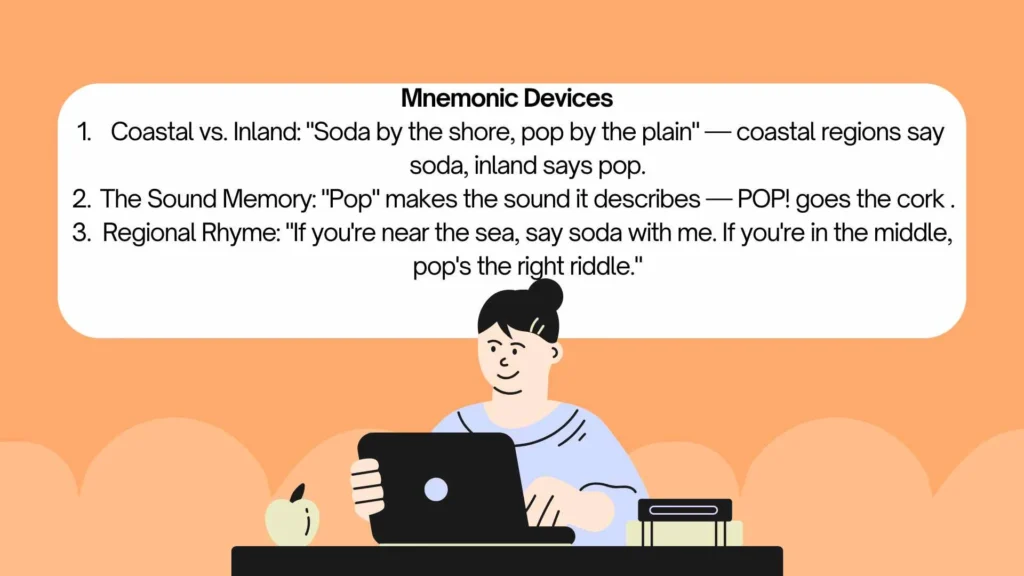
- Coastal vs. Inland: “Soda by the shore, pop by the plain” — coastal regions say soda, inland says pop.
- The Sound Memory: “Pop” makes the sound it describes — POP! goes the cork .
- Regional Rhyme: “If you’re near the sea, say soda with me. If you’re in the middle, pop’s the right riddle.”
Regional Variations
United States:
- Soda: Northeast, California, Florida, Milwaukee, St. Louis
- Pop: Midwest, Northwest, Minnesota, North Dakota
- Coke: Southern states (generic term)
United Kingdom:
- “Fizzy drink” or “soft drink”
Ireland:
- “Minerals”
Australia/New Zealand:
- “Soft drink”
Scotland:
- “Juice” for any soft drink
Singular and Plural Forms
Singular:
- “Can I have a soda?”
- “I’ll take a pop.”
Plural:
- “Sodas” (adding ‘s’)
- “Pops” (adding ‘s’)
Possessive:
- “The soda’s carbonation was perfect.”
- “That pop’s flavor is unique.”
Grammar Rules
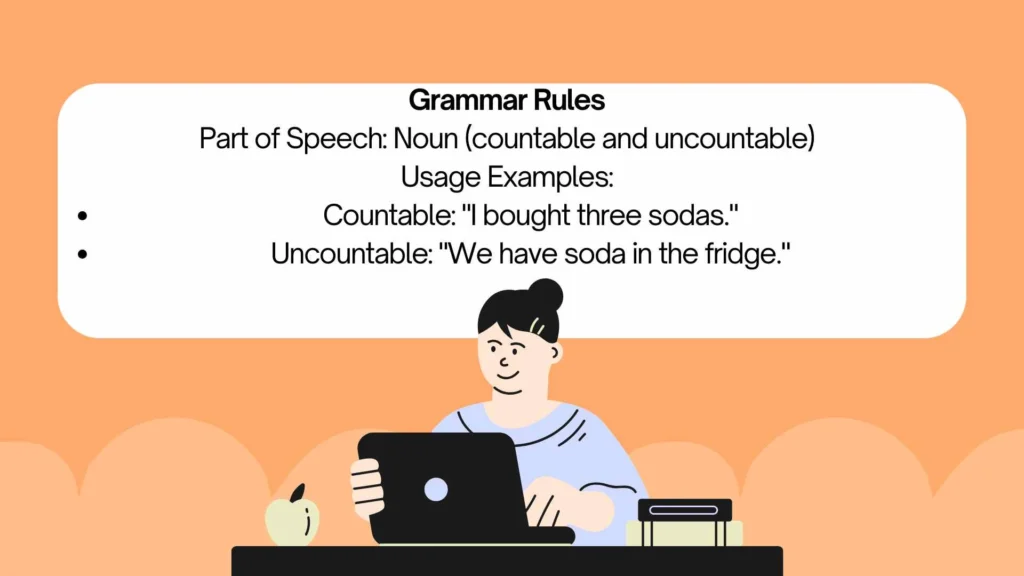
Part of Speech: Noun (countable and uncountable)
Usage Examples:
- Countable: “I bought three sodas.”
- Uncountable: “We have soda in the fridge.”
As Adjectives:
- “Soda fountain”
- “Pop bottle”
Synonyms and Antonyms
Synonyms:
- Soft drink
- Carbonated beverage
- Fizzy drink (UK)
- Tonic (Boston)
- Soda pop (combined term)
Antonyms:
- Still drink (non-carbonated)
- Flat drink
- Water
Formal vs. Informal Usage
Formal Contexts:
- “Carbonated beverage” or “soft drink” is preferred
- Business reports use “soft drink industry”
- Example: “The carbonated beverage market continues to grow.”
Informal Contexts:
- “Soda” and “pop” are everyday terms
- Regional preferences dominate casual conversation
- Example: “Can you grab me a soda from the fridge?”
Illustrative Examples
- In New York, I always order a soda.
- My friend from Detroit always asks for a pop.
- Southerners might say “Coke” even when they want a Sprite .
- The soda fountain was invented in 1811 .
- Pop is called that because of the sound the cork makes .
- I moved from California to Chicago and switched from soda to pop.
- The first soda fountains appeared in Baltimore and NYC .
- In Boston, some older folks still say tonic .
- The term soda pop combines both regional terms .
- Faygo Soda, a Detroit company, helped popularize pop .
- In the UK, they say fizzy drink rather than soda or pop .
- “Pop goes the cork!” was how the term was first described .
Practice Section (15 MCQs)
- Which region primarily uses “soda”?
- a) Midwest
- b) Northeast
- c) South
- d) Alaska
- Which region primarily uses “pop”?
- a) West Coast
- b) Northeast
- c) Midwest
- d) Florida
- What do Southerners often call any soft drink?
- a) Soda
- b) Pop
- c) Coke
- d) Tonic
- The term “pop” originated from:
- a) The taste
- b) The sound of the cork
- c) The color
- d) The inventor’s name
- In which year was “soda water” first recorded?
- a) 1812
- b) 1834
- c) 1863
- d) 1905
- Which Detroit company helped popularize “pop”?
- a) Coca-Cola
- b) Pepsi
- c) Faygo
- d) Dr Pepper
- What do Australians typically call carbonated drinks?
- a) Soda
- b) Pop
- c) Soft drink
- d) Fizzy drink
- Coca-Cola was invented in which city?
- a) New York
- b) Chicago
- c) Atlanta
- d) Detroit
- “Soda” comes from a word meaning:
- a) Sweet liquid
- b) Sodium carbonate
- c) Carbonated water
- d) Sugar syrup
- Which is the older recorded term, “soda” or “pop”?
- a) Soda (1834)
- b) Pop (1812)
- c) Both same year
- d) Neither
- What is the combined term for both regional words?
- a) Soda pop
- b) Pop soda
- c) Soft drink
- d) Fizzy pop
- In Scotland, what is the generic term for soft drinks?
- a) Soda
- b) Pop
- c) Juice
- d) Minerals
- Which term was used in 1812 in a letter by Robert Southey?
- a) Soda
- b) Pop
- c) Coke
- d) Tonic
- What is a common older term for soda in Boston?
- a) Pop
- b) Tonic
- c) Coke
- d) Juice
- The generic use of “Coke” in the South is an example of:
- a) Regional dialect
- b) Genericide
- c) Technical term
- d) Formal usage
Answer Key:
- b
- c
- c
- b
- b
- c
- c
- c
- b
- b
- a
- c
- b
- b
- b
Frequently Asked Questions
Q1: Is it soda or pop?
Both are correct. It depends on where you live. The Northeast and West Coast say “soda,” while the Midwest and Northwest say “pop” .
Q2: Why do some people say “Coke” for all soft drinks?
In the South, “Coke” became generic for all carbonated beverages because Coca-Cola was invented in Atlanta in 1886 and became deeply embedded in the region’s culture .
Q3: Where did the term “soda” come from?
“Soda” comes from the Italian “sida” or Medieval Latin “soda,” referring to sodium carbonate. It was first used for “soda water” in 1834 .
Q4: Where did the term “pop” come from?
“Pop” is imitative of the sound made when opening a carbonated beverage. It was first recorded in 1812 in a letter by Robert Southey: “pop goes the cork” .
Q5: Is “soda pop” a real term?
Yes, “soda pop” is a combined term that was first recorded in 1863 . It combines both regional terms and is understood everywhere.
Conclusion
I hope this guide has clarified the fascinating “soda or pop” debate. Both terms refer to the same fizzy, carbonated beverage the only difference is geography and dialect. The Northeast and West Coast prefer “soda,” while the Midwest and Northwest say “pop” .
Southerners have their own unique term, “Coke,” thanks to Coca-Cola’s Atlanta origins . Understanding these regional patterns not only helps you order drinks correctly but also reveals the rich linguistic diversity of American English. So whether you ask for a soda or a pop, you’ll get the same refreshing drink just be prepared for a conversation about where you’re from!

James Anderson is a thriller and mystery author known for his suspenseful plots and unexpected twists. His storytelling keeps readers on the edge of their seats, blending intrigue with psychological depth. James has a talent for creating gripping narratives that captivate audiences from beginning to end.
📚 Books:
- The Hidden Truth
- Shadow Game
- Beyond the Lies
 Ethan Walker