Table of Contents
- Introduction
- Direct Answer
- Quick Comparison Table
- Deep Meanings & Definitions
- Historical Origin & Etymology
- Pronunciation Guide
- The Technical Differences
- Correct Spelling & Common Typos
- Mnemonic Devices (Memory Tricks)
- Regional Variations (US vs. UK English)
- Singular and Plural Forms
- Grammar Rules & Parts of Speech
- Synonyms and Antonyms
- Formal vs. Informal Usage
- Illustrative Examples
- Practice Section (15 MCQs)
- Frequently Asked Questions (FAQs)
- Conclusion
Introduction
I’ve noticed that few tiny expressions confuse writers as much as “and/or.” At first glance, it looks harmless a simple combination of two conjunctions. But once you try to use it in formal writing, legal documents, or even emails, uncertainty creeps in. Should you use it? Avoid it? Replace it?
Understanding “and/or” isn’t just about grammar it’s about clarity, precision, and credibility in communication. Whether you’re a student, professional, or content creator, mastering this term will help you write more effectively and avoid ambiguity.
Direct Answer
“And/or” is a compound conjunction used to indicate that one or both of two options may apply. It means “A or B or both.” While useful for expressing inclusivity, it can create ambiguity and is often discouraged in formal writing unless clarity demands it.
Quick Comparison Table
| Aspect | And/Or |
| Spelling | and/or |
| Meaning | A, B, or both |
| Core Usage | Indicates inclusive choice |
| Formality | Often avoided in formal writing |
| Clarity Level | Can be ambiguous |
Deep Meanings & Definitions
What Does “And/Or” Mean?
The expression “and/or” combines the meanings of “and” and “or” into one compact form.
- “And” → Adds elements (A + B)
- “Or” → Chooses between elements (A or B)
- “And/or” → Includes both possibilities:
- A only
- B only
- A and B together
Example Breakdown:
- “You may bring a pen and/or pencil.”
- Pen only ✔
- Pencil only ✔
- Both ✔
And or explained simply examples
Understanding and and or becomes much easier when you see them in real examples. These words connect ideas, but they do not mean the same thing.
- And joins two things together.
- Or gives a choice between two or more things.
- Everyday examples make the difference easier to remember.
- Learning with simple sentences improves understanding quickly.
- These examples help avoid common mistakes.
- Both words appear in school, work, and daily conversations.
- They also have special meanings in math and logic.
- Knowing the difference improves reading and writing skills.
- The meaning depends on the situation.
- Practice with examples builds confidence.
Here are a few simple examples:
- I like tea and coffee. (I like both.)
- You can have tea or coffee. (Choose one.)
- Bring your notebook and pen. (Bring both items.)
- Call me today or tomorrow. (Either day is fine.)
- She studies English and science. (She studies both subjects.)
And or explained simply answer
The simplest way to understand and and or is to remember what each word does in a sentence.
- And means both things are included.
- Or means one choice, another choice, or sometimes both depending on the context.
- These words connect ideas clearly.
- They help people communicate without confusion.
- They are common in English, math, and computer logic.
- Understanding them improves problem-solving.
- They are easy to learn with everyday examples.
- Context always helps determine the exact meaning.
- They appear in questions, instructions, and conversations.
- Mastering them makes communication more accurate.
In simple words:
- And = together
- Or = choice
This easy rule works in most everyday situations.
And or symbol in math
Math uses special symbols instead of writing the words and and or every time.
- Learning these symbols makes math easier to read.
- Different math topics may use different symbols.
- Logic and probability often use these signs.
- Symbols save time when writing equations.
- They help explain relationships clearly.
- Students often see them in higher-level math.
- Understanding the symbols reduces confusion.
- Each symbol has a specific meaning.
- Practice helps you recognize them quickly.
- Knowing the symbols improves math confidence.
Common symbols include:
- ∩ often represents and in set theory.
- ∪ often represents or in set theory.
- ∧ represents and in logic.
- ∨ represents or in logic.
Always check your textbook because symbols can vary depending on the math topic.
Does and” in math mean add
Many students wonder if and automatically means add in math. The answer is not always.
- The meaning depends on the problem.
- Sometimes and joins information.
- Sometimes it signals addition.
- Other times it represents multiplication or logical connection.
- Reading the entire question is important.
- Context decides the correct operation.
- Word problems require careful thinking.
- Never assume one meaning every time.
- Math uses precise language.
- Understanding context prevents mistakes.
For example:
- 3 and 5 does not automatically mean 3 + 5.
- If a question says add 3 and 5, then you calculate 3 + 5 = 8.
- In probability or logic, and has a different meaning.
And and or in math probability
In probability, and and or have very different meanings.
- And looks for events happening together.
- Or looks for one event, the other, or both.
- These ideas are essential in probability.
- Students often confuse the two.
- Diagrams can help visualize the difference.
- Practice improves accuracy.
- Probability uses specific formulas.
- The wording of the question matters.
- Small word changes can change the answer.
- Careful reading leads to better results.
Examples:
- Rolling an even number and a number greater than 3 means both conditions must be true.
- Rolling a 2 or a 5 means either result is acceptable.
Remember:
- And = both conditions
- Or = at least one condition
And in maths formula
The word and appears in many math formulas and expressions because it connects conditions or values.
- It often combines requirements.
- It may represent logical operations.
- Different branches of math use it differently.
- Algebra, logic, and probability all use and.
- Understanding the context is important.
- The formula explains the intended meaning.
- Students should read symbols carefully.
- Practice makes formulas easier to understand.
- Small details can change the answer.
- Learning common uses builds confidence.
For example:
- In logic, A ∧ B means both statements are true.
- In probability, P(A and B) means both events happen together.
The formula always tells you how and should be interpreted.
Or symbol in math probability
Probability often uses a special symbol for or when working with sets and events.
- The symbol helps write formulas quickly.
- It represents one event, the other, or both.
- Students frequently see it in probability lessons.
- It is common in set theory.
- Learning symbols improves problem-solving.
- The meaning stays consistent within the topic.
- It simplifies mathematical writing.
- Visual examples make it easier to understand.
- Practice helps you remember the symbol.
- Understanding symbols improves exam performance.
The most common symbol is:
- ∪ (union)
For example:
- A ∪ B means event A or B or both happen.
Does and in math means add or multiply
The word and does not always mean add or multiply in math. Its meaning depends on the type of question.
- Context determines the correct operation.
- Word problems often use and differently.
- Logic gives and a special meaning.
- Probability treats and as both events occurring.
- Arithmetic may use and when adding numbers.
- Multiplication only applies when the question requires it.
- Reading carefully avoids mistakes.
- One word can have different meanings.
- Understanding the topic is essential.
- Practice builds stronger math skills.
Quick guide:
- Arithmetic: It may indicate addition if the instruction says to add.
- Probability: It means both events happen.
- Logic: It means both statements are true.
- General math: It does not automatically mean add or multiply. Always follow the context of the problem.
Historical Origin & Etymology
The term “and/or” is relatively modern compared to traditional conjunctions.
- First recorded usage: 19th century
- Gained popularity in legal and bureaucratic writing
- Likely emerged as a practical shorthand to avoid lengthy phrasing like:
- “A or B or both”
Evolution:
- Initially used in legal contracts
- Spread into academic and technical writing
- Now debated in style guides due to ambiguity
Pronunciation Guide
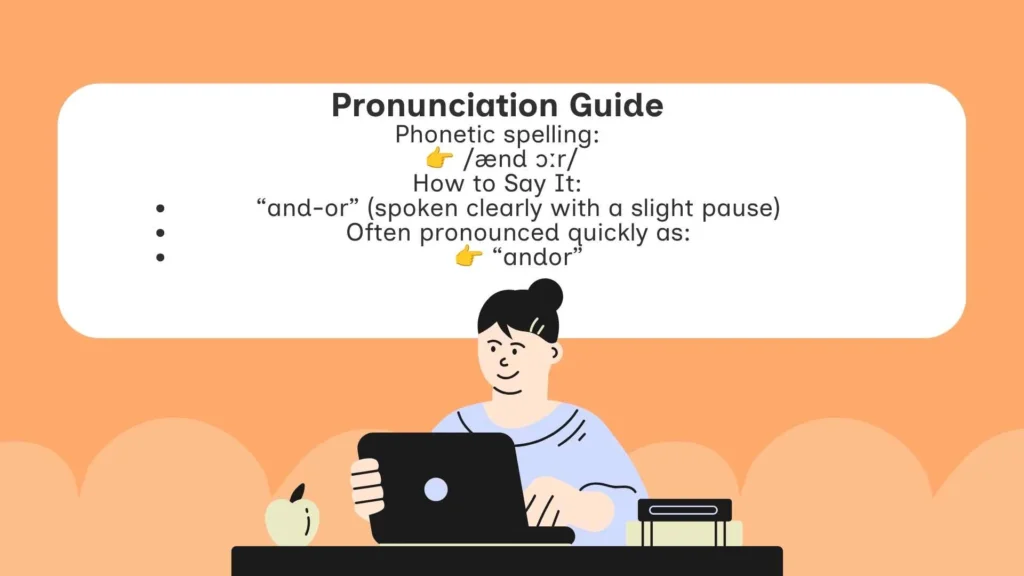
Phonetic spelling:
👉 /ænd ɔːr/
How to Say It:
- “and-or” (spoken clearly with a slight pause)
- Often pronounced quickly as:
👉 “andor”
Tip:
Think of it as two words fused together but still distinct.
The Technical Differences
Why Is “And/Or” Confusing?
The confusion stems from logical overlap:
| Word | Logic Type |
| And | Inclusive |
| Or | Exclusive (sometimes inclusive) |
| And/Or | Explicitly inclusive |
Linguistic Insight:
- In formal logic:
- OR can already mean “one or both”
- Therefore, “and/or” is often redundant
Example:
- “Tea or coffee” can already mean:
- Tea ✔
- Coffee ✔
- Both ✔
So why use “and/or”?
- To remove doubt in legal or technical contexts
Correct Spelling & Common Typos
Correct Form:
- ✅ and/or (with slash)
Common Mistakes:
- ❌ and or (loses clarity)
- ❌ and\or (incorrect symbol)
- ❌ &/or (informal, avoid in writing)
- ❌ and/or/ (extra punctuation)
Why Errors Happen:
- Confusion about punctuation rules
- Overuse of symbols in informal writing
- Misunderstanding of conjunction roles
Mnemonic Devices (Memory Tricks)
Here’s a simple trick:
👉 “Slash means both can clash.”
- The slash ( / ) signals inclusion of both options
- Helps you remember it’s not just either/or
Another one:
👉 “And/or = All or one or more”
Regional Variations (US vs. UK English)
Interestingly, “and/or” remains the same across regions:
| Region | Usage |
| US English | Common in legal/technical writing |
| UK English | Often avoided in formal prose |
| Canadian | Similar to US |
| Australian | Similar to UK |
Style Guide Insight:
- UK and academic styles often recommend rewriting instead of using “and/or”
Singular and Plural Forms
“And/or” is not a noun, so it doesn’t have:
- ❌ Plural forms
- ❌ Possessive forms
However, it affects subject-verb agreement.
Example:
- “The manager and/or employees are responsible.”
👉 Verb agrees with the plural possibility
Grammar Rules & Parts of Speech
Part of Speech:
👉 Conjunction (compound)
Function:
- Connects words, phrases, or clauses
- Expresses inclusive alternatives
Rule:
Avoid using “and/or” when:
- A simpler structure works
- It creates confusion
Better Alternatives:
- “A or B, or both”
- “Either A, B, or both”
Synonyms and Antonyms
Synonyms:
- Either…or (inclusive)
- One or both
- Any combination of
Antonyms:
- Neither…nor
- Only one
- Exclusively
Formal vs. Informal Usage
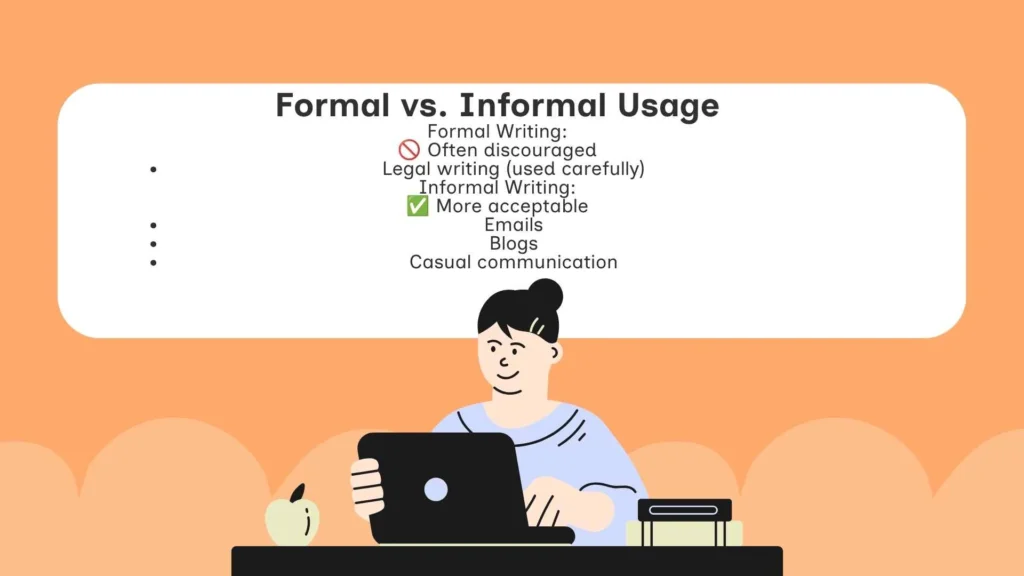
Formal Writing:
🚫 Often discouraged
- Legal writing (used carefully)
- Academic writing (avoid if possible)
Informal Writing:
✅ More acceptable
- Emails
- Blogs
- Casual communication
Best Practice:
Instead of:
👉 “Submit documents and/or ID”
Write:
👉 “Submit documents, ID, or both”
Illustrative Examples
- You can choose tea and/or coffee.
- The policy applies to employees and/or contractors.
- Bring your passport and/or ID card.
- The course includes theory and/or practical work.
- Participants may attend online and/or offline sessions.
- The discount applies to shoes and/or accessories.
- Students must complete assignments and/or exams.
- The device supports Android and/or iOS.
- You may select red and/or blue options.
- The system requires a username and/or password.
- Submit your resume and/or portfolio.
- The event includes music and/or dance performances.
Practice Section (15 MCQs)
Choose the correct usage:
- You can bring snacks ___ drinks.
A) and
B) or
C) and/or - The rule applies to teachers ___ students.
A) and/or
B) and
C) nor - Submit your assignment ___ project.
A) and/or
B) neither
C) but - You may choose tea ___ coffee ___ both.
A) and/or
B) or
C) nor - The offer includes shirts ___ pants.
A) and/or
B) neither
C) yet - The policy affects managers ___ employees.
A) and/or
B) but
C) so - You can attend online ___ offline ___ both.
A) and/or
B) or
C) yet - Bring ID ___ passport.
A) and/or
B) nor
C) but - The course requires reading ___ writing tasks.
A) and/or
B) so
C) yet - Choose one option ___ both options.
A) and/or
B) but
C) nor - The app supports login via email ___ phone.
A) and/or
B) yet
C) but - The discount applies to kids ___ adults.
A) and/or
B) nor
C) yet - You can use cash ___ card ___ both.
A) and/or
B) but
C) yet - The event features music ___ comedy.
A) and/or
B) nor
C) yet - Submit documents ___ ID ___ both.
A) and/or
B) but
C) nor
Answer Key:
- C
- A
- A
- A
- A
- A
- A
- A
- A
- A
- A
- A
- A
- A
- A
Frequently Asked Questions (FAQs)
Is “and/or” grammatically correct?
Yes, it is grammatically correct, but many style guides recommend avoiding it due to potential ambiguity.
Why do lawyers use “and/or”?
Legal writing uses it to eliminate ambiguity and ensure all possibilities are covered.
Can I replace “and/or” with “or”?
Often yes, because “or” can already include both options depending on context.
Is “and/or” informal?
It’s considered semi-formal—acceptable in technical contexts but discouraged in polished writing.
What is the best alternative to “and/or”?
Use:
- “A or B or both”
- Rewrite the sentence for clarity
What is the logic of and and or?
In logic, AND means all conditions must be true for the result to be true. OR means the result is true if at least one condition is true. These operators are widely used in mathematics, programming, and Boolean logic.
What does ∧ and ∨ mean in math?
The symbol ∧ means AND, while ∨ means OR in mathematical logic. They are used to combine statements and determine whether a logical expression is true or false.
What is the shorthand for and or?
The common shorthand for AND is &&, and for OR it is || in many programming languages. In mathematical logic, ∧ represents AND and ∨ represents OR.
Does && or || go first?
In most programming languages, && is evaluated before || unless parentheses change the order. This precedence helps expressions produce the correct logical result.
Is || and && the same?
No, || and && are different logical operators. && requires all conditions to be true, while || returns true if at least one condition is true.
What is a && b?
The expression a && b means both a and b must be true for the entire expression to be true. If either value is false, the result is false.
Conclusion
“And/or” is one of those deceptively simple expressions that carry significant weight in writing. I’ve seen it clarify meaning in technical contexts but also confuse readers when overused. The key takeaway is balance: use it only when necessary and replace it when clarity can be improved.
Mastering “and/or” means understanding not just grammar, but also intent, precision, and audience expectations. When used thoughtfully, it becomes a powerful tool—when misused, it becomes clutter.
Write clearly, choose wisely, and when in doubt—simplify.

Ethan Walker is a non-fiction author and thought leader who writes about personal growth, productivity, and modern life challenges. His work focuses on helping readers simplify their lives, make better decisions, and achieve meaningful success. With a clear and practical writing style, Ethan provides valuable insights that inspire positive change and long-term improvement.
📚 Books:
- The Road to Clarity
- Moments of Truth
- Breaking the Limits
 Olivia Turner