Table of Contents
- Introduction
- Direct Answer
- Quick Comparison Table
- Deep Meanings & Definitions
- Historical Origin & Etymology
- Pronunciation Guide
- The Technical Differences
- Correct Spelling & Common Typos
- Mnemonic Devices
- Regional Variations
- Singular and Plural Forms
- Grammar Rules
- Synonyms and Antonyms
- Formal vs. Informal Usage
- Illustrative Examples
- Practice Section (15 MCQs)
- Frequently Asked Questions
- Conclusion
Introduction
I have often observed confusion surrounding the words “knick” and “nick.” Are they simply variations of the same word, or do they have distinct meanings? This linguistic puzzle frequently appears in writing and conversation. In this guide, I will clarify the differences, explain their origins, and provide simple rules to help you use each word correctly.
Direct Answer
“Nick” is the correct spelling for a small cut, notch, or to steal. “Knick” is not a standard English word except in the phrase “knick-knack” (a small decorative item). “Knickerbocker” also uses “knick.” Use “nick” for damage or theft.
Quick Comparison Table
| Feature | Nick | Knick |
| Status | Standard English word | Not a standard word (except compounds) |
| Meaning | Small cut, notch, or to steal | Only appears in “knick-knack” or “knickerbocker” |
| Part of Speech | Noun, verb | Part of compound nouns |
| Common Usage | “I nicked my finger” | “Knick-knack” (small ornament) |
| Regional Acceptance | All English varieties | Only in specific compounds |
Deep Meanings & Definitions
Nick (Noun):
- A small cut or notch
- “He had a nick on his chin from shaving.”
- A specific condition or state (in the nick of time)
- “He arrived in the nick of time.”
- A prison (slang, British)
- “He spent a night in the nick.”
Nick (Verb):
- To make a small cut or notch
- “I nicked myself while shaving.”
- To steal (British slang)
- “Someone nicked my bike.”
- To arrest (British slang)
- “The police nicked him for theft.”
Knick:
Not a standalone word. Appears in:
- Knick-knack: A small decorative object or trinket
- Knickerbocker: A New Yorker or a type of pants
Historical Origin & Etymology
Nick:
- Origin uncertain, but likely from Middle English “nikken” meaning to make a notch or cut
- Possibly influenced by Old Norse “hnykka” (to jerk) or Dutch “nikken” (to nod)
- First used in the 15th century
Knick:
- Appears in “knick-knack” (also spelled “nick-nack”) meaning a trivial ornament
- Origin from “knack” meaning a trick or trinket
- Used since the 16th century
Pronunciation Guide
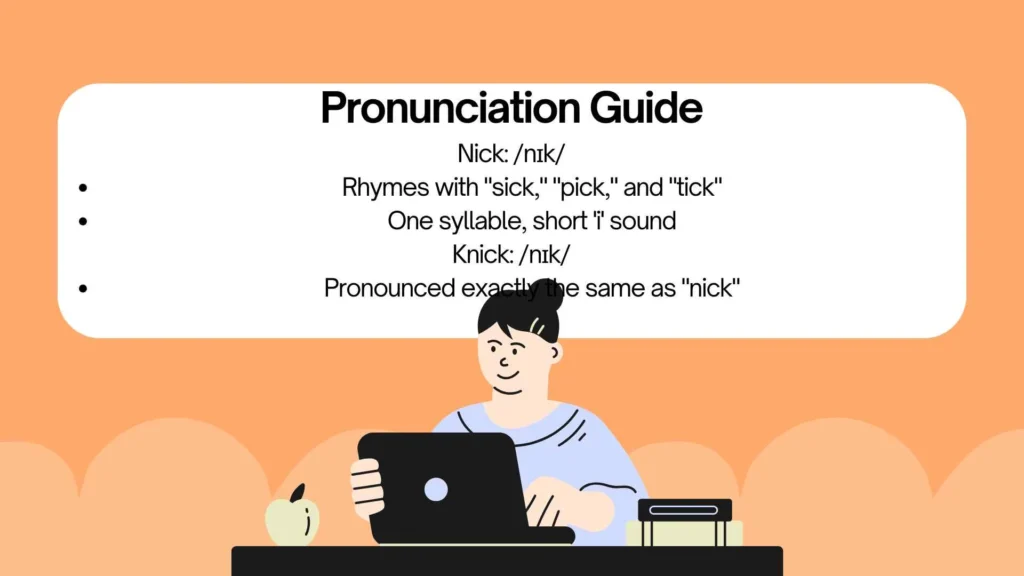
Nick: /nɪk/
- Rhymes with “sick,” “pick,” and “tick”
- One syllable, short ‘i’ sound
Knick: /nɪk/
- Pronounced exactly the same as “nick”
- The ‘k’ is NOT silent (both ‘k’ and ‘c’ are pronounced together as /k/)
The Technical Differences
The Main Distinction:
- Nick is a proper word with multiple meanings (cut, steal, condition)
- Knick is not a word on its own
Confusion Sources:
- Similar Pronunciation: Both sound identical
- Compound Words: “Knick-knack” sounds like it uses “knick”
- Visual Similarity: The ‘k’ at the beginning of both confuses people
The ‘Kn’ Confusion:
- “Knife,” “knight,” “know” have silent ‘k’s
- “Nick” has no silent letters
- This leads to confusion about whether “nick” should have a ‘k’
Correct Spelling & Common Typos
Correct:
- Nick (for cut, steal, or notch)
- Knick-knack (for small ornament)
Common Typos:
- Knick instead of “nick”
- Knack for “nick” (different word entirely)
- Nack (misspelling)
- Nikk (incorrect doubling)
Most Common Error:
Writing “knick” when you mean “nick” (a small cut or theft)
Mnemonic Devices
- “Nick the Knife”: Remember that a “nick” is a cut you make with a knife—and both start with ‘n,’ not ‘kn.’
- “Knick-Knack = Two K’s”: The only time you use “knick” is when you have a “knick-knack” (with two ‘k’s) sitting on your shelf.
- “No K in Nick for the Cut”: If you’re talking about a cut or stealing, there’s no ‘k’ at the beginning.
- Memory Rhyme:
- “If you make a little mark, it’s spelled N-I-C-K. If it’s a trinket in the dark, it’s K-N-I-C-K.”
Regional Variations
Consistent Across Regions:
Both words maintain consistent spelling in all English varieties:
- American English: Nick, knick-knack
- British English: Nick, knick-knack
- Canadian English: Nick, knick-knack
- Australian English: Nick, knick-knack
Usage Variations:
- British: “Nick” commonly means “to steal” or “police station”
- American: “Nick” is less common for theft; “steal” is preferred
Singular and Plural Forms
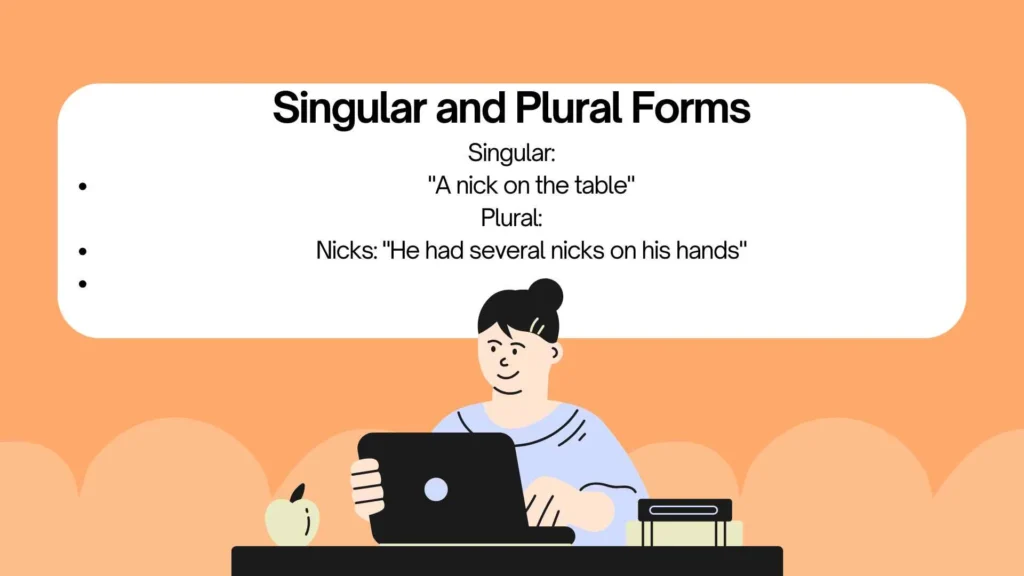
Singular:
- “A nick on the table”
- “A knick-knack on the shelf”
Plural:
- Nicks: “He had several nicks on his hands”
- Knick-knacks: “She collected knick-knacks from around the world”
Possessive:
- Nick’s: “The nick’s depth was minimal”
- Knick-knack’s: “The knick-knack’s value was sentimental”
Grammar Rules
Part of Speech:
- Nick (Noun): “The nick was barely visible.”
- Nick (Verb): “I nicked my finger.”
- Knick-knack (Noun): “The shelves were filled with knick-knacks.”
Verb Conjugation:
- Present: nick/nick
- Past: nicked
- Present Participle: nicking
Common Prepositions:
- “In the nick of time”
- “Nick at” (something)
Synonyms and Antonyms
Synonyms for Nick (cut):
- Scratch
- Chip
- Dent
- Notch
- Mark
Synonyms for Nick (steal – British):
- Steal
- Snatch
- Swipe
- Pinch
Antonyms:
- Smooth (for damaged surface)
- Give (for steal)
- Return (for steal)
Synonyms for Knick-knack:
- Trinket
- Bauble
- Ornament
- Tchotchke
- Curio
Formal vs. Informal Usage
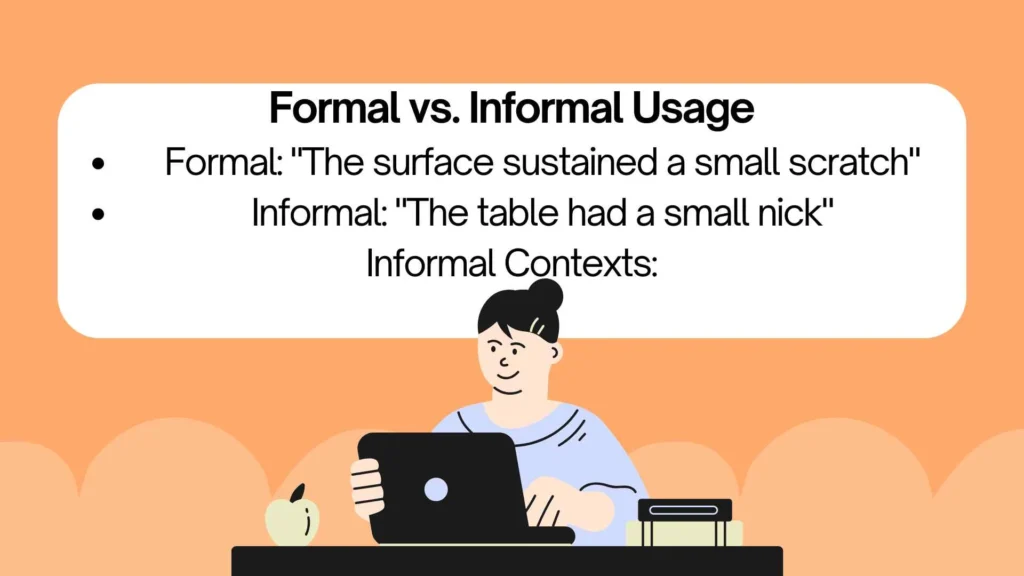
Formal Contexts:
- Nick is acceptable but may be replaced by more precise terms
- Formal: “The surface sustained a small scratch”
- Informal: “The table had a small nick”
Informal Contexts:
- Nick is very common in everyday speech
- Knick-knack is casual, rarely used formally
Professional Recommendations:
- Technical Writing: Use “notch,” “scratch,” or “chip” instead of “nick”
- British Slang: “Nick” for steal is very informal, avoid in formal writing
Illustrative Examples
- He nicked his chin while shaving this morning.
- Someone nicked my wallet on the subway.
- The table had a small nick in its surface.
- She arrived in the nick of time for the meeting.
- The shelves were filled with knick-knacks from her travels.
- I nicked the car door when I parked too close.
- The police station is called “the nick” in British slang.
- He nicked himself on the sharp edge of the metal.
- Her favorite knick-knack was a small porcelain cat.
- The diamond had a tiny nick that reduced its value.
- The burglar nicked the jewelry from the display case.
- The repairman fixed the nick in the wooden floor.
Practice Section (15 MCQs)
- What is the correct spelling for a small cut?
- a) Knick
- b) Nick
- c) Both
- d) Neither
- “Knick” is a standalone word:
- a) True
- b) False
- Which word means “to steal” in British slang?
- a) Knick
- b) Nick
- c) Both
- d) Neither
- “Knick-knack” means:
- a) A small cut
- b) A small decorative item
- c) A type of crime
- d) A kitchen utensil
- “In the ___ of time” – fill in:
- a) Knick
- b) Nick
- c) Both
- d) Neither
- How do you pronounce “knick”?
- a) K-nick
- b) Nick
- c) Knee-k
- d) Kn-ick
- “Nick” functions as:
- a) Noun only
- b) Verb only
- c) Both noun and verb
- d) Adjective
- Which is the correct spelling for a trinket?
- a) Knick-knack
- b) Nick-nack
- c) Both
- d) Neither
- “He ___ himself while shaving.” Fill in:
- a) Knicked
- b) Nicked
- c) Both
- d) Neither
- The “k” in “knick-knack” is:
- a) Silent
- b) Pronounced
- c) Sometimes silent
- d) Always silent
- In American English, “nick” for stealing is:
- a) Very common
- b) Less common
- c) Never used
- d) Formal
- The plural of “nick” is:
- a) Nick
- b) Nicks
- c) Nickes
- d) Niks
- “Knick-knack” is what part of speech?
- a) Verb
- b) Noun
- c) Adjective
- d) Adverb
- Which is a synonym for “nick” (cut)?
- a) Scratch
- b) Smooth
- c) Fill
- d) Repair
- The correct spelling for a small scratch is:
- a) Knick
- b) Nick
- c) Nique
- d) Nikk
Answer Key:
- b
- b
- b
- b
- b
- b
- c
- a
- b
- b
- b
- b
- b
- a
- b
Frequently Asked Questions
Q1: Is “knick” ever correct?
“Knick” is not a standalone word. It only appears in compound words like “knick-knack” or names like “Knickerbocker” .
Q2: What is the difference between “nick” and “knick”?
“Nick” is a word meaning a small cut, notch, or to steal. “Knick” is not a word on its own, though it appears in “knick-knack” .
Q3: Why do people confuse “nick” and “knick”?
People confuse them because:
- They are pronounced identically
- The “kn” spelling pattern (as in “knife”) leads to confusion
- “Knick-knack” sounds like it might be related to “nick”
Q4: Does “nick” have different meanings in British and American English?
Yes. In British English, “nick” also means to steal, arrest, or a prison . In American English, it primarily means a small cut or notch.
Q5: Is “knick-knack” the same as “nick-nack”?
“Knick-knack” is the standard spelling. “Nick-nack” is an accepted variant, but “knick-knack” is more common .
Conclusion
I hope this guide has clarified the distinction between “nick” and “knick.” Remember that “nick” is your go-to word for cuts, notches, and (in British English) stealing. “Knick” has no standalone meaning it only appears in “knick-knack” for small ornaments. By remembering that a cut is a “nick” (no ‘k’), you can avoid this common spelling error. With these simple rules, you’ll never confuse these words again.

James Anderson is a thriller and mystery author known for his suspenseful plots and unexpected twists. His storytelling keeps readers on the edge of their seats, blending intrigue with psychological depth. James has a talent for creating gripping narratives that captivate audiences from beginning to end.
📚 Books:
- The Hidden Truth
- Shadow Game
- Beyond the Lies
 Ethan Walker
 Olivia Turner