Table of Contents
- Introduction
- Direct Answer (Meaning Overview)
- Quick Comparison Table
- Deep Meanings & Definitions
- Historical Origin & Etymology
- Pronunciation Guide
- The Linguistic Logic Behind the Phrase
- Common Variations and Misinterpretations
- Mnemonic Devices (Memory Tricks)
- Regional Variations (US vs UK Usage)
- Grammar Role and Sentence Structure
- Synonyms and Antonyms
- Formal vs Informal Usage
- Illustrative Examples
- Practice Section (15 MCQs)
- Frequently Asked Questions (FAQs)
- Conclusion
Introduction
I often encounter learners who are confused by strong English idioms that carry emotional and social weight, and “my way or the highway” is one of the most misunderstood among them.
It appears simple, but it reflects authority, conflict, and decision-making pressure in communication.
Many people hear it in movies, workplace conversations, or family arguments without fully understanding its linguistic force.
As a linguistics professor, I find this phrase fascinating because it compresses power dynamics into a short, memorable structure.
Understanding it helps you decode tone, intent, and social hierarchy in English conversations.
It is also important for SEO, writing, and communication clarity in professional contexts.
By the end of this guide, you will understand not only the meaning but also how and why it is used.
Direct Answer (Meaning Overview)
“My way or the highway” is an idiomatic expression meaning that someone must either accept the speaker’s rules or decisions or leave the situation entirely. It reflects a rigid, authoritarian stance where no compromise is allowed. It is commonly used in leadership, relationships, or conflict situations to show absolute control or finality in decision-making.
Quick Comparison Table
| Aspect | Explanation |
| Phrase Type | Idiom |
| Meaning | Do it my way or leave |
| Tone | Authoritarian, firm, sometimes aggressive |
| Usage | Speech, informal writing, dialogue |
| Core Idea | No compromise allowed |
Deep Meanings & Definitions
The phrase “my way or the highway” is not literal. It is metaphorical and belongs to the category of English idioms that express power imbalance.
Core meanings include:
- Strict authority enforcement
- No negotiation policy
- Ultimatum-based communication
- Control over decision-making
- Exit option offered instead of compromise
Linguistically:
- “My way” = preferred method or rule set
- “Highway” = symbolic exit route (leave the situation)
So the phrase essentially encodes:
“Either follow my instructions or leave completely.”
Historical Origin & Etymology
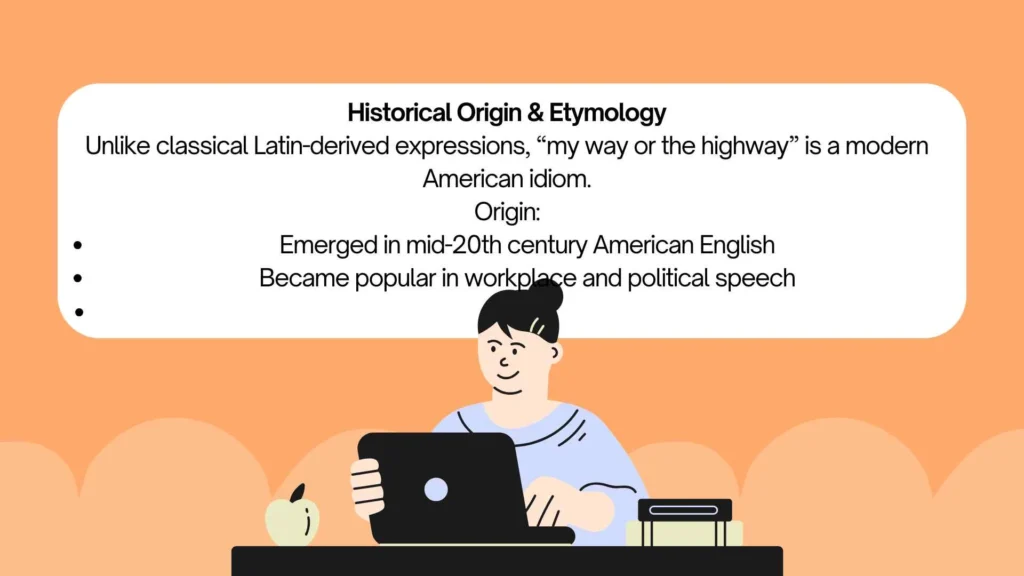
Unlike classical Latin-derived expressions, “my way or the highway” is a modern American idiom.
Origin:
- Emerged in mid-20th century American English
- Became popular in workplace and political speech
- Associated with managerial authority culture
Etymological breakdown:
- “Way” → Old English weg, meaning path or method
- “Highway” → Old English hegweg, meaning main public road
Cultural evolution:
- Originally informal speech
- Popularized in films, corporate environments, and media
- Now widely used in global English
It reflects a shift in modern English toward direct, assertive idiomatic expressions.
Pronunciation Guide
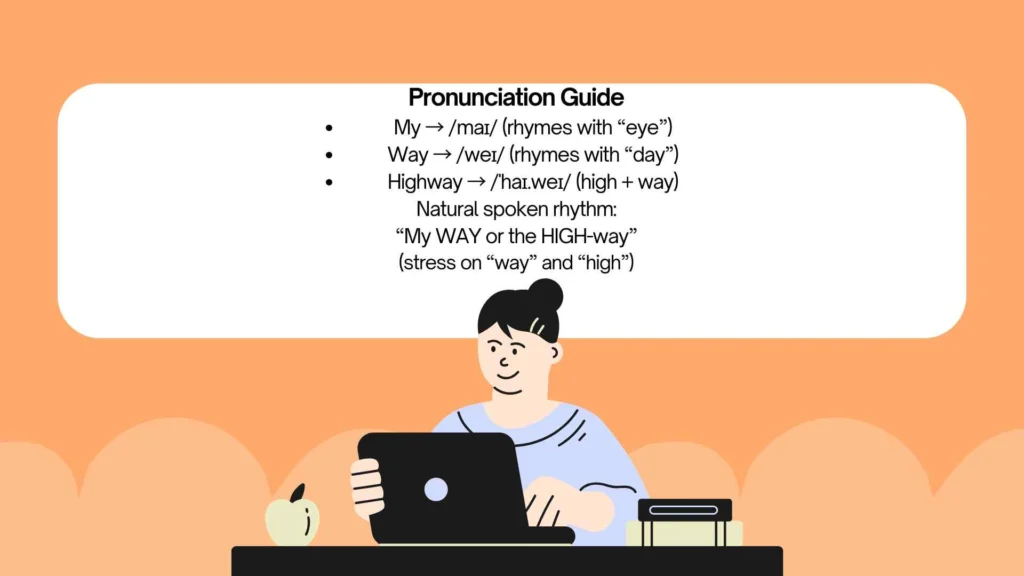
- My → /maɪ/ (rhymes with “eye”)
- Way → /weɪ/ (rhymes with “day”)
- Highway → /ˈhaɪ.weɪ/ (high + way)
Natural spoken rhythm:
“My WAY or the HIGH-way”
(stress on “way” and “high”)
The Linguistic Logic Behind the Phrase
This idiom is structurally interesting because it uses binary opposition.
Why it is powerful linguistically:
- Creates a forced choice structure
- Eliminates middle ground
- Uses rhythm and rhyme for memorability
- Relies on metaphor (highway = exit)
Communication effect:
- Establishes dominance
- Ends negotiation
- Signals final decision
In pragmatics, this is called a directive speech act, where the speaker imposes conditions on the listener.
Common Variations and Misinterpretations
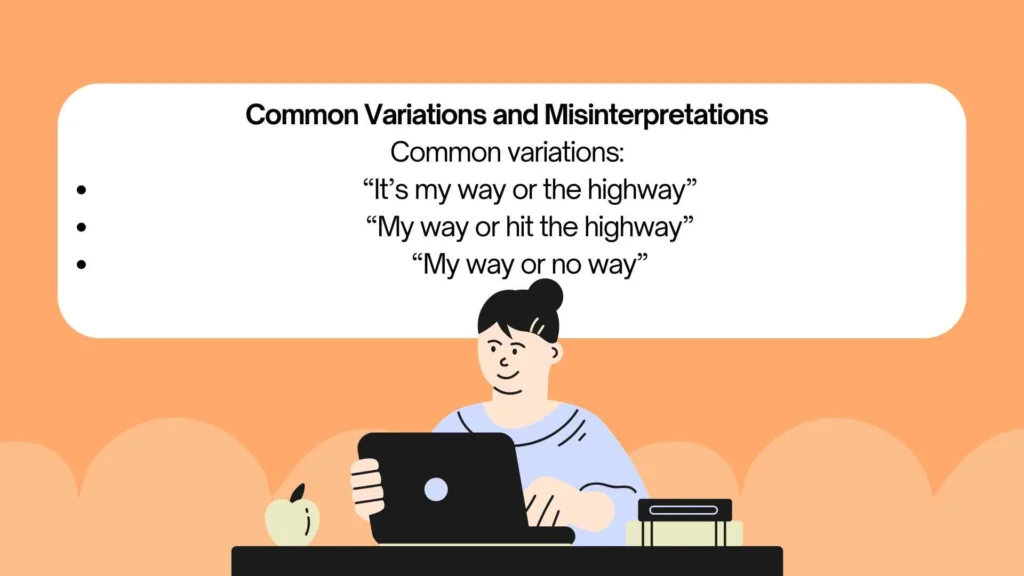
Common variations:
- “It’s my way or the highway”
- “My way or hit the highway”
- “My way or no way”
Common misunderstandings:
- Thinking it is literal transportation advice
- Assuming it always means anger (it can also be playful)
- Misinterpreting as collaborative statement (it is not)
Why confusion happens:
- Idioms are non-literal
- Cultural exposure varies
- Media exaggeration of tone
Mnemonic Devices (Memory Tricks)
To remember the meaning:
“MY WAY = stay, HIGHWAY = leave”
Or:
“No shared road—choose one road or go.”
This reinforces the idea of:
- Control vs exit
- Choice restriction
- Authority boundary
Regional Variations (US vs UK Usage)
United States:
- Very common in workplace culture
- Often used in leadership or negotiation contexts
- Can sound firm or aggressive
United Kingdom:
- Less common in formal speech
- Used more sarcastically or humorously
Other English regions:
- Globally understood due to media exposure
- Mostly informal usage everywhere
Grammar Role and Sentence Structure
Parts of speech:
- Entire phrase = idiomatic imperative construction
Structure:
- “My way” = noun phrase
- “or” = coordinating conjunction
- “the highway” = noun phrase
Function in sentence:
- Acts as a command or ultimatum
Example:
- “If you don’t agree, it’s my way or the highway.”
Synonyms and Antonyms
Synonyms:
- Take it or leave it
- My rules apply
- No compromise
- Final decision
- All or nothing
Antonyms:
- Let’s compromise
- Open discussion
- Flexible approach
- Mutual agreement
- Collaborative decision-making
Formal vs Informal Usage
Formal contexts:
Rare, but may appear in:
- Leadership speeches
- Business storytelling
- Descriptions of management style
Informal contexts:
- Daily conversation
- Movies and TV shows
- Social media posts
- Arguments or debates
Tone warning:
It can sound authoritarian or dismissive in professional environments.
Illustrative Examples
- The manager said it was my way or the highway during the meeting.
- In teamwork, “my way or the highway” rarely leads to success.
- He used a my way or the highway approach in negotiations.
- The coach’s attitude was strict: my way or the highway.
- She rejected collaboration and chose a my way or the highway stance.
- That leadership style feels too rigid and controlling.
- It’s not healthy to apply a my way or the highway mindset in relationships.
- The company adopted a flexible approach instead of my way or the highway rules.
- His tone clearly meant my way or the highway.
- They left the project after hearing the ultimatum.
- My way or the highway doesn’t work in creative teams.
- She prefers negotiation over a my way or the highway attitude.
Practice Section (15 MCQs)
1. “My way or the highway” means:
A) Travel advice
B) Strict ultimatum
C) Suggestion
D) Question
2. The phrase is:
A) Literal
B) Idiom
C) Verb
D) Adjective
3. Tone is usually:
A) Soft
B) Neutral
C) Authoritarian
D) Romantic
4. “Highway” symbolizes:
A) Success
B) Exit
C) Agreement
D) Comfort
5. Origin is mainly:
A) Latin
B) Modern American English
C) Greek
D) French
6. It allows:
A) Full compromise
B) No compromise
C) Partial agreement
D) Silence
7. It is mostly used in:
A) Formal writing only
B) Informal speech
C) Legal documents
D) Poetry only
8. The phrase structure is:
A) Question
B) Imperative idiom
C) Noun only
D) Adverb
9. Synonym is:
A) Take it or leave it
B) Maybe later
C) Always agree
D) Never decide
10. It expresses:
A) Flexibility
B) Authority
C) Confusion
D) Humor only
11. “My way” refers to:
A) Exit route
B) Preferred method
C) Road
D) Question
12. It is often seen in:
A) Media
B) Math
C) Chemistry
D) Geography
13. Opposite is:
A) No compromise
B) Collaboration
C) Order
D) Command
14. Highway symbolizes:
A) Cooperation
B) Leaving situation
C) Agreement
D) Silence
15. The phrase is best described as:
A) Literal instruction
B) Figurative ultimatum
C) Scientific term
D) Grammar rule
Answer Key:
1-B, 2-B, 3-C, 4-B, 5-B, 6-B, 7-B, 8-B, 9-A, 10-B, 11-B, 12-A, 13-B, 14-B, 15-B
Frequently Asked Questions (FAQs)
1. Is “my way or the highway” rude?
It can sound rude because it removes compromise and enforces authority.
2. Is it formal or informal?
It is mainly informal and conversational.
3. What does “highway” mean in the phrase?
It symbolizes leaving or exiting a situation.
4. Can it be used in business?
Yes, but it may sound too strict in modern collaborative workplaces.
5. Is there a softer alternative?
Yes, phrases like “let’s agree on a direction” are softer alternatives.
Conclusion
The phrase “my way or the highway” is a powerful English idiom that reflects authority and lack of compromise.
It is deeply rooted in modern American conversational language and widely understood globally.
Linguistically, it works through binary choice and metaphorical meaning.
While effective in expressing control, it can also sound rigid or aggressive.
Understanding it helps decode tone and intention in communication.
In modern usage, flexibility is often preferred over such ultimatums.
Mastering this phrase improves both language comprehension and social awareness.

Ethan Walker is a non-fiction author and thought leader who writes about personal growth, productivity, and modern life challenges. His work focuses on helping readers simplify their lives, make better decisions, and achieve meaningful success. With a clear and practical writing style, Ethan provides valuable insights that inspire positive change and long-term improvement.
📚 Books:
- The Road to Clarity
- Moments of Truth
- Breaking the Limits
 Olivia Turner