Table of Contents
- The 60-Second Answer
- Quick Comparison Table
- Deep Meanings and Definitions
- Historical Origin and Etymology
- Pronunciation Guide
- The Technical Differences Explained
- Correct Spelling and Common Typos
- Mnemonic Devices to Remember the Difference
- Regional Variations: US vs. UK vs. Everywhere Else
- Singular and Plural Forms
- Grammar Rules and Parts of Speech
- Synonyms and Antonyms
- Formal versus Informal Usage
- Illustrative Examples in Context
- Practice Section: 15 Multiple Choice Questions
- Frequently Asked Questions
- Conclusion
The 60-Second Answer
Organization and organisation are two spellings of the same word, referring to a structured group of people with a collective purpose or the act of arranging elements systematically. Organization is the standard spelling in American English, while organisation is preferred in British and Commonwealth English. Both are correct within their respective regions.
Quick Comparison Table
| Aspect | Organization (US) | Organisation (UK/Commonwealth) |
| Spelling | Uses ‘z’ (from Greek root -ize) | Uses ‘s’ (from French root -ise) |
| Primary Usage | United States, Philippines, Canada (preferred) | United Kingdom, Australia, New Zealand, Ireland |
| Meaning | Identical | Identical |
| Pronunciation | /ˌɔːrɡənəˈzeɪʃən/ | /ˌɔːɡənaɪˈzeɪʃən/ |
| Related Forms | Organized, organizing, organizer | Organised, organising, organiser |
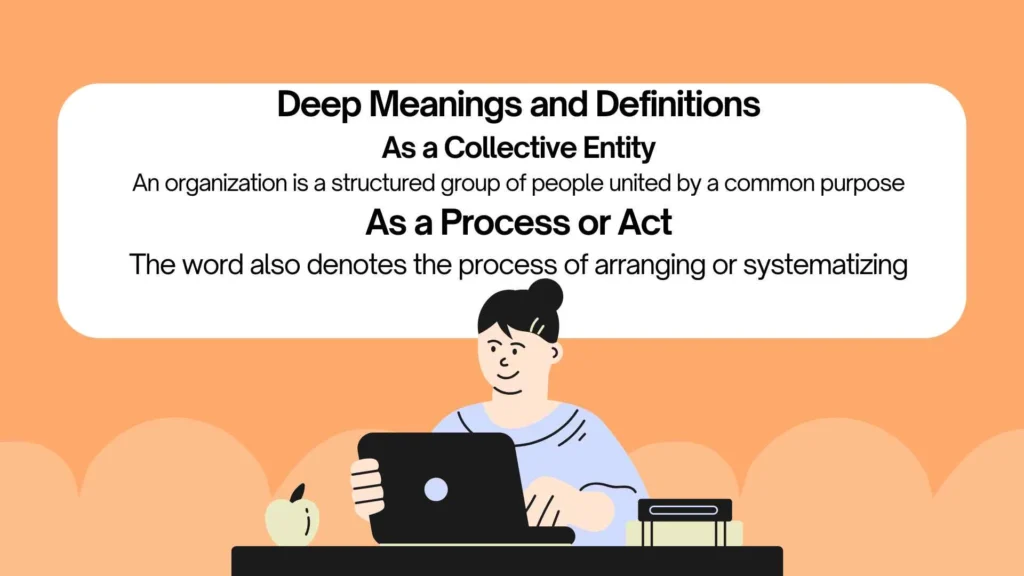
Deep Meanings and Definitions
At its core, this word carries three principal meanings that have shaped its usage across centuries.
As a Collective Entity
An organization is a structured group of people united by a common purpose. This encompasses everything from multinational corporations to local community associations. As Britannica Dictionary defines it, an organization is “a company, business, club, etc., that is formed for a particular purpose” . Religious organizations, charitable foundations, and political parties all fall under this umbrella.
As a Process or Act
The word also denotes the process of arranging or systematizing. This definition speaks to the action of bringing order to chaos, as in “the organization of her notes into an outline” . This meaning captures the dynamic aspect of organizing the deliberate effort to create structure from disorder.
As an Arranged State
Finally, organization refers to the quality of being systematically arranged. When we praise someone’s organizational skills, we acknowledge their ability to arrange things in a sensible, useful manner. This meaning extends to abstract concepts, such as “the organization of ideas in an essay” .
Organization or organisation skills
- Like a compass that always points north, strong organization or organisation skills help you stay focused on your goals.
- Like a well-packed suitcase, every task has its proper place.
- Like a skilled conductor leading an orchestra, good planning keeps everything working together.
- Like a tidy bookshelf, everything stays easy to find when it is arranged well.
- Like a clear roadmap, organized habits reduce confusion and save time.
- Like a strong bridge, these skills connect ideas with successful results.
- Like a carefully built puzzle, every small piece fits where it belongs.
- Like a reliable clock, organized people manage time with consistency.
- Like a calm river, good organization allows work to flow smoothly.
- Like a solid foundation, these skills support long-term success in school, work, and daily life.
Organization or organisation meaning
- Like a neatly labeled folder, organization or organisation means keeping things in order.
- Like arranging flowers in a vase, it creates beauty through structure.
- Like sorting puzzle pieces before building, it makes every step easier.
- Like placing books by category, it helps people find what they need quickly.
- Like building with clear blueprints, organization gives direction before action.
- Like putting ingredients in separate bowls, it prepares everything for success.
- Like a clean workspace, it reduces stress and improves focus.
- Like a balanced recipe, every part has its purpose.
- Like a traffic signal, it keeps people moving in the right direction.
- Like a map with clear landmarks, organization provides clarity instead of confusion.
Organization or organisation for company
- Like the engine of a car, organization or organisation keeps a company moving efficiently.
- Like a captain guiding a ship, it helps teams reach their destination.
- Like a strong team in a relay race, everyone knows their role.
- Like a carefully planned garden, every department grows in the right place.
- Like a secure lock, good organization protects important business information.
- Like a game plan before a match, it prepares employees for success.
- Like a network of roads, it connects different business functions.
- Like a balanced scale, it keeps work fairly distributed.
- Like a lighthouse during a storm, it guides businesses through challenges.
- Like a dependable machine, organized systems reduce delays and mistakes.
World Health organization or Organisation
- Like a global safety net, the World Health organization or Organisation supports countries during health challenges.
- Like a trusted doctor, it offers expert health guidance.
- Like a bright beacon, it shares reliable information during emergencies.
- Like a bridge between nations, it encourages international cooperation.
- Like an umbrella in heavy rain, it provides protection through public health efforts.
- Like a teacher in a classroom, it helps people understand health risks.
- Like a skilled firefighter, it responds quickly to many health emergencies.
- Like a watchtower, it monitors diseases around the world.
- Like a helpful neighbor, it supports communities in difficult times.
- Like a shared toolbox, it provides valuable health resources for countries.
Organization or organisation pronunciation
- Like learning the tune of a new song, mastering organization or organisation pronunciation becomes easier with practice.
- Like repeating a favorite phrase, confidence grows with every attempt.
- Like following dance steps, correct pronunciation comes from steady practice.
- Like listening to an experienced guide, hearing native speakers improves accuracy.
- Like practicing a musical instrument, every repetition builds skill.
- Like reading aloud every day, speaking clearly becomes more natural.
- Like tracing letters while learning to write, careful practice develops confidence.
- Like matching puzzle pieces, each syllable fits together smoothly.
- Like warming up before exercise, pronunciation improves with regular use.
- Like riding a bicycle, correct pronunciation feels natural after enough practice.
Organization or organisation reddit
- Like sitting around a community table, Organization or organisation reddit discussions bring together many opinions.
- Like browsing a busy library, users can find different experiences and ideas.
- Like joining a group conversation, everyone shares personal insights.
- Like exploring many paths in a park, different threads lead to different answers.
- Like asking neighbors for advice, Reddit users often offer practical suggestions.
- Like opening a collection of journals, every post shares a unique perspective.
- Like attending an open forum, people freely exchange ideas.
- Like watching a panel discussion, multiple viewpoints appear in one place.
- Like exploring a treasure chest, useful tips often hide among many comments.
- Like following footprints through a forest, older discussions can still guide new readers.
Organization or organisation grammar
- Like choosing between color and colour, organization or organisation grammar depends on regional English.
- Like wearing different uniforms for the same team, both spellings serve the same purpose.
- Like two roads leading to one town, each spelling reaches the same meaning.
- Like using different accents for the same language, both forms are correct in the right region.
- Like selecting the right key for a lock, consistency matters more than preference.
- Like following local traffic rules, grammar should match your audience.
- Like using different currencies abroad, each spelling belongs to a different English standard.
- Like reading two editions of the same book, the meaning remains unchanged.
- Like speaking with local customs, spelling should fit regional expectations.
- Like choosing the proper uniform for an event, use one spelling consistently throughout your writing.
Organization or organisation chart
- Like a family tree, an organization or organisation chart shows relationships between roles.
- Like a roadmap for a business, it explains how departments connect.
- Like the branches of a tree, each level grows from a central structure.
- Like a building blueprint, it shows where every position belongs.
- Like a ladder, it displays different levels of responsibility.
- Like a train with connected cars, every role links to another.
- Like a classroom seating chart, it helps everyone understand where they fit.
- Like a spider web, every connection supports the whole structure.
- Like a city map, it makes navigation through the company much easier.
- Like a chain of teamwork, it clearly shows reporting relationships and responsibilities.
Historical Origin and Etymology
The journey of this word from ancient Greek to modern English reveals much about its dual spelling. The word traces back to the Greek organon, meaning “tool,” “instrument,” or even “musical instrument” . This root reflects the fundamental concept of an organization as a tool for achieving collective goals.
The word entered English through a fascinating linguistic pipeline. It first appeared in late Middle English around 1375–1425 as organizacion, borrowed from Medieval Latin organizātiō. The Latin term derived from organizāre, meaning “to contrive” or “to arrange” . The Old French verb organiser further cemented the word’s place in European languages, meaning “to combine into an orderly whole” .
The spelling divergence emerged primarily during the early American period. As American colonists developed their own dialects and speech patterns, they naturally began diverging from British norms. More significantly, early American dictionary editors, including Noah Webster, deliberately “Americanized” certain spellings by preferring ‘z’ over ‘s’ in words like organize . This was part of a broader movement to establish a distinct American linguistic identity, separating the newly independent nation from its British colonial past.
Pronunciation Guide
The pronunciation of this word varies subtly between American and British English, though both are easily understood on both sides of the Atlantic.
American English
Phonetic spelling: /ˌɔːrɡənəˈzeɪʃən/
- First syllable rhymes with “or”
- The ‘z’ sound is pronounced clearly, like the ‘z’ in “zero”
- Stress falls on the fourth syllable: or-guh-nuh-ZAY-shun
British English
Phonetic spelling: /ˌɔːɡənaɪˈzeɪʃən/
- First syllable rhymes with “or” or “aw”
- The ‘s’ is pronounced as a soft ‘z’ sound in many British pronunciations
- Stress falls on the fourth syllable: aw-guh-nye-ZAY-shun
In both varieties, the word has four syllables: OR-gan-i-ZA-tion (American) or AW-gan-i-ZA-tion (British). The primary difference lies in the vowel sounds and the subtle quality of the middle consonants.
The Technical Differences Explained
The confusion between these two spellings stems from a fundamental linguistic principle: English spelling isn’t always phonetically consistent. Both spellings represent the same sounds but follow different orthographic traditions.
The ‘z’ spelling, organization, aligns with words derived from Greek roots where -ize is the standard suffix. This is why we have realize, prioritize, and categorize in American English—all using the Greek-derived ‘-ize’ ending. American English preserves this etymological consistency .
The ‘s’ spelling, organisation, reflects the French influence on British English. Many words entered English through Norman French, where -ise was the conventional ending. This pattern continues in British English with words like realise, prioritise, and categorise .
The key insight is that both spellings are technically correct. The choice depends entirely on your audience and the regional standard you follow. Using “organization” in a British publication would be considered a minor error, while “organisation” in an American context would similarly stand out as non-standard.
Correct Spelling and Common Typos
Despite the regional differences, certain misspellings are universally recognized as errors.
Most Common Typos
- Organzation – Missing the ‘i’ after ‘z’
- Orgnization – Missing the ‘a’ after ‘g’
- Organiztion – Missing the ‘a’ before ‘tion’
- Organisation – In American contexts, this is a regional variant, not a typo (but may be marked as such)
- Organazation – Using ‘a’ instead of ‘i’ in the suffix
These errors typically occur because:
- The word has multiple syllables, making it easy to drop vowels
- The ‘-ization’ suffix is long and contains similar-looking letters
- Typing quickly leads to omitted letters, especially vowels in unstressed syllables
The Ultimate Rule
- Use organization for American audiences
- Use organisation for British, Australian, New Zealand, and most Commonwealth audiences
- In international settings, consistency matters more than which spelling you choose
Mnemonic Devices to Remember the Difference
For American English Users
“Z is for America” – The United States, along with countries like the Philippines and Canada (mostly), uses the ‘z’ spelling. Remember that the American flag has stars, and “stars” contains a ‘z’ sound in some accents—or simply, “Z for USA.”
For British/Commonwealth Users
“S is for the Queen’s English” – The British preference for ‘s’ connects to many other words where UK spelling differs from US: realise, prioritise, categorise. If you remember one, you remember them all.
The Universal Memory Trick
“An organization organizes, while an organisation organises” – This shows the spelling relationship to the verb form. If you know which version of the verb you use, the noun follows the same pattern.
Regional Variations (US vs. UK English)
United States
Standard: organization
- Used exclusively in formal and informal writing
- Required by all major US style guides (AP, Chicago, MLA)
- Pronunciation: /ˌɔːrɡənəˈzeɪʃən/
United Kingdom
Standard: organisation
- Official spelling in government and education
- Used in most British publications
- Pronunciation: /ˌɔːɡənaɪˈzeɪʃən/
Canada
Preference: organization (approximately 86% usage)
- Officially follows British spelling conventions but heavily influenced by American proximity
- Many Canadian organizations use “organization” in practice
- Government documents may use either, depending on audience
Australia and New Zealand
Strong preference: organisation (approximately 71% and 63% respectively)
- Follows British spelling traditions
- Used in all official and educational contexts
- American spelling may appear in business contexts with US connections
India and Other Commonwealth Nations
Mixed usage
- India shows a 53% preference for “organisation”
- Many former British colonies maintain UK spelling traditions
- Increasing American influence due to global business and technology
Singular and Plural Forms
Regular Plural
- Singular: organization / organisation
- Plural: organizations / organisations
Both spellings follow standard English pluralization rules by adding an ‘s’.
Examples:
- “The organization has 500 members.”
- “Several organizations have joined the initiative.”
Possessive Forms
Singular Possessive: organization’s / organisation’s
- Used when something belongs to a single organization
- Example: “The organization’s mission is to protect the environment.”
Plural Possessive: organizations’ / organisations’
- Used when something belongs to multiple organizations
- Example: “The organizations’ collaborative efforts have been successful.”
Important note: When the plural ends in ‘s’ (as both do), the possessive uses only an apostrophe, not an apostrophe plus ‘s’.
Grammar Rules and Parts of Speech
As a Noun
Primary usage: A noun that can function as both a countable and uncountable noun .
Countable noun: Referring to a specific entity
- “She works for a non-profit organization.”
- “There are many organizations in this sector.”
Uncountable noun: Referring to the abstract concept of arranging
- “The organization of this report is excellent.”
- “He has a natural talent for organization.”
Related Parts of Speech
- Verb: organize / organise (to arrange or form)
- Adjective: organizational / organisational (relating to organization)
- Adverb: organizationally / organisationally (in an organizational manner)
- Agent Noun: organizer / organiser (a person who organizes)
Example sentences showing parts of speech:
- “The organization (noun) hired a professional organizer (noun) to improve its organizational (adjective) structure.”
- “Her organizational (adjective) skills are organizationally (adverb) beneficial to the team.”
Synonyms and Antonyms
Synonyms for Organization (as a group)
- Association
- Company
- Corporation
- Institution
- Federation
- Alliance
- Coalition
- Body
- Group
- Agency
Synonyms for Organization (as a system)
- Structure
- Arrangement
- System
- Order
- Classification
- Coordination
- Method
- Plan
- Scheme
- Framework
Antonyms
- Chaos
- Disorder
- Disorganization
- Confusion
- Disarray
- Turmoil
- Anarchy
- Randomness
Example using contrast:
“The organization of the files brought order to what had been chaos and confusion.”
Formal versus Informal Usage
Formal Contexts
- Business documents: Use your region’s standard spelling consistently
- Academic writing: Follow your institution’s style guide
- Government publications: Use the official spelling of your country
- International communication: Consider your audience’s preference
Example (Formal):
“The organization hereby certifies that all financial statements are accurate and complete.”
Informal Contexts
- Social media: Either spelling is acceptable, though regional preference persists
- Personal emails: Use what feels natural to you
- Casual writing: Consistency matters more than which spelling you choose
Example (Informal):
“Hey, I’m starting a new organization to clean up the park—wanna join?”
The Professional Guideline
Always match your spelling to your audience. If you’re writing for an American publication, use “organization.” If you’re writing for a British publication, use “organisation.” In international settings, pick one and remain consistent throughout your document.
Illustrative Examples in Context
Business and Corporate
- “The multinational organization has offices in 45 countries and employs over 15,000 people worldwide.”
- “After months of planning, the organisation announced its merger with a rival firm, creating a formidable market presence.”
Non-Profit and Charitable
- “She founded a charitable organization dedicated to providing clean water to remote villages in sub-Saharan Africa.”
- “The organisation has been instrumental in raising awareness about climate change through grassroots campaigns.”
Academic and Educational
- “The organization of this research paper is exceptional, guiding the reader smoothly through complex arguments.”
- “University students benefit greatly from joining academic organisations that connect them with professionals in their field.”
Everyday Usage
- “I admire my sister’s organization skills her closet is color-coded and perfectly arranged.”
- “Could you help me with the organisation of the fundraising event? I’m struggling to coordinate everything.”
International Contexts
- “The United Nations is perhaps the world’s most recognized international organization.”
- “Our organisation works closely with the World Health Organisation on pandemic preparedness initiatives.”
Possessive Forms
- “The organization’s board of directors approved the new strategic plan unanimously.”
- “All participating organisations’ representatives attended the conference in Geneva.”
Practice Section: 15 Multiple Choice Questions
1. Which spelling is standard in American English?
- A. Organisation
- B. Organization
- C. Organazation
- D. Orgnization
2. The word ‘organization’ derives from which Greek root?
- A. Organismos
- B. Organon
- C. Organikos
- D. Organesis
3. Which plural form is correct for both spellings?
- A. Organizationes
- B. Organisations
- C. Organizations
- D. Both B and C are correct
4. Which country strongly prefers ‘organisation’ over ‘organization’?
- A. United States
- B. Canada
- C. Philippines
- D. United Kingdom
5. What is the possessive form of the plural ‘organizations’?
- A. Organization’s
- B. Organizations’
- C. Organizations’s
- D. Organizations
6. In Canadian English, which spelling is more common?
- A. Organisation
- B. Organization
- C. Both are equally common
- D. Neither is standard
7. Which word is NOT a synonym for ‘organization’ as a group?
- A. Association
- B. Institution
- C. Chaos
- D. Federation
8. What is the verb form of ‘organization’?
- A. Organizate
- B. Organize
- C. Organition
- D. Organalize
9. Which shows correct British English spelling?
- A. The organization’s strategy
- B. The organisation’s strategy
- C. The organiztion’s strategy
- D. The organisation’s strategie
10. The adjective form of ‘organisation’ is:
- A. Organisational
- B. Organizational
- C. Organised
- D. Both A and B are correct
11. In Australian English, which spelling is preferred?
- A. Organisation
- B. Organization
- C. Both are equally acceptable
- D. Neither is used
12. What does ‘organization’ mean when used uncountably?
- A. A group of people
- B. The act of arranging
- C. A business entity
- D. A type of institution
13. Which is a common typo for this word?
- A. Organisation
- B. Organization
- C. Organzation
- D. All of the above
14. What is the plural possessive form of ‘organisation’?
- A. Organisation’s
- B. Organisations’
- C. Organisations’s
- D. Organisationes’
15. Which statement about the two spellings is TRUE?
- A. They have different meanings
- B. They are pronounced differently
- C. They are both correct in their respective regions
- D. One spelling is always wrong
Answer Key
- B
- B
- D
- D
- B
- B
- C
- B
- B
- D
- A
- B
- C
- B
- C
Frequently Asked Questions
Is ‘organization’ or ‘organisation’ the correct spelling?
Answer: Both are correct. ‘Organization’ is the standard in American English, while ‘organisation’ is preferred in British and Commonwealth English. The choice depends on your audience and location. Neither is intrinsically wrong—they simply follow different regional conventions .
Why does American English use ‘z’ while British English uses ‘s’?
Answer: This difference stems from early American dictionary editors who deliberately simplified and “Americanized” certain spellings to distinguish American from British English. Noah Webster, in particular, advocated for ‘-ize’ endings over ‘-ise,’ which he saw as more etymologically consistent with Greek roots. The British retained the French-influenced ‘-ise’ spellings .
Can I use both spellings in the same document?
Answer: You should avoid using both in a single document. Consistency is key in professional writing. Choose one spelling based on your audience and stick with it throughout your text. Mixing them can make your writing appear careless or confused about which regional standard you’re following.
Which spelling should I use in Canada?
Answer: Canadian English officially follows British spelling conventions, but American influence is strong. In practice, ‘organization’ is more common in Canada (approximately 86% usage) due to proximity to the United States. Government documents and formal writing may use either, but ‘organization’ is increasingly preferred .
Does the pronunciation differ between the two spellings?
Answer: There are subtle pronunciation differences between American and British English, but they are not directly tied to the ‘z’ versus ‘s’ spelling. Both spellings represent the same word, and any pronunciation variation is regional, not orthographic. The ‘z’ is pronounced as ‘z’ in American English, while the ‘s’ in British English is often pronounced as a soft ‘z’ sound in this position .
What is the full meaning of organization?
The full meaning of organization is a structured group of people who work together to achieve a common goal. It can also refer to the process of arranging people, tasks, or resources in an organized and efficient way.
How do you spell organisation in the US?
In the United States, organisation is spelled organization with the letter “z” instead of “s.” Both spellings are correct, but organization is the standard American English form, while organisation is commonly used in British English.
Which is correct an organisation or an organisation?
An organisation is the correct phrase because the word organisation begins with a vowel sound, so the article “an” is used. This follows standard English grammar rules in both British and American English.
What are the 4 types of organization?
The four common types of organization are functional, divisional, matrix, and flat organizations. Each structure organizes employees differently based on roles, products, projects, or management style to improve efficiency and achieve business goals.
What are the 4 pillars of organization?
The four pillars of organization are commonly considered to be planning, structure, communication, and accountability. Together, these pillars help teams stay organized, improve productivity, and work toward shared objectives effectively.
What are the 5 best types of organizational structure?
The five widely used types of organizational structure are functional, divisional, matrix, flat, and hierarchical structures. Each offers unique advantages depending on a company’s size, goals, and management approach, helping businesses operate more efficiently.
Conclusion
The choice between “organization” and “organisation” is far more than a simple spelling preference it reflects centuries of linguistic evolution, cultural identity, and the fascinating divergence of English across the globe. Both spellings carry the same rich meaning, rooted in the Greek concept of an instrument or tool for achieving collective goals.
Whether you write “organization” for American audiences or “organisation” for British readers, the key is consistency and audience awareness. In our increasingly globalized world, understanding these regional differences demonstrates linguistic sophistication and cultural sensitivity.
Remember the simple rule: Z is for America, S is for the Queen’s English. And if all else fails, pick one, stick with it, and write with confidence. After all, what matters most is not the spelling but the clarity and quality of your communication. The power of an organization lies not in how you spell it, but in what you accomplish together.

Ethan Walker is a non-fiction author and thought leader who writes about personal growth, productivity, and modern life challenges. His work focuses on helping readers simplify their lives, make better decisions, and achieve meaningful success. With a clear and practical writing style, Ethan provides valuable insights that inspire positive change and long-term improvement.
📚 Books:
- The Road to Clarity
- Moments of Truth
- Breaking the Limits
 Olivia Turner