Table of Contents
- Introduction
- Direct Answer: What is the Difference Between Their and They’re?
- Quick Comparison Table
- Deep Meanings & Definitions
- Historical Origin & Etymology
- Pronunciation Guide
- The Technical Differences
- Correct Spelling & Common Typos
- Mnemonic Devices (Memory Tricks)
- Regional Variations (US vs. UK English)
- Singular and Plural Forms
- Grammar Rules & Parts of Speech
- Synonyms and Antonyms
- Formal vs. Informal Usage
- Illustrative Examples
- Practice Section (15 MCQs)
- Frequently Asked Questions (FAQs)
- Conclusion
Introduction
I have spent years grading essays, editing manuscripts, and coaching writers, and if there is one grammatical pitfall that consistently trips up even the most educated professionals, it is the confusion between their or they’re. It is a deceptively simple error that can undermine your credibility in an instant, whether you are drafting a business proposal, posting on social media, or writing a college application essay. Mastering this distinction is not just about following arbitrary rules; it is about communicating with clarity and precision. In this comprehensive guide, I will dissect every nuance of these homophones, from their etymological roots to their practical applications, ensuring you never second-guess yourself again.
Direct Answer
Their is a possessive determiner indicating ownership or belonging, meaning “belonging to them.” They’re is a contraction of “they are.” The apostrophe in “they’re” signals the omission of the letter ‘a.’ If you can substitute “they are” in a sentence, use “they’re”; otherwise, use “their.”
Quick Comparison Table
| Feature | Their | They’re |
| Spelling | T-H-E-I-R | T-H-E-Y-‘-R-E |
| Meaning | Belonging to them | They are |
| Core Usage | Possessive adjective | Contraction |
| Part of Speech | Determiner (Possessive) | Contraction (Pronoun + Verb) |
| Can Substitute? | No | Yes, with “they are” |
Deep Meanings & Definitions
Understanding the distinct roles of their or they’re requires recognizing their fundamentally different grammatical functions.
Their is a possessive determiner, also known as a possessive adjective. It is used to indicate that something belongs to or is associated with a group of people, animals, or things previously mentioned or easily identified. It is the third-person plural possessive form. For example, in the sentence “The students submitted their assignments,” the word ‘their’ signals that the assignments belong to the students.
They’re is a contraction, a shortened form of two words: the pronoun they and the verb are. The apostrophe replaces the letter ‘a’ from “are.” This is a purely grammatical abbreviation used in informal and formal writing alike to make sentences more concise and conversational. For instance, “They’re going to the cinema” is simply a shortened version of “They are going to the cinema.”
Historical Origin & Etymology
Tracing the history of their or they’re reveals a fascinating story of linguistic evolution and the standardization of English.
Their comes from the Old Norse word þeirra (pronounced “thayr-ah”), meaning “of them.” The Norse influence on English came through Viking invasions and settlements in the British Isles during the 8th to 11th centuries. Before this, Old English used the word hira for the same purpose. Over time, the Norse þeirra replaced the native term. The spelling evolved through Middle English forms like thair, thar, and theire before settling on the modern “their” around the 15th century.
They’re is a much more recent invention. The contraction “they’re” emerged in the 16th century as English speakers began contracting common verb phrases to speed up speech and writing. It follows the pattern of other contractions like “we’re” (we are) and “you’re” (you are). The apostrophe was introduced to mark the missing letter ‘a’. The pronoun “they” itself comes from the same Old Norse root þeir, which replaced the Old English hīe.
Pronunciation Guide
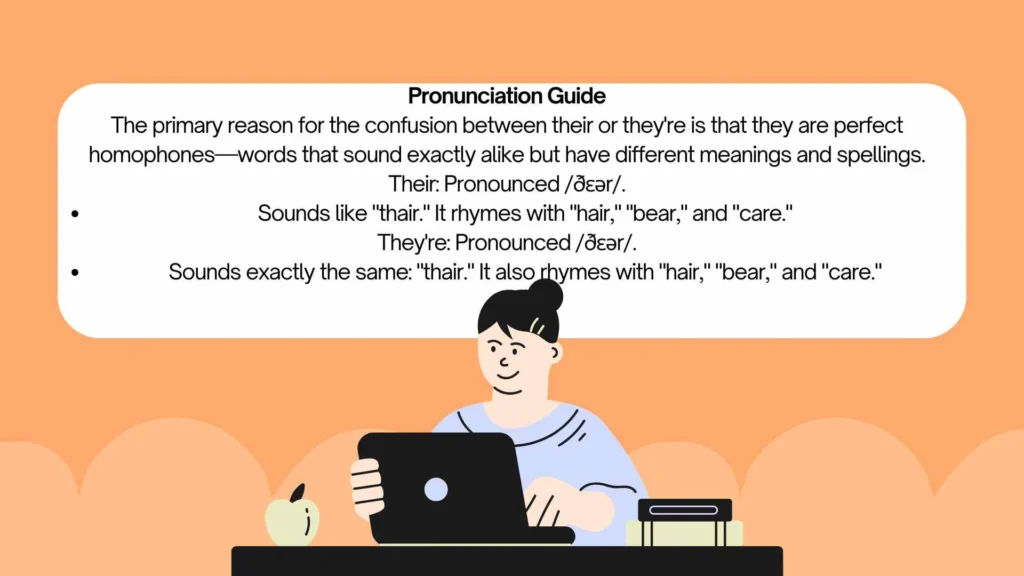
The primary reason for the confusion between their or they’re is that they are perfect homophones—words that sound exactly alike but have different meanings and spellings.
Their: Pronounced /ðɛər/.
- Sounds like “thair.” It rhymes with “hair,” “bear,” and “care.”
They’re: Pronounced /ðɛər/.
- Sounds exactly the same: “thair.” It also rhymes with “hair,” “bear,” and “care.”
There (the third member of this homophone trio) is also pronounced /ðɛər/. This triple homophony is the root of all the confusion. The only way to distinguish them in spoken English is through context.
The Technical Differences
The confusion between their or they’re is a classic example of a grammatical error driven by phonetic similarity rather than conceptual misunderstanding. Here is the linguistic logic behind the correct usage.
- Functional Load: Linguists refer to the “functional load” of a language—the importance of certain distinctions for clear communication. The distinction between their and they’re carries a high functional load because confusing them can obscure meaning. For example, “Their going” is nonsensical, while “They’re going” is a complete thought.
- Apostrophe Rules: The apostrophe in they’re performs a critical grammatical function: it indicates omission. This is the same rule that governs contractions like don’t (do not), can’t (cannot), and it’s (it is). The most common error occurs when writers treat the apostrophe as a tool for making words plural (the “greengrocer’s apostrophe”) or forget its purpose entirely.
- Possessive Logic: The word their does not have an apostrophe because it is already a possessive pronoun. In English, possessive pronouns and determiners (my, your, his, her, its, our, their) never take apostrophes. This is a consistent rule that distinguishes them from possessive nouns (e.g., “the dog’s bone”).
Correct Spelling & Common Typos
While the spelling of their or they’re is straightforward, the misuse stems from cognitive slips rather than spelling errors.
Correct Spelling:
- Their
- They’re
Common Typos and Misuses:
- Using “their” instead of “they’re”:
- Incorrect: “Their going to the store.”
- Correct: “They’re going to the store.”
- Using “they’re” instead of “their”:
- Incorrect: “The students submitted they’re homework.”
- Correct: “The students submitted their homework.”
- Misplacing the apostrophe:
- Incorrect: “Theyr’e” or “Theire”
- Correct: “They’re”
The most frequent mistake occurs when writers type quickly and rely on autocorrect. Since both words are correctly spelled, spell-checkers will not flag the error. This is why understanding the rule is more important than memorizing the spelling.
Mnemonic Devices (Memory Tricks)
To never forget the difference between their or they’re again, use these simple and effective memory tricks.
- The “They Are” Test: This is the most reliable method. If you can replace the word with “they are” and the sentence still makes sense, use they’re. If not, use their. For example, “They’re (they are) my friends” works, but “Their (they are) car” does not.
- The “I” in “Their”: Remember that their has the word “heir” in it. An heir is someone who inherits something. Therefore, their is about ownership or belonging. The “I” in “their” can stand for “Inheritance” or “Identity.”
- The Apostrophe is a Flag: Think of the apostrophe in they’re as a flag that signals something is missing—specifically, the letter ‘a’. It is a contraction, a shortcut. If you see an apostrophe, ask yourself, “What is missing?”
Regional Variations (US vs. UK English)
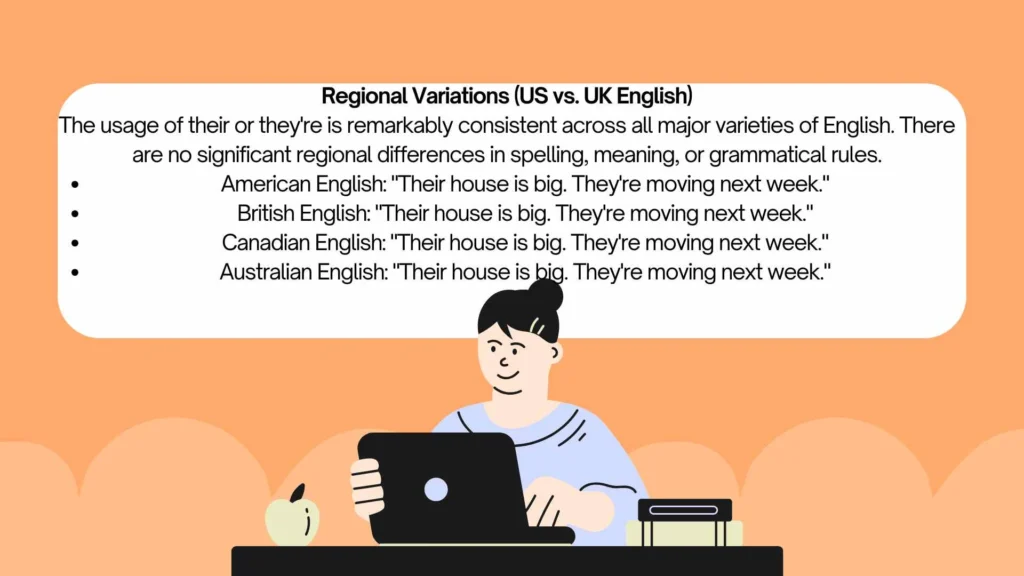
The usage of their or they’re is remarkably consistent across all major varieties of English. There are no significant regional differences in spelling, meaning, or grammatical rules.
- American English: “Their house is big. They’re moving next week.”
- British English: “Their house is big. They’re moving next week.”
- Canadian English: “Their house is big. They’re moving next week.”
- Australian English: “Their house is big. They’re moving next week.”
The only minor distinction lies in the pronunciation of the vowel sound. In British Received Pronunciation (RP), the vowel /ɛə/ is pronounced with a more open mouth, while in American English, it is often rhotic (with a pronounced ‘r’ sound). However, both are considered homophones within their respective dialects.
Singular and Plural Forms
The words their and they’re have unique grammatical properties regarding number.
Their:
- Itself: Their is already plural in reference. It refers to a group of people.
- Singular “They”: In recent years, the singular they has gained widespread acceptance for referring to a single person whose gender is unknown or non-binary. In this case, their is used as a singular possessive: “Every student should bring their laptop.”
- Possessive Form: Since their is already a possessive, it does not take an apostrophe to indicate possession. It is the possessive form.
They’re:
- Itself: They’re is a contraction of “they are,” which is already plural in form (though, as noted, “they” can be used as a singular pronoun).
- No Possessive Form: Because it is a contraction of a pronoun and a verb, they’re cannot be used as a possessive.
Grammar Rules & Parts of Speech
Understanding the parts of speech of their or they’re is essential for correct usage.
Their:
- Part of Speech: Possessive determiner (or possessive adjective).
- Role in Sentence: It modifies a noun, indicating ownership. It always appears directly before the noun it modifies.
- Example: “Their project was impressive.” (Here, ‘their’ modifies ‘project’.)
- Related Words: My, your, his, her, its, our.
They’re:
- Part of Speech: Contraction (pronoun + verb).
- Role in Sentence: It functions as the subject and verb of a clause. It is always followed by an adjective, a noun phrase, or a verb in the -ing form.
- Example: “They’re working hard.” (Here, ‘they’re’ functions as the subject and verb.)
- Expanded Form: They are.
Synonyms and Antonyms
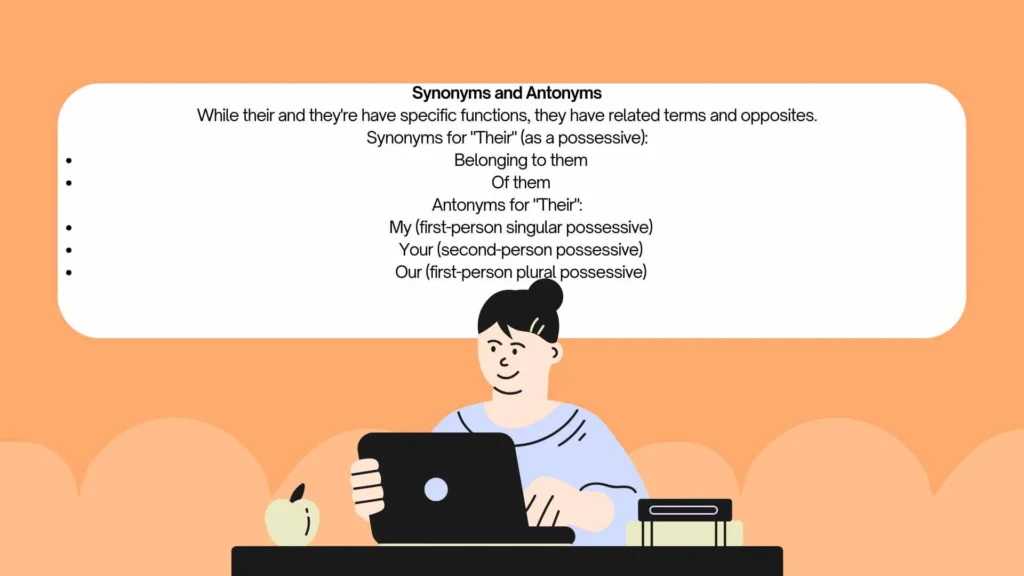
While their and they’re have specific functions, they have related terms and opposites.
Synonyms for “Their” (as a possessive):
- Belonging to them
- Of them
Antonyms for “Their”:
- My (first-person singular possessive)
- Your (second-person possessive)
- Our (first-person plural possessive)
Synonyms for “They’re” (as a contraction):
- They are (expanded form)
Antonyms for “They’re”:
- There is no direct antonym for “they are,” but conceptually, it could be contrasted with “we are” or “I am” if referring to a different group.
Formal vs. Informal Usage
One of the fascinating aspects of their or they’re is that their appropriateness varies slightly across different contexts.
In Formal Contexts (Academic Papers, Business Reports, Legal Documents):
- Their is universally accepted and frequently used. It is the standard way to indicate plural possession.
- Example: “The researchers presented their findings.”
- They’re is generally accepted but often considered too casual for highly formal documents. In academic or legal writing, contractions are often avoided altogether. Therefore, writers will use “they are” instead of they’re.
- Formal: “They are expected to attend.”
- Informal: “They’re expected to attend.”
In Informal Contexts (Emails, Social Media, Fiction):
- Their is used as usual.
- They’re is preferred because it sounds more natural and conversational. It is the norm in everyday writing and speech.
- Example: “They’re coming over for dinner.”
Illustrative Examples
Here are 12 diverse examples to solidify your understanding of their or they’re.
- The employees submitted their reports before the deadline.
- They’re planning a surprise party for the manager.
- The children put away their toys after playing.
- I think they’re going to win the championship this year.
- The students were proud of their achievements.
- They’re the most talented musicians I have ever heard.
- The birds returned to their nests at sunset.
- If they’re not here by noon, we will leave without them.
- The team celebrated their victory with enthusiasm.
- They’re convinced that the new policy will be effective.
- The neighbors have painted their house a bright blue color.
- When they’re finished with the project, they will present it to the board.
Practice Section (15 MCQs)
Test your knowledge with these multiple-choice questions.
- The board members expressed ____ opinions on the matter.
- a) their
- b) they’re
- c) there
- ____ going to announce the results tomorrow morning.
- a) Their
- b) They’re
- c) There
- The engineers submitted ____ final designs for approval.
- a) their
- b) they’re
- c) there
- I suspect ____ not telling the whole truth.
- a) their
- b) they’re
- c) there
- The guests have arrived, and ____ ready to be seated.
- a) their
- b) they’re
- c) there
- The team members were proud of ____ collective effort.
- a) their
- b) they’re
- c) there
- ____ the ones who broke the record, not us.
- a) Their
- b) They’re
- c) There
- The students asked if ____ could have an extension.
- a) their
- b) they’re
- c) there
- The committee has made ____ decision final.
- a) their
- b) they’re
- c) there
- If ____ coming, they should RSVP by Friday.
- a) their
- b) they’re
- c) there
- The dogs wagged ____ tails excitedly.
- a) their
- b) they’re
- c) there
- ____ going to need more resources to complete the task.
- a) Their
- b) They’re
- c) There
- The authors dedicated ____ book to their mentor.
- a) their
- b) they’re
- c) there
- I believe ____ already aware of the situation.
- a) their
- b) they’re
- c) there
- The managers updated ____ staff on the new policies.
- a) their
- b) they’re
- c) there
Answer Key:
- a
- b
- a
- b
- b
- a
- b
- b
- a
- b
- a
- b
- a
- b
- a
Frequently Asked Questions (FAQs)
Q1: Is “their” used for singular or plural?
A1: Their is traditionally used for plural antecedents. However, it is also widely accepted as a singular pronoun to refer to a person of unspecified gender, as in “Every student should bring their laptop.”
Q2: Is “they’re” considered proper English?
A2: Yes, they’re is perfectly proper English. It is a standard contraction of “they are.” While it is sometimes avoided in the most formal academic writing, it is widely used in business, journalism, and everyday communication.
Q3: How do I know when to use “their” instead of “they’re”?
A3: Use the substitution test. If you can replace the word with “they are” and the sentence makes sense, use they’re. If not, use their. For example, “Their car is red” cannot be changed to “They are car,” so ‘their’ is correct.
Q4: Why are “their” and “they’re” so often confused?
A4: They are perfect homophones, meaning they sound identical in spoken English. This phonetic overlap leads to cognitive errors when writers transcribe speech to text or write quickly without pausing to consider grammar.
Q5: Is “they’re” the same as “there”?
A5: No. There refers to a place or is used as an expletive (“There is a book”). They’re is a contraction of “they are.” They are homophones (sound the same) but have entirely different meanings.
Conclusion
I hope this comprehensive exploration has demystified the confusion between their or they’re. Remember, the key to mastery lies in understanding their distinct roles: one is a possessive determiner indicating ownership, and the other is a contraction of “they are.” By applying the simple “they are” substitution test and internalizing the memory tricks provided, you can eliminate this common error from your writing forever. Whether you are crafting a professional email or a creative story, using these words correctly will enhance your credibility and ensure your message is received with clarity and confidence.

Olivia Turner is a lifestyle and contemporary romance writer who focuses on positivity and everyday inspiration. Her stories are light, relatable, and filled with warmth, making them perfect for readers looking for uplifting content. Olivia draws inspiration from daily life and simple joyful moments.
📚 Books:
- Love & Coffee
- Chasing Happiness
- Moments That Matter
 Ethan Walker