Table of Contents
- Introduction
- Direct Answer: Meaning of “Through” vs “Thru”
- Quick Comparison Table
- Deep Meanings & Definitions
- Historical Origin & Etymology
- Pronunciation Guide
- The Technical Differences
- Correct Spelling & Common Typos
- Mnemonic Devices (Memory Tricks)
- Regional Variations (US vs UK English)
- Singular and Plural Forms
- Grammar Rules & Parts of Speech
- Synonyms and Antonyms
- Formal vs Informal Usage
- Illustrative Examples
- Practice Section (15 MCQs)
- Frequently Asked Questions (FAQs)
- Conclusion
Introduction
I often notice people second-guessing themselves when they write “through” or “thru”, especially in texting, emails, or professional writing. It looks like a simple spelling choice, but it actually carries strong implications about tone, formality, and linguistic evolution.
In modern English, both forms exist—but they are not equal. One is standard, while the other is stylistic and informal.
Understanding when and how to use each version can improve your writing clarity, professionalism, and even SEO performance if you’re creating content online.
In this guide, I’ll break down everything from meaning and history to usage rules and memory tricks so you never confuse them again.
Direct Answer: Meaning of “Through” vs “Thru”
“Through” is the standard English spelling meaning moving from one side to another or completing something from start to finish. “Thru” is an informal, simplified version commonly used in texting, signage, and branding, but not accepted in formal writing.
Quick Comparison Table
| Feature | Through | Thru |
| Spelling | Standard English | Informal variant |
| Meaning | Movement or completion | Same meaning (abbreviated form) |
| Usage | Academic & formal writing | Casual, signage, branding |
Deep Meanings & Definitions
Through
Through is a versatile English word meaning:
- From one side to another
- From beginning to end
- By means of something
- Completion of an action
Example meanings:
- “Walk through the tunnel” (movement)
- “Work through a problem” (process)
Thru
Thru is:
- A non-standard spelling
- Used for brevity
- Common in informal communication
Examples:
- Drive-thru
- Thru traffic
- Text messages
Thru or through meaning
- Through is the standard English spelling used in formal writing, books, school, and professional communication.
- Thru is an informal spelling that commonly appears on road signs, restaurant drive-thrus, and casual messages.
- Through expresses movement from one side to another or completion of an action.
- Thru carries the same meaning but fits only informal situations.
- Most grammar experts recommend using through in essays, emails, and business writing.
- You will often see thru in phrases like drive-thru or walk-thru.
- Choosing through makes your writing look more polished and trustworthy.
- Both words share the same pronunciation despite the spelling difference.
- Understanding this difference helps you avoid common writing mistakes.
- Use through unless an informal style or a brand name specifically uses thru.
Through or thru in a sentence
- Through works naturally in formal sentences like I walked through the park before sunset.
- Thru fits casual examples such as We went thru the drive-thru for lunch.
- Teachers usually expect students to write through in assignments.
- Businesses may use thru when space is limited on signs.
- A formal email should always include through instead of thru.
- Everyday text messages often contain thru because it is shorter.
- News articles and books almost always prefer through.
- Choosing the correct spelling depends on the purpose of your sentence.
- If you want your writing to sound professional, write through.
- Reading both forms in context makes it easier to remember when each one fits.
Through or thru for dates
- Through is the preferred word when showing a date range in formal writing.
- Example: The event runs May 1 through May 10.
- Thru may appear on informal posters or handwritten notices.
- Schools and offices generally expect through in schedules.
- Contracts and official documents should always use through.
- Through clearly shows that the ending date is included.
- Thru is understandable but looks less professional.
- Style guides usually recommend through for published content.
- Using through creates consistency in business communication.
- For the best grammar and SEO writing, choose through for dates.
Thru in a sentence
- We drove thru the tunnel before sunset.
- She ordered coffee thru the drive-thru.
- I hurried thru the hallway to catch the meeting.
- They walked thru the garden together.
- He looked thru the window with curiosity.
- We finished the project thru teamwork.
- The message came thru without any problems.
- She smiled thru the difficult moments.
- Traffic moved slowly thru the city.
- The children ran thru the playground laughing.
Through or thru grammar
- Grammar rules recognize through as the standard spelling.
- Thru is considered an informal alternative in modern English.
- Academic writing should always use through.
- Formal business communication also prefers through.
- Informal chats may use thru without changing the meaning.
- Grammar checkers often suggest replacing thru with through.
- Professional writers rarely use thru outside special contexts.
- The choice affects writing style more than meaning.
- Learning the standard spelling improves writing confidence.
- Following grammar rules helps your content appear more credible.
Through or thru examples
- Through: She read through the entire book in one weekend.
- Through: The river flows through the valley.
- Through: He worked through every challenge patiently.
- Through: We stayed together through difficult times.
- Through: Sunlight came through the window.
- Thru: We stopped at the drive-thru for dinner.
- Thru: The shortcut goes thru the woods.
- Thru: He came thru when everyone needed help.
- Thru: I walked thru the crowd quickly.
- Thru: The package came thru without delays.
Through or thru or threw
- Through means moving from one side to another or completing something.
- Thru is the informal spelling of through.
- Threw is the past tense of throw.
- Example: She walked through the door.
- Example: We drove thru the drive-thru.
- Example: He threw the ball across the field.
- Confusing through and threw is a common spelling mistake.
- The words sound similar but have different meanings.
- Checking the sentence context helps you choose the correct word.
- Remember that threw always relates to throwing something.
Thru and thru or through and through
- Through and through is the correct and standard English expression.
- It means completely, entirely, or in every way.
- Example: She is kind through and through.
- Example: The fabric was soaked through and through.
- Thru and thru is an informal variation that appears in casual writing.
- Formal publications almost always use through and through.
- The traditional spelling looks more professional.
- Both expressions communicate the same basic idea.
- Choosing through and through strengthens clear, polished writing.
- For school, work, and SEO content, through and through is the best choice.
Historical Origin & Etymology
Through
- Derived from Old English “þurh”
- Influenced by Germanic linguistic roots
- Evolved into Middle English “thurgh” → modern “through”
Thru
- Emerged in the 19th–20th century
- Popularized by:
- Fast food industries (e.g., drive-thru)
- Road signage
- Advertising for brevity
“Thru” is essentially a modern abbreviation born from convenience culture.
Pronunciation Guide
- Through → /θruː/ → sounds like “throo” (rhymes with blue)
- Thru → /θruː/ → identical pronunciation
👉 Important: They sound the same, only spelling and formality differ.
The Technical Differences
The confusion exists because:
- Both words are homophones
- “Thru” visually mirrors pronunciation efficiency
- Digital communication encourages shorter spellings
However:
- “Through” = grammatically correct in all contexts
- “Thru” = context-dependent abbreviation
Think of it like:
- Through = formal suit
- Thru = casual T-shirt
Correct Spelling & Common Typos
Common mistakes:
- “throu” ❌
- “threw” ❌ (different word)
- “thrugh” ❌
- “thruu” ❌
Why errors happen:
- Fast typing
- Auto-correct interference
- Confusion with similar-sounding words
Mnemonic Devices (Memory Tricks)
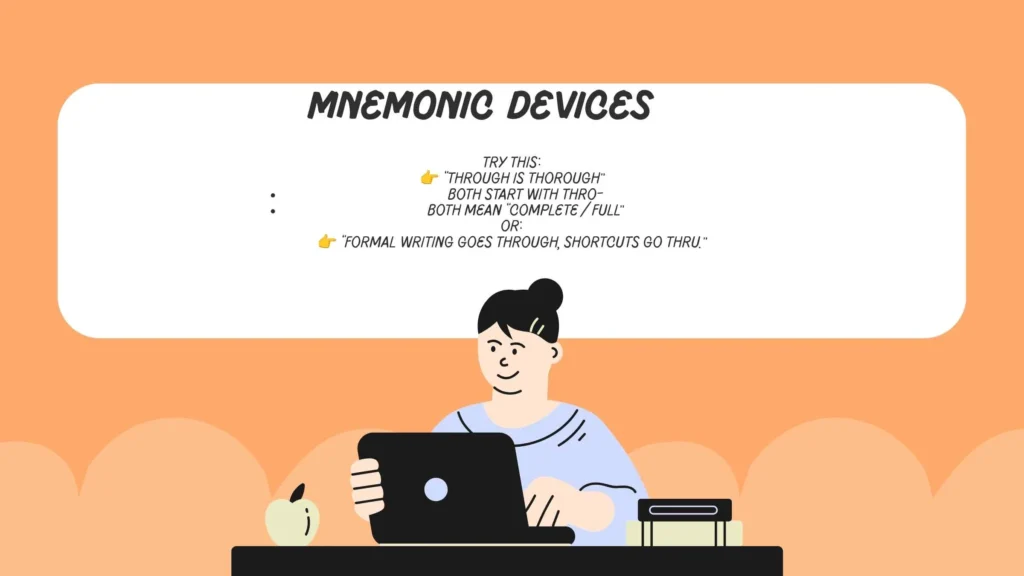
Try this:
👉 “Through is Thorough”
- Both start with Thro-
- Both mean “complete / full”
Or:
👉 “Formal writing goes through, shortcuts go thru.”
Regional Variations (US vs UK English)
British English:
- Strictly uses through in all formal contexts
- “Thru” is generally discouraged
American English:
- Uses through formally
- Accepts thru in signage, branding, informal writing
Canadian & Australian English:
- Follow British conventions mostly
- “Thru” is informal or commercial only
Singular and Plural Forms
Since these are not nouns, plural forms do not apply.
However, related noun usage:
- passage through
- drive-thru locations
- walk-throughs (noun form exists separately)
Grammar Rules & Parts of Speech
Through
Can function as:
- Preposition → “walk through the door”
- Adverb → “sleep through the night”
- Adjective → “through train” (rare usage)
Thru
- Not a formal part of grammar
- Used only as an informal variant of “through”
Synonyms and Antonyms
Synonyms of “through”
- Across
- Throughout
- By means of
- Finished
Antonyms
- Around
- Outside
- Around-the-edge (contextual)
Formal vs Informal Usage
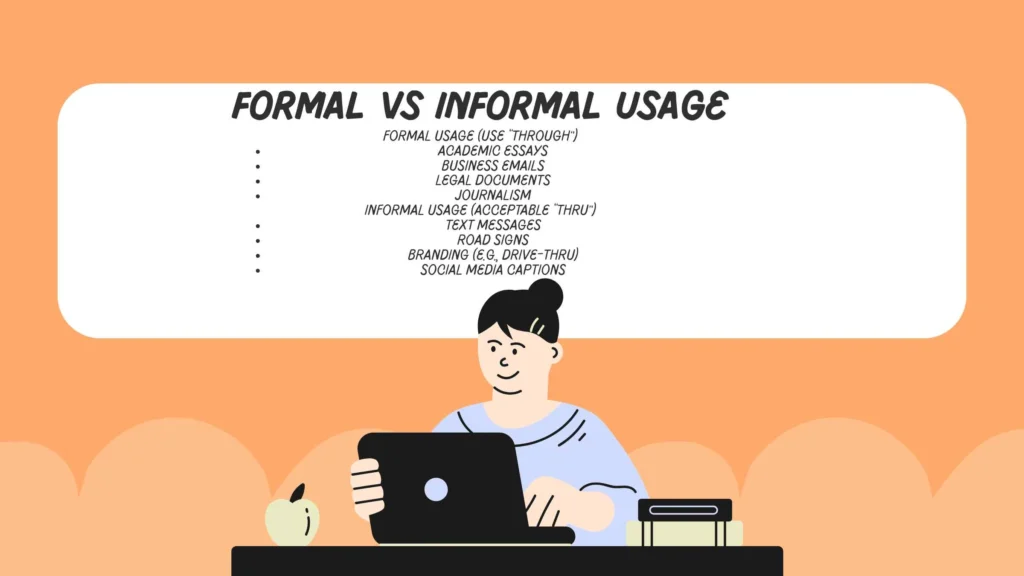
Formal Usage (Use “Through”)
- Academic essays
- Business emails
- Legal documents
- Journalism
Informal Usage (Acceptable “Thru”)
- Text messages
- Road signs
- Branding (e.g., drive-thru)
- Social media captions
Illustrative Examples
- She walked through the forest.
- The tunnel goes through the mountain.
- I worked through the night.
- We drove thru the fast food lane.
- He read through the entire report.
- The train passes through the city.
- I’ll support you through every challenge.
- The coffee shop has a drive-thru window.
- She went through a difficult phase.
- The message got through to him.
- We moved through the crowd quickly.
- Thru traffic is not allowed here.
Practice Section (15 MCQs)
- “Through” is mainly used in:
A) Informal writing
B) Formal writing
C) Numbers - “Thru” is:
A) Standard spelling
B) Informal spelling
C) Verb - They are:
A) Different meanings
B) Same meaning
C) Opposites - “Drive-thru” is used in:
A) Academic papers
B) Branding
C) Grammar books - “Through” can be:
A) Only noun
B) Preposition
C) Only verb - Pronunciation of both is:
A) Different
B) Same
C) Opposite - “Thru” is common in:
A) Legal writing
B) Text messages
C) Research papers - Correct formal spelling is:
A) Thru
B) Through
C) Throo - “Walk ___ the door”
A) thru
B) through
C) threw - “Through” comes from:
A) Latin only
B) Old English
C) French only - “Thru” is mostly:
A) Ancient
B) Modern abbreviation
C) Grammar rule - UK English prefers:
A) Thru
B) Through
C) Both equally - “Through” can mean:
A) Completion
B) Only direction
C) Only time - “Thru” is acceptable in:
A) Essays
B) Signs
C) Exams - They are:
A) Homophones
B) Antonyms
C) Synonyms only
Answer Key
1-B, 2-B, 3-B, 4-B, 5-B, 6-B, 7-B, 8-B, 9-B, 10-B, 11-B, 12-B, 13-A, 14-B, 15-A
Frequently Asked Questions (FAQs)
Is “thru” grammatically correct?
No, it is informal and not accepted in formal writing.
Can I use “thru” in emails?
Only in casual or internal communication, not professional emails.
Why is “thru” used in drive-thru?
Because branding prefers shorter, faster-readable words.
Are “through” and “thru” pronounced differently?
No, both are pronounced the same.
Which should I use in exams?
Always use “through”.
Which one is correct, thru or through?
Through is the correct standard English spelling used in formal writing, academic work, and professional communication. Thru is an informal simplified spelling that is mainly seen on road signs, advertisements, and casual writing.
Does thru mean through?
Yes, thru means the same as through. However, it is considered an informal spelling, while through is the preferred choice for correct grammar, SEO content, and formal English.
Why is it spelt thru?
Thru was introduced as a simplified spelling to make the word shorter and easier to read. It became popular on traffic signs and in marketing because it saves space, but through remains the standard spelling in dictionaries.
Which is correct, walk thru or walk through?
Walk through is the correct spelling in standard English. It is commonly used to describe a step-by-step explanation or physically walking through a place, while walk thru is an informal variation.
How to use the word “thru” in a sentence?
Thru is usually used in informal contexts. For example: We drove thru the tunnel before sunset. In formal writing, replace thru with through for better grammar and readability.
Is it work through or walk through?
Both are correct, but they have different meanings. Work through means to solve or deal with a problem, while walk through means to explain something step by step or physically move through a place.
Conclusion
The difference between through and thru is not about meaning—it’s about formality and context. While both words sound identical and share the same idea of movement or completion, only “through” is universally correct in formal English.
“Thru” survives in modern language as a shortcut used in branding and informal communication.
Understanding this distinction helps you write more professionally and avoid common mistakes in both academic and digital contexts.

Olivia Turner is a lifestyle and contemporary romance writer who focuses on positivity and everyday inspiration. Her stories are light, relatable, and filled with warmth, making them perfect for readers looking for uplifting content. Olivia draws inspiration from daily life and simple joyful moments.
📚 Books:
- Love & Coffee
- Chasing Happiness
- Moments That Matter
 Ethan Walker