Table of Contents
- Introduction
- Direct Answer: The 40-Second Summary
- Quick Comparison Table
- Deep Meanings & Definitions
- Historical Origin & Etymology
- Pronunciation Guide
- The Technical Differences
- Correct Spelling & Common Typos
- Mnemonic Devices (Memory Tricks)
- Regional Variations (US vs. UK English)
- Singular and Plural Forms
- Grammar Rules & Parts of Speech
- Synonyms and Antonyms
- Formal vs. Informal Usage
- Illustrative Examples
- Practice Section (15 MCQs)
- Frequently Asked Questions (FAQs)
- Conclusion
Introduction
I’ve spent years watching even the most meticulous writers stumble over this seemingly trivial space between “on” and “to.” And I get it. You’re typing quickly, and your brain knows what you mean, but your fingers hesitate is it onto or on to? This isn’t just pedantry; mastering this distinction is the mark of a confident writer who controls nuance. It can change the meaning of your sentence, dictate clarity in professional communication, and save you from embarrassing typos. Today, we are settling this debate for good, transforming a common point of confusion into a source of linguistic authority.
Direct Answer
“Onto” indicates movement to a position on a surface or object. “On to” is used when on is part of a phrasal verb (like move on or hold on) and is followed by the preposition or infinitive to. If you can replace it with “on” or “upon,” use onto; if not, use on to.
Quick Comparison Table
| Feature | Onto | On To |
| Spelling | One word | Two words |
| Core Meaning | To a position on a surface; upon | Separate words: on (adverb/particle) + to (preposition/infinitive) |
| Primary Usage | Physical or metaphorical movement to a location | Follows phrasal verbs ending in on (e.g., move on, hold on, log on) |
| The Test | Can be replaced by “upon” or “on” | Cannot be replaced by “upon”; it changes the verb’s meaning |
| Example | She climbed onto the roof. | We moved on to the next topic. |
Deep Meanings & Definitions
Onto
As a preposition, onto primarily signifies movement toward and arrival at a position on a surface. It is a closed compound word that functions as a single unit of meaning. Beyond the physical, it can mean being aware of something (“The police are onto him”) or discovering something important (“I think we’re onto something big”).
On To
This is not a single grammatical unit but a pairing of two words that happen to sit next to each other. The word on typically acts as an adverb or a particle that completes the meaning of a phrasal verb (e.g., move on, carry on, go on). The word to is a separate preposition or part of an infinitive verb. This distinction is crucial: the phrase move on means “to proceed,” and the to introduces the next object or action.
Historical Origin & Etymology
The preposition onto, meaning “to a position on,” emerged in the early 18th century as a logical formation by analogy with into (which had been established much earlier). It was a natural linguistic evolution to create a single word that compactly expresses movement resulting in contact with a surface.
For centuries, English struggled with this. The two-word form on to was the standard for a long time. However, as written English evolved, the convenience and clarity of a single word won out. By the 18th century, onto was being widely used in print. Despite this, it remained a point of contention, especially in British English, where the two-word form was often preferred in formal writing until well into the 20th century. This slower adoption in the UK reflects a general conservatism in British orthography compared to the more pragmatic and simplifying trends in American English.
Pronunciation Guide
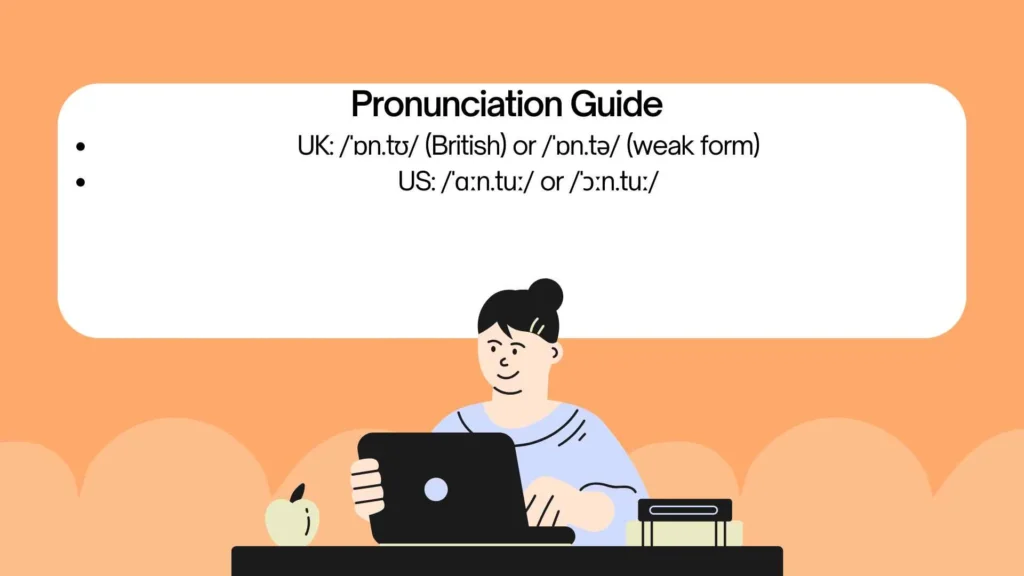
The pronunciation is identical whether you are using onto or on to, which is why the confusion is primarily a written one.
Phonetic Spelling:
- UK: /ˈɒn.tʊ/ (British) or /ˈɒn.tə/ (weak form)
- US: /ˈɑːn.tuː/ or /ˈɔːn.tuː/
Rhymes with:
- In American English, it rhymes with “can’t you” (when pronounced casually).
- It can be broken down into two simple sounds: “AHN” + “too.”
The Technical Differences
Why are these words so confusing? The problem lies in the verb-particle construction. When a phrasal verb like log on or hold on is used, the particle on is semantically tied to the verb. It changes the verb’s meaning so drastically that the two cannot be separated without losing the sentence’s core idea.
Consider the verb move:
- “Move onto the chair” means you change your position so that you are now on the chair.
- “Move on to the next chair” means you stop focusing on the current chair and shift your attention or physical progress to the next one.
In the second example, move on is a phrasal verb meaning “to proceed.” The to belongs to the prepositional phrase “to the next chair,” not to the word on. This is the key to unlocking this rule: you are not moving onto a topic; you are moving on and directing that action to the next topic.
Correct Spelling & Common Typos
The most common mistake is writing onto when on to is required and vice versa.
Frequent Errors:
- Substituting ‘onto’ for ‘on to’: This is the most frequent error. Writers will mistakenly write: “Let’s move onto the next point.” This is grammatically incorrect because you cannot move onto a point; you move on and proceed to it.
- Substituting ‘on to’ for ‘onto’: While less common, this error occurs when people over-correct. For example, “He stepped on to the stage” is acceptable but old-fashioned; the modern standard is “He stepped onto the stage.”
- Failing to Recognize Phrasal Verbs: Writers who don’t identify hold on, log on, or pass on as phrasal verbs will incorrectly combine them into one word.
Mnemonic Devices
The single best way to remember is the “Up” Test.
If you can insert the word “up” before “on” in your sentence and it still makes sense, you should use onto.
- “She hopped (up) onto the table.” ✔️ (Hop up onto is logical).
- “We moved (up) on to the next topic.” ❌ (Move up on to is nonsense).
Another trick: Think “Position” vs. “Progression.”
- Is it about physical location? (Position) → Use onto.
- Is it about continuing a process? (Progression) → Use on to.
Regional Variations (US vs. UK English)
American English:
- Onto is the standard and preferred form for all uses.
- It is widely accepted and taught in schools.
- The two-word form on to is generally reserved for phrasal verb constructions.
British English:
- Historically, on to was the dominant spelling. For a long time, many considered onto non-standard.
- Today, onto is gaining widespread acceptance and is increasingly considered standard, but the two-word form is still very common and often preferred in formal writing.
- In the UK, you are more likely to see “He stepped on to the bus,” whereas in the US, “He stepped onto the bus” is far more common.
Australian and Canadian English: These varieties generally follow British conventions but are heavily influenced by American usage. Onto is becoming the default in both, aligning with the global trend toward simplification.
Singular and Plural Forms
This is a straightforward area: onto and on to do not have plural forms. They are prepositions and particles, not nouns. Their spelling remains constant regardless of the number of objects being referred to.
Possessive Forms: It is impossible to have a possessive form of a preposition. You would never write “onto’s” or “on to’s.” If you need to express possession, you must use a different construction.
- Incorrect: The book’s fall onto’s floor.
- Correct: The book’s fall onto the floor.
Grammar Rules & Parts of Speech
Understanding the parts of speech is essential.
Onto is a preposition. Its job is to show a relationship between a verb and a noun (its object). Specifically, it shows the result of a movement—the object is now on a surface.
On To is not a single part of speech. It is a sequence:
- On: Usually an adverb or a particle (a word that looks like a preposition but acts as part of a verb phrase).
- To: A preposition (introducing a noun) or the sign of the infinitive (introducing a verb).
Sentence Structure:
- Onto structure: [Subject] + [Verb] + [Onto] + [Object].
- I threw the ball onto the roof.
- On to structure: [Subject] + [Phrasal Verb (Verb + on)] + [to] + [Object/Infinitive].
- Please log on to the system. (Where ‘log on’ is the phrasal verb, and ‘to the system’ is a prepositional phrase).
Synonyms and Antonyms
Synonyms for ‘Onto’ (preposition):
- Upon
- On
- Against
- At (in the sense of direction)
- Over (when it covers something)
Antonyms for ‘Onto’ (preposition):
- Off of
- From
- Off
Phrases for ‘On To’ (contextual synonyms):
- Onward to
- Forward to
- Along to
- Up to (in the sense of continuing)
Formal vs. Informal Usage
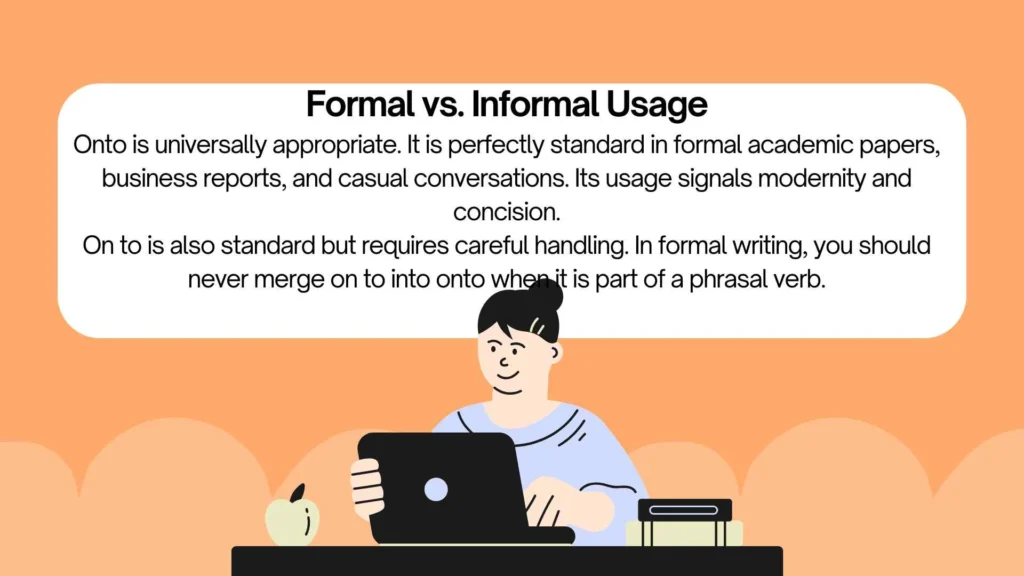
Onto is universally appropriate. It is perfectly standard in formal academic papers, business reports, and casual conversations. Its usage signals modernity and concision.
On to is also standard but requires careful handling. In formal writing, you should never merge on to into onto when it is part of a phrasal verb. Many style guides still recommend the two-word form for clarity in complex sentences, especially in British English. However, in informal contexts like social media, people often use onto colloquially, even when on to is technically correct (e.g., “I’m moving onto the next game,” which is fine in casual writing but should be “moving on to” in formal work). For a professional impression, learn the rule.
Illustrative Examples
- Physical Movement (Onto): She placed the heavy box onto the highest shelf.
- Physical Movement (Onto): The cat leaped onto the kitchen counter.
- Metaphorical (Onto): The detectives are onto the suspect’s alibi.
- Discovery (Onto): I think we’re onto a groundbreaking solution.
- Phrasal Verb (On to): After winning the regional title, they went on to compete nationally.
- Phrasal Verb (On to): Please hold on to the railing as you descend.
- Phrasal Verb + Infinitive (On to): He studied hard and passed on to become a doctor.
- Phrasal Verb (On to): You need to log on to the portal to access your files.
- Physical Movement (On to): The road continues on to the next village.
- Phrasal Verb (On to): The crowd carried on to celebrate their victory.
- Phrasal Verb (On to): If the price drops further, I will add on to my investment.
- Phrasal Verb (On to): The teacher moved on to the next chapter after the test.
Practice Section (15 MCQs)
- He climbed _______ the roof to fix the antenna.
a) on to
b) onto - I need to hold _______ my hat in this strong wind.
a) onto
b) on to - After we finish this section, we’ll move _______ the final exam.
a) onto
b) on to - I think the boss is _______ our plan.
a) onto
b) on to - The water spilled _______ the floor.
a) onto
b) on to - She logged _______ her computer.
a) onto
b) on to
c) Both a and b are acceptable - The book fell _______ the table.
a) onto
b) on to - Once you graduate, you can go _______ college.
a) onto
b) on to - He held _______ my arm so I wouldn’t fall.
a) onto
b) on to - The band walked _______ the stage to perform.
a) onto
b) on to - We need to pass this information _______ the authorities.
a) onto
b) on to - The view opens _______ a beautiful garden.
a) onto
b) on to - He transferred the files _______ the hard drive.
a) onto
b) on to - The discussion went _______ to last for hours.
a) onto
b) on to - I’d like to add a new room _______ my house.
a) onto
b) on to
Answer Key
- b) onto (You climb up onto a surface).
- b) on to (The phrasal verb is hold on, so it’s hold on to).
- b) on to (You move on, then proceed to the exam).
- a) onto (To be aware or informed about).
- a) onto (Physical movement to a surface).
- c) Both a and b are acceptable (Both are used in modern writing).
- a) onto (Physical movement to a surface).
- b) on to (You go on and then proceed to college).
- b) on to (The phrasal verb is hold on).
- a) onto (Physical movement to a surface).
- b) on to (You pass on something to someone).
- a) onto (The view looks “upon” the garden).
- a) onto (Physical movement to a device).
- b) on to (The phrasal verb is went on; it went on to last).
- b) on to (You add on to something).
Frequently Asked Questions (FAQs)
Q1: Is ‘onto’ one word or two?
It depends on the usage. Onto is one word when it’s a preposition meaning “on” or “upon.” However, on to is two words when on is part of a phrasal verb.
Q2: Can ‘onto’ and ‘on to’ be used interchangeably?
Rarely, and only in specific cases like the phrasal verb “log on to” vs. “log onto,” where both are acceptable. In most cases, they change the meaning of the sentence (e.g., move on to vs. move onto). They are not interchangeable.
Q3: What is the best way to remember the difference?
Use the “Up” Test. If you can put “up” before “on” and the sentence still makes sense, use onto. If not, use on to.
Q4: Is ‘onto’ more American or British?
Historically, onto is more strongly associated with American English. While it is now standard in British English, the two-word form on to remains more common in formal UK writing.
Q5: Is ‘onto’ informal?
No. Onto is a standard, formal preposition. It can be used in any context, including academic and professional writing. However, incorrectly using it in place of on to is an informal error.
Conclusion
So, is it on to or onto? The answer, as we’ve seen, is elegantly simple when you break down the grammar. Remember, onto is about physical or metaphorical placement on a surface. It’s a single preposition that does one job. On to, however, is a team-up of two distinct words, a signal that you are dealing with a phrasal verb like move on, hold on, or log on. Don’t fear this distinction any longer. Next time you’re writing, take a moment to ask yourself what you mean: are you placing something, or are you continuing a process? Master this, and you’ve conquered one of the most subtle and rewarding nuances of the English language.

Olivia Turner is a lifestyle and contemporary romance writer who focuses on positivity and everyday inspiration. Her stories are light, relatable, and filled with warmth, making them perfect for readers looking for uplifting content. Olivia draws inspiration from daily life and simple joyful moments.
📚 Books:
- Love & Coffee
- Chasing Happiness
- Moments That Matter
 Ethan Walker