Table of Contents
- Introduction
- Direct Answer
- Quick Comparison Table
- Deep Meanings & Definitions
- Historical Origin & Etymology
- Pronunciation Guide
- The Technical Differences
- Correct Spelling & Common Typos
- Mnemonic Devices
- Regional Variations
- Singular and Plural Forms
- Grammar Rules & Parts of Speech
- Synonyms and Antonyms
- Formal vs. Informal Usage
- Illustrative Examples
- Practice Section
- Frequently Asked Questions
- Conclusion
Introduction
I have witnessed countless students, writers, and professionals stumble over the seemingly simple choice between “bitting” and “biting.” It is a confusion that can undermine your credibility in an instant, whether you are drafting a business email, writing a novel, or simply trying to use the correct term in a social media post. Mastering this distinction is not just about spelling; it is about precision in communication and demonstrating a command of the English language that commands respect. In this definitive guide, I will dissect every nuance, leaving no room for doubt, so you can use these words with absolute confidence.
Direct Answer
The simple distinction is that “biting” is the correct spelling when referring to the action of using teeth to cut, grip, or sting, or when describing something sharply critical or painfully cold. “Bitting” is a specialized technical term referring to the process of fitting a bit in a horse’s mouth or, more commonly, the pattern of cuts on the key of a lock. For 99% of daily writing, “biting” is the word you need.
Quick Comparison Table
| Feature | Biting (Common Word) | Bitting (Specialized Term) |
| Spelling | b-i-t-i-n-g | b-i-t-t-i-n-g |
| Primary Meaning | The action of using teeth to cut, wound, or grip; sharp, stinging, or sarcastic | The act of putting a bit in a horse’s mouth, or the pattern of cuts on a key |
| Part of Speech | Verb (present participle) and Adjective | Noun and Verb (present participle of the verb “to bit”) |
| Core Usage | Everyday language, describing physical acts and figurative language (e.g., “biting criticism,” “biting wind”) | Specialized contexts like equestrianism, locksmithing, and mechanical engineering |
| Frequency | Extremely common | Rare and technical |
Deep Meanings & Definitions
Understanding the deep meanings of these terms helps solidify their correct usage.
Biting
As a verb, biting is the present participle of the verb “bite,” describing the action of cutting, piercing, or gripping with the teeth. This can range from a dog’s bite to a person taking a bite of food. As an adjective, it has two powerful figurative meanings:
- Sharp and Painful: Describing a physical sensation that is intensely uncomfortable, like a biting wind or the biting cold.
- Sarcastic or Critical: Describing remarks that are harsh, cutting, and intended to hurt or criticize, such as a biting satire or a biting comment.
Bitting
According to the American Heritage Dictionary, bitting is a noun that means “one of the indentations on the bit of a key”. This is the most common modern usage. The verb form, also “bitting,” refers to the act of fitting a key or putting a bit into a horse’s mouth, as the dictionary defines it: “To place a bit in the mouth of (a horse, for example)”.
Bitting or biting meaning
- Biting is the correct and commonly used word. It means using your teeth to cut, grip, or break something. People also use it to describe sharp comments, cold weather, or strong pain.
- Bitting is much less common. It usually relates to placing a bit in a horse’s mouth or refers to technical uses in specific industries.
- If you are talking about teeth, animals, or people, biting is almost always the right choice.
- Knowing the difference helps you avoid spelling mistakes in everyday writing.
- Many English learners confuse these words because they look very similar.
- The meaning depends on the context in which the word appears.
- In daily conversation, you will see biting far more often than bitting.
- Dictionaries list biting as the standard form for actions involving teeth.
- Bitting has specialized meanings and rarely appears in general English.
- Understanding this distinction makes your writing clearer and more accurate.
Bit’ or bitten by a dog
- Bitten by a dog is the correct expression when describing the injury.
- Bit is the simple past tense, while bitten is the past participle.
- You can say, “The dog bit me yesterday.”
- You can say, “I was bitten by a dog.”
- Use bitten after helping verbs like have, has, had, was, or were.
- Many people mistakenly use bit where bitten is required.
- Choosing the correct form makes your sentence grammatically correct.
- Native English speakers use bitten by a dog in medical and formal situations.
- The phrase clearly explains that a dog caused the bite.
- Learning this grammar rule improves both spoken and written English.
I got bit or bitten
- I got bitten is the grammatically correct form in standard English.
- I got bit is common in informal American English conversations.
- Formal writing usually prefers I got bitten.
- Both expressions describe the same event but differ in grammar style.
- Many native speakers casually say I got bit in everyday speech.
- If you are writing for school or work, choose I got bitten.
- Understanding the difference helps you match the situation.
- Grammar guides generally recommend bitten after got.
- Informal speech often accepts shorter expressions.
- Using the right version improves clarity and correctness.
Bit vs bite vs byte
- Bit is the past tense of bite and also a small unit of digital data.
- Bite is the present tense verb that means using teeth to cut or grip.
- Byte is a computer term equal to eight bits of digital information.
- Although these words sound alike, they have different meanings.
- Context tells readers which word is correct.
- Bite belongs to everyday language about eating or injuries.
- Bit changes meaning depending on whether you discuss grammar or technology.
- Byte appears in computing, storage, and file sizes.
- Correct spelling prevents confusion between language and technology.
- Learning these differences strengthens your vocabulary.
Bitting pronunciation
- Bitting is usually pronounced as BIT-ing.
- The first syllable sounds like the word bit.
- The second syllable sounds like ing.
- Stress falls on the first syllable.
- The pronunciation remains the same in most English accents.
- Because the word is uncommon, many people mistake it for biting.
- Listening to native speakers can improve pronunciation.
- Practicing aloud helps build confidence.
- Understanding pronunciation supports better communication.
- Learning the correct sound prevents common speaking mistakes.
Bitting food
- Bitting food is generally considered incorrect in standard English.
- The correct phrase is biting food.
- Biting food means using your teeth to chew or break food.
- English dictionaries rarely recognize bitting food in everyday use.
- Many spelling mistakes happen because both words look similar.
- Choosing biting makes your writing natural.
- Native speakers almost always say biting food.
- The phrase fits conversations about eating and chewing.
- Using the correct word improves grammar.
- Remember that actions involving teeth usually require biting.
Biting someone
- Biting someone means using your teeth to hurt another person.
- It can happen during play, anger, fear, or self-defense.
- Parents often teach children that biting is not acceptable behavior.
- Adults may also use the phrase in discussions about safety.
- The expression can appear in medical or legal situations.
- Animal bites also require proper care and attention.
- The phrase always refers to the action of using teeth.
- Context explains whether the event is playful or serious.
- Clear wording helps readers understand the situation.
- Using the phrase correctly improves communication.
Bite past tense pronunciation
- The past tense of bite is bit.
- Bit is pronounced like the word sit with a b sound.
- It has one short syllable.
- The pronunciation stays consistent across most English accents.
- Do not pronounce bit the same as bite.
- Bite has a long i sound, while bit has a short i sound.
- Practicing both words together helps you hear the difference.
- Correct pronunciation improves spoken English.
- Listening to native examples builds confidence.
- Understanding this difference helps avoid common pronunciation mistakes.
Historical Origin & Etymology
The divergence in spelling has a fascinating linguistic history.
The Etymology of “Biting”
The word “bite” has ancient roots, tracing back to the Old English verb “bītan,” which itself comes from the Proto-Germanic word *”bītaną”. This is a strong verb in Germanic languages, meaning its past tense is formed by changing the vowel (like “sing, sang, sung”). The “-ing” suffix is added to the base form “bite” to create the present participle, a common English construction. Its meaning has remained remarkably stable for over a thousand years.
The Etymology of “Bitting”
“Bitting” is derived from the noun “bit” (as in a drill bit, a horse’s bit, or a key’s bit). This noun is also from Old English, but from the word “bita,” meaning a piece bitten off or a morsel. The extension from “a piece bitten off” to “a cutting part of a tool” and later to the metal part of a key or bridle is a natural semantic shift. The verb form, “to bit,” then took the standard “-ing” suffix to create “bitting,” but crucially, it retains the double ‘t’ from the noun to indicate the connection to the original object, “bit.”
The key difference lies in their grammatical roots: “biting” is derived from the verb “bite,” while “bitting” is derived from the noun “bit.”
Pronunciation Guide
Despite the spelling difference, the pronunciation is subtly distinct.
- Biting: Pronounced /ˈbaɪ.tɪŋ/.
- Audio-style description: It rhymes with “lighting,” “writing,” and “fighting.” The first syllable uses the “ai” diphthong like in the word “buy,” followed by a clear ‘t’ and the standard ‘-ing’ ending.
- Bitting: Pronounced /ˈbɪt.ɪŋ/.
- Audio-style description: It rhymes with “sitting,” “fitting,” and “knitting.” The first syllable uses a short ‘i’ sound like in the word “bit,” followed by a crisp, double-sounding ‘t’ and the ‘-ing’ ending.
The Technical Differences
The confusion arises because both words sound very similar, differing only by a single consonant sound that is easily slurred in casual speech. The core technical difference is the grammatical function of their root words.
- Biting is the “-ing” form of the verb “bite.” The rule is simple: you take the verb and add “-ing.” You don’t change the spelling of the base word.
- Bitting is the “-ing” form of the verb “to bit” or a noun derived from the noun “bit.” The rule here is to double the final consonant of a one-syllable word ending in a single vowel + consonant (bit -> bitting). This is standard English spelling for verbs like “sit” (sitting) and “hit” (hitting).
Linguistically, the choice signals the root concept. If you mean “to cut with teeth,” you are tapping into the verb “bite.” If you mean “to equip with a bit” or “the pattern on a key,” you are tapping into the noun “bit.”
Correct Spelling & Common Typos
The most frequent mistake is overlooking the double ‘t’ and writing “bitting” when you mean “biting.” This is a classic case of phonetic misspelling where the writer sounds out the word and misses the subtle, quick pronunciation of the double consonant.
Conversely, a less common but possible mistake is dropping the second ‘t’ and writing “biting” when the correct technical term is “bitting.” This often happens because people are unaware that “bitting” is even a word.
Spellchecker.net suggests that common misspellings for “bitting” include confusing it with words like “biting,” “batting,” and “betting”. The key is to understand the context and meaning you intend to convey.
Mnemonic Devices
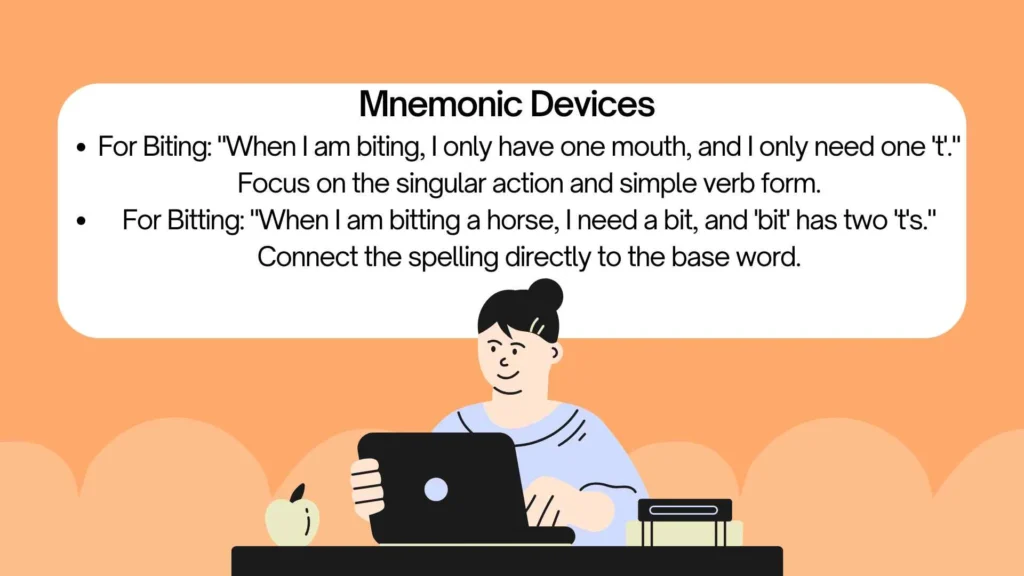
To permanently fix the correct spelling in your mind, use these simple memory tricks.
- For Biting: “When I am biting, I only have one mouth, and I only need one ‘t’.” Focus on the singular action and simple verb form.
- For Bitting: “When I am bitting a horse, I need a bit, and ‘bit’ has two ‘t’s.” Connect the spelling directly to the base word.
- Another trick: Think of “Biting” as being a “T-free zone” for the double consonant, while “Bitting” is for “Tools, Tack, and Locks.”
Regional Variations (US vs. UK English)
The definitions and core spelling rules for these words are consistent across all major English-speaking regions, including American, British, Canadian, and Australian English.
The primary variation in usage is in equestrian contexts. In British and Australian English, the term “bitting” may be slightly more common in horse-riding circles, but the core spelling and meaning remain the same. In American English, it is just as technical and rare. The distinction between “biting” and “bitting” is a linguistic universal, not a regional preference.
Singular and Plural Forms
The pluralization of these terms is straightforward.
- Biting: The noun form is rare but possible (e.g., “The bitings from the dog were severe”). The plural is “bitings.” Its possessive form is “biting’s” (e.g., “The biting’s effect was immediate”).
- Bitting: The noun (meaning the pattern on a key) is usually uncountable but can be pluralized as “bittings” when referring to multiple patterns. The possessive form is “bitting’s” (e.g., “The bitting’s complexity was remarkable”).
Grammar Rules & Parts of Speech
Understanding their grammatical roles is essential for correct usage.
Biting
- Verb (Present Participle): Used to form continuous tenses. “The dog is biting the postman.”
- Adjective: Used to modify a noun. “She made a biting remark about his tie.”
- Noun (Gerund): Used as a subject or object. “Biting your nails is a bad habit.”
Bitting
- Noun: Refers to the pattern on a key. “The locksmith inspected the bitting of the key.”
- Verb (Present Participle): Used to describe the action of fitting a bit. “He is bitting the new horse.”
Synonyms and Antonyms
Expanding your vocabulary helps to sharpen your understanding of each word.
Synonyms for Biting (Adjective)
- Sharp, painful, physical context: nipping, piercing, stinging, keen, bitter, cutting.
- Critical, hurtful, figurative context: caustic, sarcastic, incisive, trenchant, mordant, scathing, lacerating.
Antonyms for Biting (Adjective)
- Physical context: mild, warm, soothing, gentle, balmy.
- Figurative context: kind, complimentary, mild, gentle, reassuring, flattering.
Synonyms for Bitting (Noun/Verb)
- Noun: Key pattern, notch, indent, cut.
- Verb: Bridling, restraining, curbing (in the horse sense).
Formal vs. Informal Usage
Choosing the wrong word can make you appear uneducated. Here is a guide on where each term belongs.
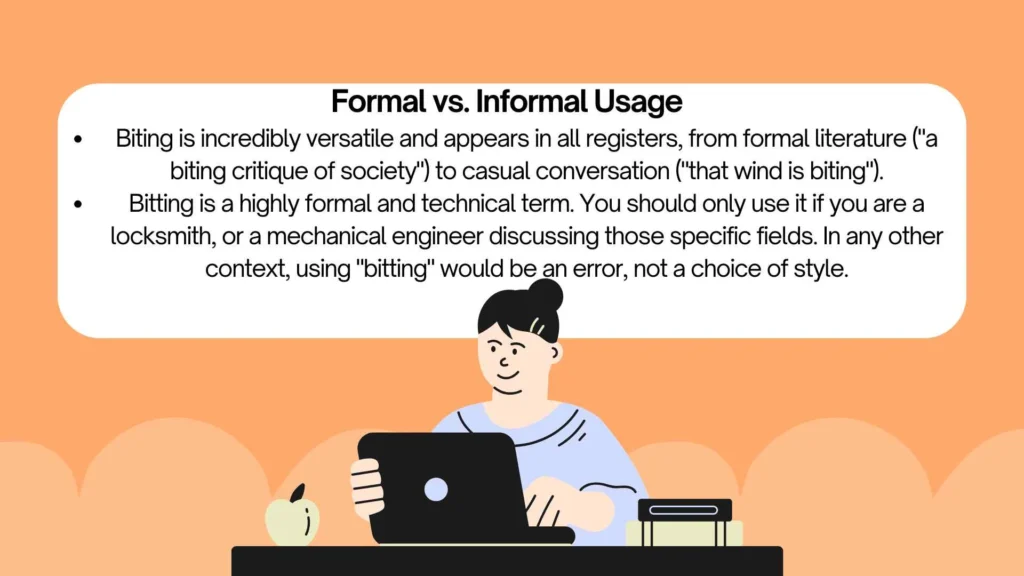
- Biting is incredibly versatile and appears in all registers, from formal literature (“a biting critique of society”) to casual conversation (“that wind is biting”).
- Bitting is a highly formal and technical term. You should only use it if you are a locksmith, a farrier, a horse trainer, or a mechanical engineer discussing those specific fields. In any other context, using “bitting” would be an error, not a choice of style.
Illustrative Examples
These examples will give you a firm grasp of how to use each word correctly in a sentence.
- The biting wind made it feel like it was well below zero.
- Her biting sarcasm left him speechless and embarrassed.
- The dog was biting his toy with great enthusiasm.
- The locksmith examined the key’s bitting to determine its cut sequence.
- The horses were bitting themselves on the fence [Note: This is an example from Dictionary.com‘s definition, meaning the horses were chewing on the fence].
- He is an expert at bitting a new horse for the first time.
- The critic’s biting review destroyed the director’s career.
- She felt a sharp, biting pain in her side after running the marathon.
- The bitting of the key is its most critical security feature.
- His biting sense of humor was often mistaken for genuine cruelty.
- Please stop biting the end of your pen; it’s a disgusting habit.
- The engineer focused on the subtle differences in the gear’s bitting for the new prototype.
Practice Section
Test your knowledge with these 15 multiple-choice questions. Choose the best answer for each.
- The dog was ___ the mailman.
a. bitting
b. biting - The locksmith studied the key’s complex ___.
a. bitting
b. biting - She gave him a ___ remark that he could not forget.
a. bitting
b. biting - The farrier is ___ the new horse.
a. bitting
b. biting - The ___ cold made their faces numb.
a. bitting
b. biting - The pattern of cuts on a key is known as its ___.
a. bitting
b. biting - He was ___ his lip nervously.
a. bitting
b. biting - The author was known for her ___ satire.
a. bitting
b. biting - He studied the ___ of the lock’s key to make a copy.
a. bitting
b. biting - The insects were ___ everyone at the picnic.
a. bitting
b. biting - I felt a sharp, ___ sensation on my hand.
a. bitting
b. biting - The art of ___ a bridle for a specific horse takes practice.
a. bitting
b. biting - My dog is a constant ___ machine, always chewing on his toys.
a. bitting
b. biting - The key’s ___ was too simple to be a high-security lock.
a. bitting
b. biting - Please stop ___ your nails and focus.
a. bitting
b. biting
Answer Key:
- b (biting)
- a (bitting)
- b (biting)
- a (bitting)
- b (biting)
- a (bitting)
- b (biting)
- b (biting)
- a (bitting)
- b (biting)
- b (biting)
- a (bitting)
- b (biting)
- a (bitting)
- b (biting)
Frequently Asked Questions
What is the difference between “bitting” and “biting”?
“Biting” is the common word for using teeth to cut, grip, or sting, or to describe something sharply cold or sarcastic. “Bitting” is a specialized technical term used only to refer to the pattern of cuts on a key or the process of putting a bit in a horse’s mouth.
Is “bitting” a real word?
Yes, “bitting” is a real word. It is the present participle of the verb “to bit” (meaning to equip with a bit) and a noun referring to the indentations on a key’s bit. It is a technical term, not a common misspelling of “biting.”
Which is correct: “bitting cold” or “biting cold”?
The correct phrase is “biting cold.” This uses the adjective form of “bite” to describe the piercing, painful quality of the cold. “Bitting cold” is incorrect.
Is it “biting comments” or “bitting comments”?
The correct phrase is “biting comments.” This refers to critical, sarcastic, or hurtful remarks, using the figurative meaning of “biting” as an adjective. “Bitting comments” would be incorrect.
Why do people confuse “biting” and “bitting”?
The confusion arises because the two words sound almost identical in casual speech, differing only by a quick, subtle double ‘t’ sound. Furthermore, “bitting” is a rare and technical word, so many people are unaware of its existence and simply assume “biting” is always correct, or they mistakenly over-correct by adding an extra ‘t’.
Is biting or bitting?
Biting is the correct spelling when referring to the action of using your teeth or the present participle of bite. Bitting is a different word used in specialized fields like horse riding or drilling and is not a substitute for biting in everyday English.
Do you say I got bit or I got bitten?
Both are correct, but usage depends on the variety of English. I got bitten is more common in formal English and British English, while I got bit is widely used in American English, especially in casual conversation.
What is the meaning of bitting?
Bitting refers to fitting or using a bit, especially in horse riding, where it describes placing a bit in a horse’s mouth. It can also relate to certain technical or mechanical processes, but it does not mean biting.
What does biting mean in slang?
In slang, biting often means copying or stealing someone else’s style, ideas, or work without originality. It can also describe a sharp, harsh, or sarcastic comment that feels emotionally cutting.
What is a fancy word for biting?
Depending on the context, formal alternatives to biting include caustic, acerbic, cutting, piercing, scathing, or sarcastic when describing speech. For physical biting, words like gnawing or clamping may be appropriate.
Why do girls say “bite me”?
“Bite me” is an informal slang expression used by anyone, including girls, to show annoyance, sarcasm, or playful defiance. It usually means “leave me alone,” “I don’t care,” or “stop bothering me,” and is rarely intended literally.
Conclusion
In conclusion, the battle between “bitting” and “biting” is not a battle at all. They are two distinct words with very different functions. I have equipped you with the knowledge to distinguish them: “Biting” is for teeth, sharp winds, and harsh words; it is your everyday champion. “Bitting” is a specialist, a word reserved for the quiet, precise world of locksmiths and the ancient craft of horse training. I am confident that with the guidelines, mnemonics, and examples I have provided, you will never make this mistake again. So go forth and write with precision, and let your command of these nuances set you apart.

James Anderson is a thriller and mystery author known for his suspenseful plots and unexpected twists. His storytelling keeps readers on the edge of their seats, blending intrigue with psychological depth. James has a talent for creating gripping narratives that captivate audiences from beginning to end.
📚 Books:
- The Hidden Truth
- Shadow Game
- Beyond the Lies
 Ethan Walker
 Olivia Turner