
Table of Contents
- Introduction
- Direct Answer
- Quick Comparison Table
- Deep Meanings & Definitions
- Historical Origin & Etymology
- Pronunciation Guide
- The Technical Differences
- Correct Spelling & Common Typos
- Mnemonic Devices
- Regional Variations
- Singular and Plural Forms
- Grammar Rules
- Synonyms and Antonyms
- Formal vs. Informal Usage
- Illustrative Examples
- Practice Section (15 MCQs)
- Frequently Asked Questions
- Conclusion
Introduction
I have observed that one of the most common spelling errors in English involves the past tense of “fight.” Many people confidently write “faught” when they mean “fought.” This mistake appears in emails, social media posts, and even student essays. In this guide, I will explain why “fought” is the only correct spelling and provide simple memory tricks to help you never confuse these two forms again.
Direct Answer
The correct spelling is fought (F-O-U-G-H-T). Faught is a common misspelling with no historical basis. “Fought” is the past tense and past participle of the verb “fight,” meaning to struggle in battle or conflict.
Quick Comparison Table
| Feature | Fought (Correct) | Faught (Incorrect) |
| Spelling | F-O-U-G-H-T | F-A-U-G-H-T |
| Status | Standard, correct | Common misspelling |
| Meaning | Past tense of “fight” | Misspelling |
| Etymology | Old English “feohtan” | No etymological basis |
| Regional Acceptance | All English varieties | None |
Deep Meanings & Definitions
Fought (Verb):
- Past tense of “fight”: engaged in physical combat or struggle
- Example: “They fought bravely in the battle.”
- Past tense of “fight”: argued or disputed
- Example: “The lawyers fought over every point.”
- Past tense of “fight”: struggled to achieve something
- Example: “She fought against all odds.”
Usage as Past Participle:
- “Have you ever fought in a war?”
- “The battle was fought on many fronts.”
Historical Origin & Etymology
Root Word:
- Old English: “feohtan” (to fight)
- Proto-Germanic: “fehtan”
- Related to German “kämpfen” and Dutch “vechten”
Evolution:
- Old English: feohtan
- Middle English: fighten
- Modern English: fight (present tense)
- Past tense: fought
- Past participle: fought
The Spelling Pattern:
“Fought” follows the irregular verb pattern where the vowel changes from “i” to “ou” in the past tense: fight → fought. Similar to:
- Bring → brought
- Buy → bought
- Seek → sought
Pronunciation Guide
Fought: Pronounced /fɔːt/ (UK) or /fɔt/ (US)
- Rhymes with “bought,” “caught,” and “thought”
- One syllable: “fawt”
- Sounds like “f-aw-t” with a silent ‘gh’
Common Mispronunciation:
Some people pronounce “faught” as it’s spelled, which reinforces the spelling error.
The Technical Differences
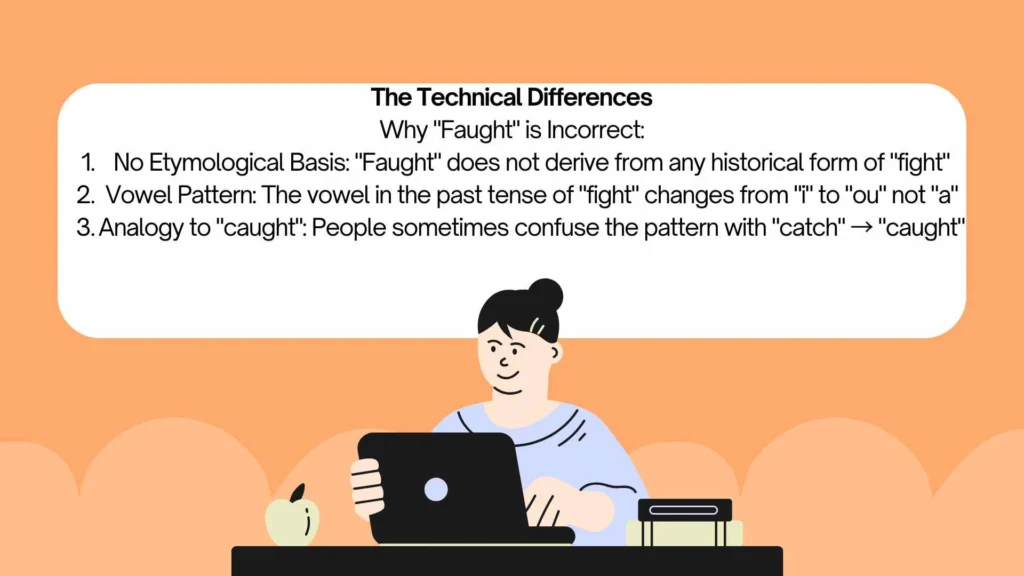
Why “Faught” is Incorrect:
- No Etymological Basis: “Faught” does not derive from any historical form of “fight”
- Vowel Pattern: The vowel in the past tense of “fight” changes from “i” to “ou” not “a”
- Analogy to “caught”: People sometimes confuse the pattern with “catch” → “caught”
The “OU” Pattern:
English has a common pattern where verbs ending in “-ight” change to “-ought” in past tense:
- Fight → Fought
- Bring → Brought
- Buy → Bought
- Seek → Sought
Correct Spelling & Common Typos
Correct:
- Fought (F-O-U-G-H-T)
Common Typos:
- Faught (most common error)
- Fought (already correct)
- Faugt (missing ‘h’)
- Foght (vowel error)
Most Common Error:
The “faught” error is widespread, particularly among young learners and non-native speakers.
Mnemonic Devices
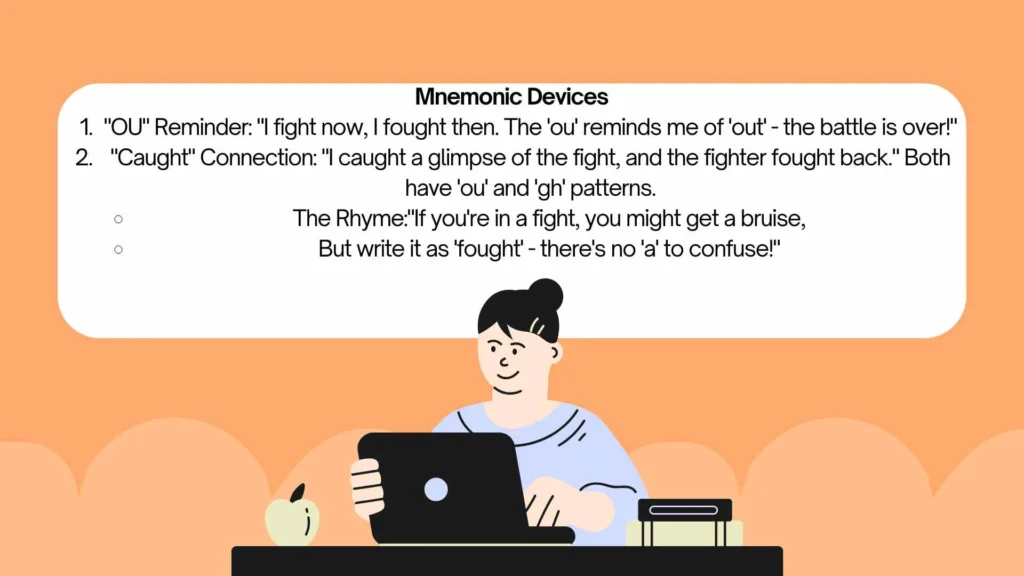
- “OU” Reminder: “I fight now, I fought then. The ‘ou’ reminds me of ‘out’ – the battle is over!”
- “Caught” Connection: “I caught a glimpse of the fight, and the fighter fought back.” Both have ‘ou’ and ‘gh’ patterns.
- The Rhyme:
- “If you’re in a fight, you might get a bruise,
- But write it as ‘fought’ – there’s no ‘a’ to confuse!”
- Pattern Memory: “Fight → Fought. No ‘a’ in sight!”
Regional Variations
No Regional Variation:
“Fought” is spelled the same across all English varieties:
- American English: Fought
- British English: Fought
- Canadian English: Fought
- Australian English: Fought
The misspelling “faught” appears globally but is universally incorrect.
Singular and Plural Forms
As a Verb:
“Fought” is the past tense form. It doesn’t have singular/plural variations:
- Singular: “He fought”
- Plural: “They fought” (same form)
As a Noun:
“Fought” is not a noun. The noun form is “fight” (singular) and “fights” (plural):
- “The fight was intense.”
- “The fights were legendary.”
Grammar Rules
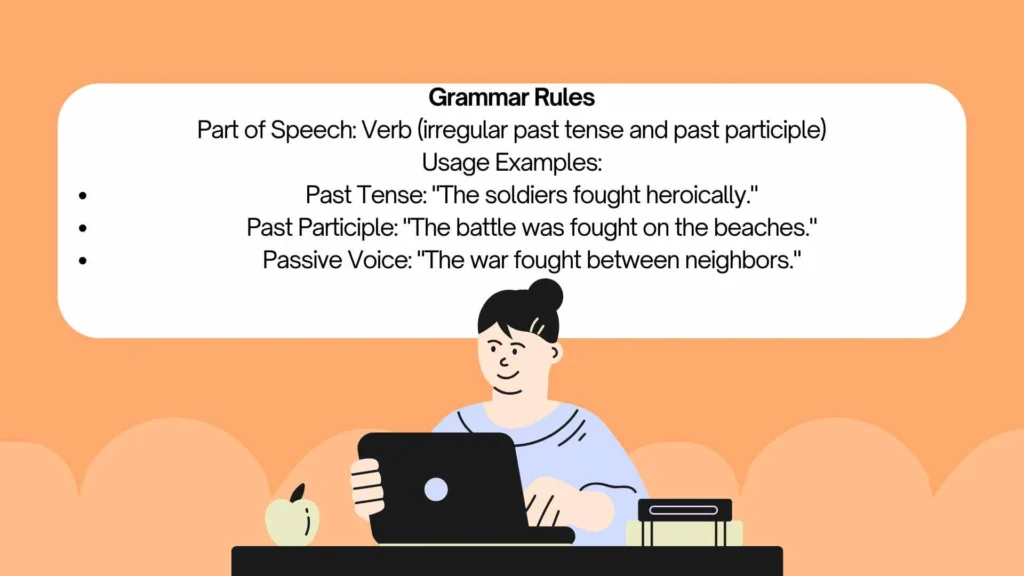
Part of Speech: Verb (irregular past tense and past participle)
Usage Examples:
- Past Tense: “The soldiers fought heroically.”
- Past Participle: “The battle was fought on the beaches.”
- Passive Voice: “The war fought between neighbors.”
Verb Conjugation:
- Present: fight
- Past: fought
- Past Participle: fought
- Present Participle: fighting
Synonyms and Antonyms
Synonyms:
- Battled
- Struggled
- Contested
- Wrestled
- Engaged
- Clashed
- Confronted
Antonyms:
- Surrendered
- Yielded
- Submitted
- Capitulated
- Complied
Contextual Synonyms:
- Physical: brawled, wrestled, boxed
- Verbal/Argument: disputed, argued, debated
- Struggle: strove, labored, endeavored
Formal vs. Informal Usage
Formal Contexts:
- Acceptable in all formal writing
- “The troops fought valiantly for their country.”
- “The case was fought on constitutional grounds.”
Informal Contexts:
- Common in everyday conversation
- “We fought about it for hours.”
- “I fought with the computer all day.”
Illustrative Examples
- The soldiers fought bravely against the enemy.
- She fought for years to achieve her dream.
- The two nations fought a long and bloody war.
- He fought with his brother over the inheritance.
- The champion fought valiantly to defend his title.
- They fought tirelessly for civil rights.
- I have never fought in a real battle.
- The animals fought over the territory.
- She fought cancer with incredible courage.
- The boxers fought for ten rounds.
- The couple fought about money constantly.
- He fought his fears and took the stage.
Practice Section (15 MCQs)
- What is the correct past tense of “fight”?
- a) Faught
- b) Fought
- c) Fighted
- d) Foughten
- Which spelling is correct?
- a) Faught
- b) Fought
- c) Fawt
- d) Fout
- “Faught” is:
- a) Correct in British English
- b) A common misspelling
- c) Correct in American English
- d) An alternative form
- The Old English root of “fight” is:
- a) Faht
- b) Feohtan
- c) Fotan
- d) Fitan
- Which word follows the same pattern as fight → fought?
- a) Sing → Sanged
- b) Bring → Brought
- c) Run → Ran
- d) Walk → Walked
- “Fought” rhymes with:
- a) Hat
- b) Bought
- c) Cat
- d) Bat
- The past participle of “fight” is:
- a) Fighted
- b) Fought
- c) Faught
- d) Fighting
- Which is NOT a synonym of fought?
- a) Battled
- b) Surrendered
- c) Struggled
- d) Contested
- “The soldiers ___ bravely.” Fill in:
- a) Faught
- b) Fought
- c) Fighted
- d) Foughted
- The correct spelling has which vowel pattern?
- a) A-U
- b) O-U
- c) E-U
- d) I-U
- “Fought” functions as what part of speech?
- a) Noun
- b) Verb
- c) Adjective
- d) Adverb
- Which pair shows the correct pattern?
- a) Fight → Faught
- b) Fight → Fought
- c) Fight → Fighted
- d) Fight → Foght
- “I have never ___ anyone.” Fill in:
- a) Faught
- b) Fought
- c) Fight
- d) Fighting
- The silent letters in “fought” are:
- a) F and T
- b) G and H
- c) O and U
- d) None
- Which sentence uses “fought” correctly?
- a) They faught in the war.
- b) The two boxers fought for the title.
- c) She faught her fears.
- d) He fighted the enemy.
Answer Key:
- b
- b
- b
- b
- b
- b
- b
- b
- b
- b
- b
- b
- b
- b
- b
Frequently Asked Questions
Q1: Is “faught” ever correct?
No. “Faught” is always incorrect. The correct spelling is “fought” .
Q2: Why do people spell it “faught”?
People often confuse the pattern with “catch → caught” or “teach → taught.” However, “fight” follows the “brought, bought, sought” pattern, not “caught” .
Q3: What is the past tense of “fight”?
The past tense of “fight” is “fought.” This is an irregular verb form .
Q4: Does “fought” have a silent letter?
Yes, the “gh” in “fought” is silent. It is pronounced like “fawt” .
Q5: Are there any regional variations in spelling “fought”?
No. “Fought” is spelled the same in all varieties of English .
Conclusion
I hope this guide has resolved the confusion between “faught” and “fought.” Remember that “fought” is the only correct spelling for the past tense of “fight.” The misspelling “faught” has no etymological basis and should always be avoided. By understanding the pattern of irregular verbs ending in “-ought” (brought, bought, sought, fought), you can remember the correct spelling every time. With this knowledge, you can confidently write about battles, arguments, and struggles without fear of spelling errors.

James Anderson is a thriller and mystery author known for his suspenseful plots and unexpected twists. His storytelling keeps readers on the edge of their seats, blending intrigue with psychological depth. James has a talent for creating gripping narratives that captivate audiences from beginning to end.
📚 Books:
- The Hidden Truth
- Shadow Game
- Beyond the Lies
 Ethan Walker
 Olivia Turner