Table of Contents
- Introduction
- Direct Answer
- Quick Comparison Table
- Deep Meanings & Definitions
- Historical Origin & Etymology
- Pronunciation Guide
- The Technical Differences
- Correct Spelling & Common Typos
- Mnemonic Devices
- Regional Variations
- Singular and Plural Forms
- Grammar Rules
- Synonyms and Antonyms
- Formal vs. Informal Usage
- Illustrative Examples
- Practice Section (15 MCQs)
- Frequently Asked Questions
- Conclusion
Introduction
I have observed that few pairs of words cause as much confusion as “altar” and “alter.” These homophones sound identical but have completely different meanings. This confusion appears in writing across all levels—from student essays to professional publications. Mastering the distinction is essential for clear, precise communication. In this guide, I will explain the differences, provide memory tricks, and help you use each word correctly.
Direct Answer
Altar (noun) is a sacred table or platform used in religious ceremonies and worship. Alter (verb) means to change, modify, or adjust something. The key difference: “altar” is a place of worship, while “alter” is an action of change.
Quick Comparison Table
| Feature | Altar | Alter |
| Part of Speech | Noun | Verb |
| Meaning | Sacred table/place of worship | To change or modify |
| Spelling | A-L-T-A-R | A-L-T-E-R |
| Pronunciation | /ˈɔːl.tər/ | /ˈɔːl.tər/ |
| Usage | “The bride walked to the altar.” | “Please alter your plans.” |
Deep Meanings & Definitions
Altar (Noun):
- A raised structure or table used in religious rituals and sacrifices
- Example: “The priest stood at the altar.”
- The front part of a church where the main religious ceremonies occur
- Example: “The choir stood near the altar.”
- A place of worship or sacrifice in non-religious contexts
- Example: “He sacrificed his career on the altar of ambition.”
Alter (Verb):
- To make a change or modification to something
- Example: “The tailor will alter the dress.”
- To adjust or adapt in response to circumstances
- Example: “We need to alter our strategy.”
- To castrate or spay an animal (veterinary term)
- Example: “The veterinarian will alter the cat.”
Historical Origin & Etymology
Altar:
- Latin: “altare” (place of sacrifice, altar)
- Related to Latin “altus” (high) or “adolere” (to burn)
- Old English: “alter” (borrowed from Latin)
- Modern English: retained as “altar” with the ‘a’ spelling
Alter:
- Latin: “alter” (other, another)
- French: “alterer” (to change)
- Old French: “alterer” (to change)
- Modern English: retained as “alter” with the ‘e’ spelling
Etymological Note:
Both words come from different Latin roots. “Altar” is from “altare” (sacrificial table), while “alter” is from “alter” (other, another).
Pronunciation Guide
Altar: /ˈɔːl.tər/ (UK) or /ˈɑːl.tər/ (US)
- Sounds like “ALL-ter” or “AWL-ter”
- Rhymes with “falter” and “halter”
- First syllable: “all” or “awl”
Alter: /ˈɔːl.tər/ (UK) or /ˈɑːl.tər/ (US)
- Sounds exactly like “altar”
- Rhymes with “falter” and “halter”
- Identical pronunciation in all English varieties
Note: The pronunciations are identical, which causes the confusion.
The Technical Differences
The ‘A’ vs ‘E’ Distinction:
- Altar has an ‘A’ (like Altar – a Actual place)
- Alter has an ‘E’ (like Edit, Effect change)
Part of Speech:
- Altar: Always a noun (a thing)
- Alter: Always a verb (an action)
Context:
- Altar: Religious, ceremonial, spiritual contexts
- Alter: Everyday contexts involving change or modification
Correct Spelling & Common Typos
Correct:
- Altar (noun – sacred table)
- Alter (verb – to change)
Common Typos:
- Altar used where alter is correct (and vice versa)
- Alter used as a noun (incorrect)
- Altor (incorrect spelling of both)
- Altur (incorrect spelling)
Most Common Error:
Using “altar” as a verb or “alter” as a noun.
Mnemonic Devices
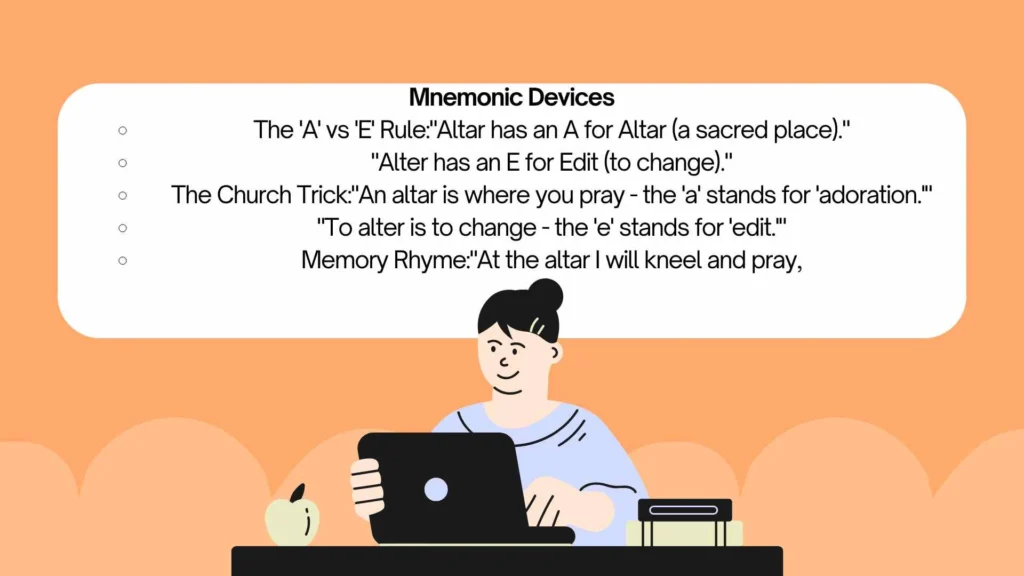
- The ‘A’ vs ‘E’ Rule:
- “Altar has an A for Altar (a sacred place).”
- “Alter has an E for Edit (to change).”
- The Church Trick:
- “An altar is where you pray – the ‘a’ stands for ‘adoration.'”
- “To alter is to change – the ‘e’ stands for ‘edit.'”
- Memory Rhyme:
- “At the altar I will kneel and pray,
- To alter means to change today.”
- Visual Association:
- Picture a church altar with an ‘A’ shaped like a steeple.
- Picture alter with an ‘E’ for “erase and edit.”
Regional Variations
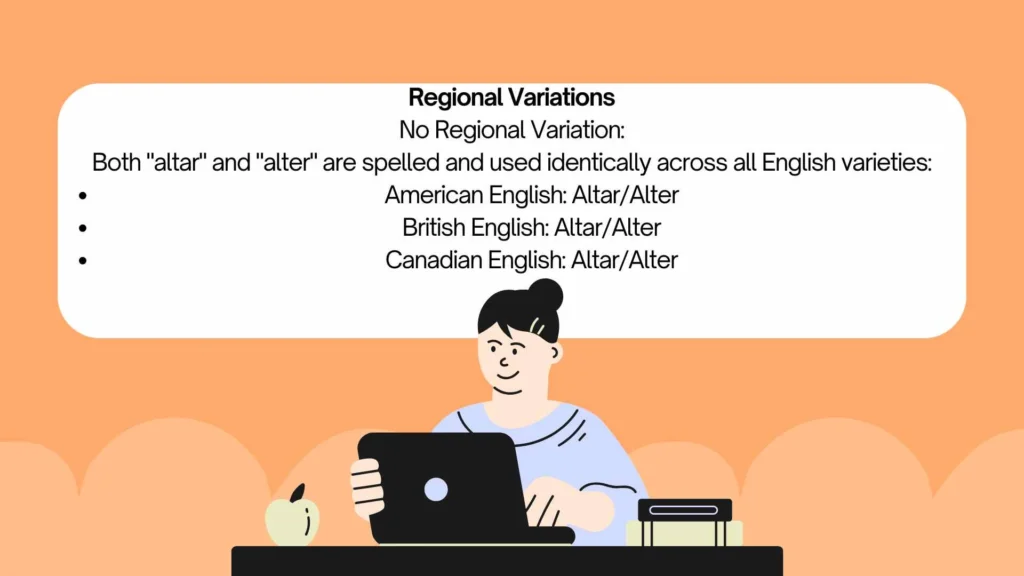
No Regional Variation:
Both “altar” and “alter” are spelled and used identically across all English varieties:
- American English: Altar/Alter
- British English: Altar/Alter
- Canadian English: Altar/Alter
- Australian English: Altar/Alter
Singular and Plural Forms
Altar:
- Singular: “The altar was decorated.”
- Plural: “Altars” (simply add ‘s’)
- Possessive: “The altar’s decorations” (singular), “The altars’ candles” (plural)
Alter:
- No singular/plural forms (it’s a verb)
- Conjugations: alters, altering, altered
Grammar Rules
Altar – Noun:
- Can be subject, object, or object of preposition
- “The altar stood at the front.” (subject)
- “They decorated the altar.” (object)
- “She knelt at the altar.” (object of preposition)
Alter – Verb:
- Transitive verb (takes an object)
- “The tailor will alter the suit.” (object: suit)
- “We must alter our plans.” (object: plans)
Common Mistake:
Never use “alter” as a noun or “altar” as a verb.
Synonyms and Antonyms
Altar (Noun):
- Synonyms: Table, shrine, sanctuary, dais, platform, holy table
- Related: Communion table, sacrificial table, chancel
Alter (Verb):
- Synonyms: Change, modify, adjust, adapt, revise, amend
- Antonyms: Keep, maintain, preserve, retain, conserve, leave unchanged
Formal vs. Informal Usage
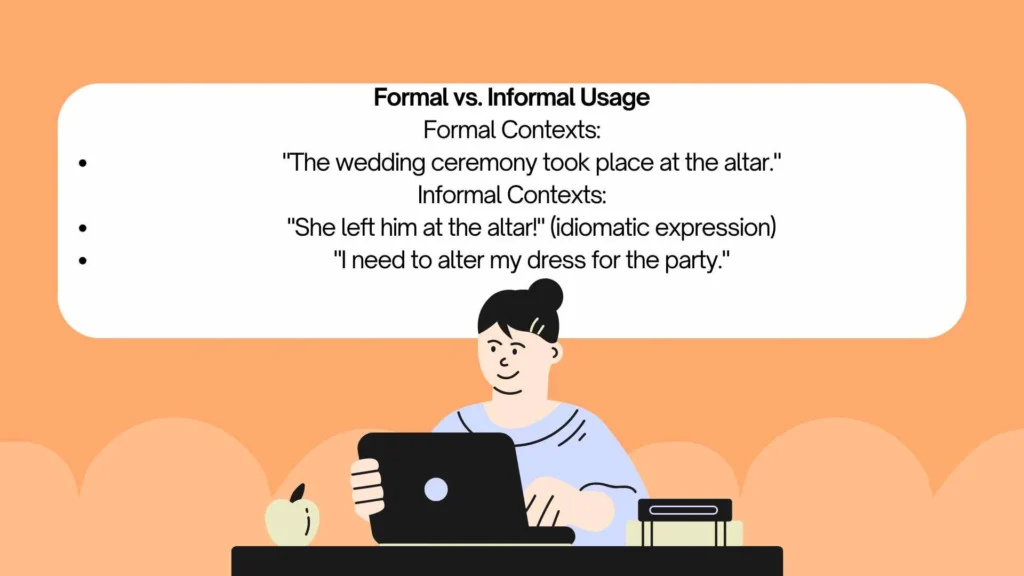
Formal Contexts:
- “The wedding ceremony took place at the altar.”
- “The committee decided to alter the proposal.”
Informal Contexts:
- “She left him at the altar!” (idiomatic expression)
- “I need to alter my dress for the party.”
Idiomatic Expression:
- “Leave someone at the altar” – to call off a wedding at the last moment
Illustrative Examples
- The bride walked down the aisle toward the altar.
- Please alter the document before submitting it.
- The priest stood behind the altar during the service.
- We need to alter our travel plans due to the weather.
- The cathedral had a magnificent marble altar.
- The tailor can alter your suit in one day.
- She left him standing at the altar.
- The company must alter its marketing strategy.
- The ancient altar was discovered during the excavation.
- I asked the pharmacist to alter the prescription dosage.
- They prayed before the altar.
- You cannot alter the past.
Practice Section (15 MCQs)
- “The priest stood at the ___.” Which word fits?
- a) Alter
- b) Altar
- c) Both
- d) Neither
- “Please ___ your plans for tomorrow.” Which word fits?
- a) Alter
- b) Altar
- c) Both
- d) Neither
- Altar is what part of speech?
- a) Verb
- b) Noun
- c) Adjective
- d) Adverb
- Alter is what part of speech?
- a) Verb
- b) Noun
- c) Adjective
- d) Adverb
- “The tailor will ___ the dress.” Which is correct?
- a) Altar
- b) Alter
- c) Both
- d) Neither
- “The church had a beautiful marble ___.” Which is correct?
- a) Alter
- b) Altar
- c) Both
- d) Neither
- The word “altar” comes from which language?
- a) Greek
- b) Latin
- c) French
- d) German
- Which spelling has an ‘e’?
- a) Altar
- b) Alter
- c) Both
- d) Neither
- The mnemonic “A for Adoration” helps remember:
- a) Alter
- b) Altar
- c) Both
- d) Neither
- “She left him at the ___.” This idiom means:
- a) Changed her mind
- b) Called off the wedding
- c) Changed her dress
- d) Went to church
- Which word means “to change”?
- a) Altar
- b) Alter
- c) Both
- d) Neither
- “The ___ was covered in flowers.” Which is correct?
- a) Alter
- b) Altar
- c) Both
- d) Neither
- “You cannot ___ the past.” Which is correct?
- a) Altar
- b) Alter
- c) Both
- d) Neither
- The pronunciation of altar and alter is:
- a) Different
- b) Identical
- c) Similar
- d) Unrelated
- Which word is a noun?
- a) Alter
- b) Altar
- c) Both
- d) Neither
Answer Key:
- b
- a
- b
- a
- b
- b
- b
- b
- b
- b
- b
- b
- b
- b
- b
Frequently Asked Questions
Q1: What is the difference between altar and alter?
“Altar” is a noun referring to a sacred table or place of worship. “Alter” is a verb meaning to change or modify something .
Q2: Are altar and alter pronounced the same?
Yes, “altar” and “alter” are perfect homophones—they are pronounced identically in all varieties of English .
Q3: How can I remember the difference between altar and alter?
Remember that “altar” has an ‘A’ (for Altar, a place) and “alter” has an ‘E’ (for Edit, to change). Or: “Altar” = sacred table, “Alter” = change .
Q4: What does “left at the altar” mean?
The expression “left at the altar” means someone called off a wedding at the last moment, leaving their partner standing at the altar without a bride or groom .
Q5: Can “alter” be used as a noun?
No, “alter” is only used as a verb. The noun form would be “alteration” (the act of changing something).
Conclusion
I hope this guide has clarified the confusion between “altar” and “alter.” Remember that “altar” (with an ‘A’) is a sacred table or place of worship—a noun. “Alter” (with an ‘E’) means to change or modify—a verb. These homophones sound identical but have completely different meanings and functions. Using the memory tricks provided, you can confidently choose the right word every time. No more confusion—just precise, accurate English!

Ethan Walker is a non-fiction author and thought leader who writes about personal growth, productivity, and modern life challenges. His work focuses on helping readers simplify their lives, make better decisions, and achieve meaningful success. With a clear and practical writing style, Ethan provides valuable insights that inspire positive change and long-term improvement.
📚 Books:
- The Road to Clarity
- Moments of Truth
- Breaking the Limits
 Olivia Turner