Table of Contents
- Introduction
- Direct Answer
- Quick Comparison Table
- Deep Meanings & Definitions
- Historical Origin & Etymology
- Pronunciation Guide
- The Technical Differences
- Correct Spelling & Common Typos
- Mnemonic Devices
- Regional Variations
- Singular and Plural Forms
- Grammar Rules
- Synonyms and Antonyms
- Formal vs. Informal Usage
- Illustrative Examples
- Practice Section (15 MCQs)
- Frequently Asked Questions
- Conclusion
Introduction
I have observed that one of the most common spelling questions about Spanish slang involves whether to write “mamasita” or “mamacita.” This confusion appears everywhere—from song lyrics to social media. The words sound nearly identical when spoken, especially in dialects with “seseo” (where ‘c’ before ‘e/i’ sounds like ‘s’). Understanding the correct spelling is essential for respectful and accurate communication. In this guide, I will settle this spelling debate once and for all.
Direct Answer
The correct spelling is mamacita (M-A-M-A-C-I-T-A). “Mamasita” is a common misspelling. “Mamacita” comes from “mamá” (mother) + the diminutive suffix “-cita,” literally meaning “little mother.” It is used as a term of endearment for an attractive woman or beloved female figure.
Quick Comparison Table
| Feature | Mamacita (Correct) | Mamasita (Incorrect) |
| Spelling | M-A-M-A-C-I-T-A | M-A-M-A-S-I-T-A |
| Meaning | Little mother (term of endearment) | Misspelling |
| Etymology | mamá + -cita | No etymological basis |
| Root Word | mamá (mother) | mamá (misspelled with ‘s’) |
| Regional Acceptance | All Spanish dialects | None |
Deep Meanings & Definitions
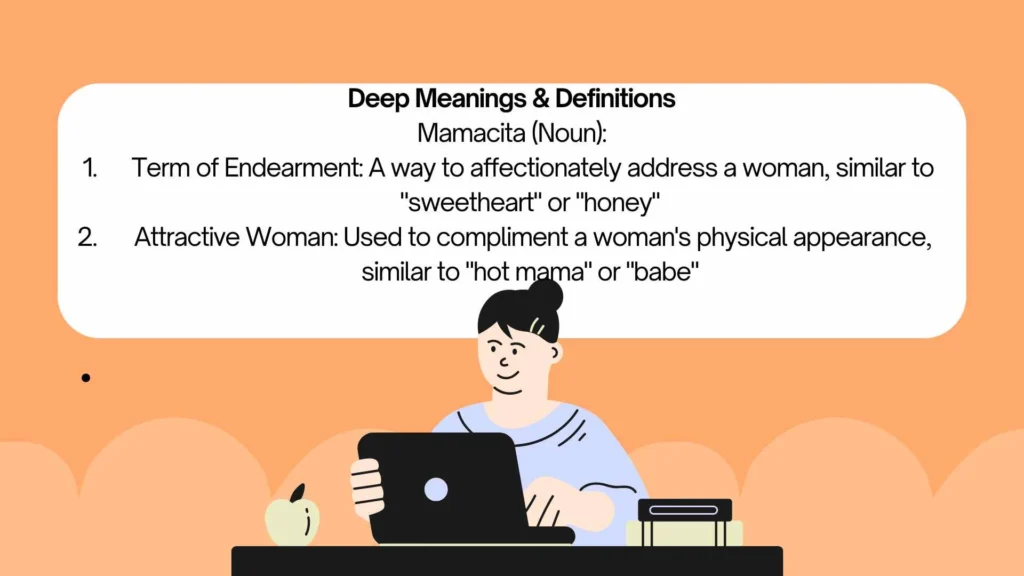
Mamacita (Noun):
- Term of Endearment: A way to affectionately address a woman, similar to “sweetheart” or “honey”
- Attractive Woman: Used to compliment a woman’s physical appearance, similar to “hot mama” or “babe”
- Affectionate Address: Can be used by family members, especially parents addressing daughters
- Respectful Term: Used for a woman in a mother-like role, even if not one’s actual mother
Related Terms:
- Mamita: Another diminutive of “mamá,” similar meaning
- Papacito: Male equivalent term
Historical Origin & Etymology
Root Word:
- “Mamá” comes from Latin “mamma,” meaning both “mother” and “breast”
- This Latin root also gave English “mammary” and “mama”
Suffix Addition:
- “-cita” is the feminine diminutive suffix in Spanish
- Used to express affection and endearment
- Examples: casita (little house), abuelita (dear grandmother)
Evolution:
- Latin: mamma → Spanish: mamá
- mamá + -cita → mamacita
- Literal meaning: “little mother”
Pronunciation Guide
Mamacita: /ma.maˈsi.ta/ or /ma.maˈθi.ta/
- “mah-mah-SEE-tah” (Latin American Spanish)
- “mah-mah-THEE-tah” (European Spanish)
- Stress on the third syllable
Why the Confusion:
- In Latin American Spanish, ‘c’ before ‘i’ is pronounced like ‘s’ (seseo)
- “Mamacita” and “mamasita” sound identical in many dialects
- This phonetic similarity causes the spelling error
The Technical Differences
Why People Misspell It:
- Pronunciation: In Latin American Spanish, ‘c’ before ‘e/i’ sounds like ‘s’
- Seseo: Many Spanish speakers pronounce ‘c’ and ‘s’ identically
- False Analogy: People assume it follows a pattern that doesn’t exist
- Lack of Spelling Knowledge: Not knowing the etymological root
The Linguistic Logic:
- The correct spelling preserves the root word “mamá” (with ‘c’)
- The suffix “-cita” maintains the ‘c’ from the root
- “Mamasita” would imply a root word “mamá” spelled with ‘s’—which doesn’t exist
Correct Spelling & Common Typos
Correct:
- Mamacita (M-A-M-A-C-I-T-A)
Common Typos:
- Mamasita (most frequent error)
- Mamcita (missing ‘a’)
- Mamacitta (double ‘t’)
- Mammacita (double ‘m’)
- Mamacita is sometimes misspelled as “mammacita” in English contexts
Mnemonic Devices
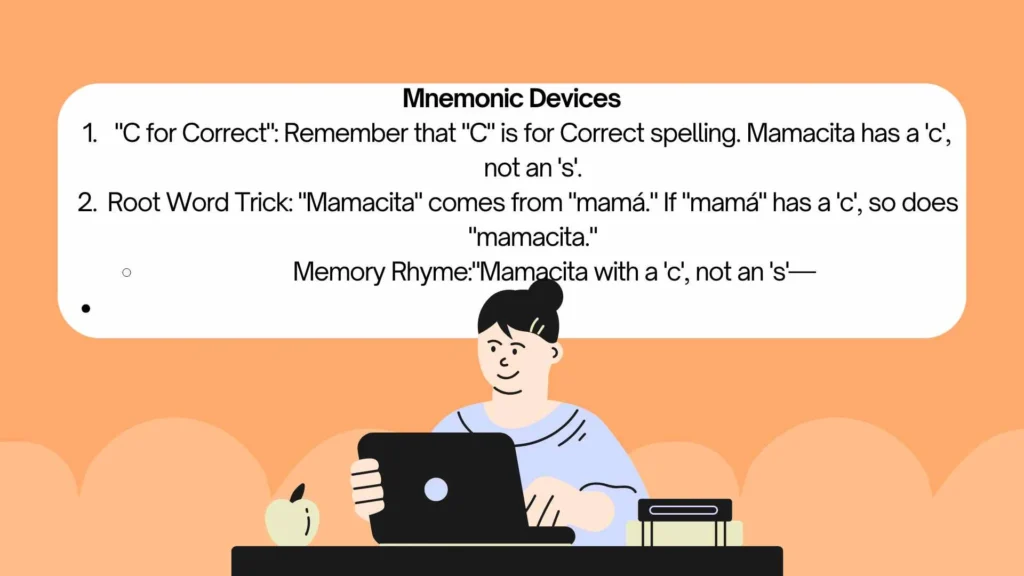
- “C for Correct”: Remember that “C” is for Correct spelling. Mamacita has a ‘c’, not an ‘s’.
- Root Word Trick: “Mamacita” comes from “mamá.” If “mamá” has a ‘c’, so does “mamacita.”
- Memory Rhyme:
- “Mamacita with a ‘c’, not an ‘s’—
- Spelling it right will bring success!”
- Visual Association: Picture a mother (“mamá”) with a little “cita” (little one). Both start with the same letter.
Regional Variations
Consistent Across Spanish:
The correct spelling “mamacita” is universal across all Spanish-speaking regions:
- Mexico: Mamacita
- Central America: Mamacita
- South America: Mamacita
- Spain: Mamacita (though less commonly used)
Regional Usage Differences:
- Central America: Very common as a flirtatious term
- Mexico: Used both at home (affectionate) and on the street (flirtatious)
- Spain: Rarely used; “mami” is preferred
- South America: Can sound rude if not used carefully
Singular and Plural Forms
Singular:
- “She is a beautiful mamacita.”
Plural:
- Mamacitas (simply add ‘s’)
- Example: “Look at those mamacitas!”
Possessive Forms:
- Singular: “The mamacita’s smile was bright.”
- Plural: “The mamacitas’ laughter filled the room.”
Grammar Rules
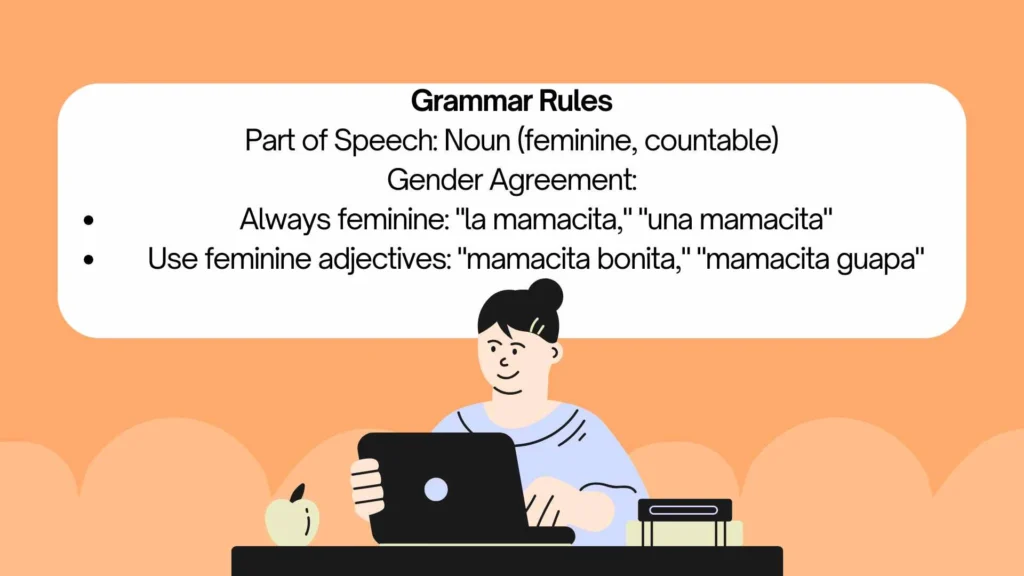
Part of Speech: Noun (feminine, countable)
Gender Agreement:
- Always feminine: “la mamacita,” “una mamacita”
- Use feminine adjectives: “mamacita bonita,” “mamacita guapa”
Usage Examples:
- Direct Address: “Hola, mamacita!” (Hello, beautiful!)
- Subject: “La mamacita llegó tarde.” (The hottie arrived late.)
- Object: “Vi a una mamacita en la fiesta.” (I saw a hottie at the party.)
Synonyms and Antonyms
Synonyms:
- Spanish: mamita, mami, bombón, muñeca, linda, chula
- English: babe, hottie, sweetheart, hot mama, cutie, honey
Antonyms:
- Spanish: fea (ugly), vieja (old woman—derogatory), señora (formal/literal)
- English: ugly, plain, unappealing
Formal vs. Informal Usage
Formal Contexts:
- Avoid usage in formal situations
- Considered too familiar and potentially disrespectful
- Better to use: “señora” or “señorita”
Informal Contexts:
- Common Usage: Among friends, family, or in flirtatious situations
- Social Media: Very common in comments and captions
- Music and Pop Culture: Frequently appears in song lyrics and media
Context Matters:
- At Home: Can be affectionate from parents to daughters
- On the Street: Can be perceived as catcalling or disrespectful
- Between Friends: Typically affectionate and acceptable
Illustrative Examples
- “¡Hola, mamacita!” he called out to his girlfriend.
- The song lyrics kept repeating “mamacita bonita.”
- She smiled when he called her mamacita.
- His grandmother was always called mamacita by the family.
- The women laughed when the man called them mamacitas.
- “Tranquila, mamacita,” her friend said calmly.
- In Mexico, “mamacita” can be a term of endearment at home.
- He posted a photo with the caption “My mamacita ♥.”
- The children called their aunt mamacita affectionately.
- “Ay, mamacita!” he exclaimed when he saw her.
- The coach called her mamacita because she cared for the team.
- “Mamacita, you look beautiful today,” he complimented.
Practice Section (15 MCQs)
- What is the correct spelling?
- a) Mamasita
- b) Mamacita
- c) Mamacitta
- d) Mammacita
- “Mamacita” comes from which root word?
- a) Mama
- b) Mamá
- c) Mami
- d) Mamasita
- What does the suffix “-cita” indicate?
- a) Large size
- b) Diminutive (small/affectionate)
- c) Male gender
- d) Plural form
- “Mamacita” literally translates to:
- a) Big mother
- b) Little mother
- c) Beautiful woman
- d) Sister
- Why do people misspell “mamacita” as “mamasita”?
- a) It’s correct in some countries
- b) Pronunciation confusion (seseo)
- c) British English spelling
- d) Formal variant
- Which term is the male equivalent of “mamacita”?
- a) Mamacito
- b) Papacito
- c) Papacita
- d) Mamito
- In which context is “mamacita” used?
- a) Formal business letters
- b) Term of endearment
- c) Official documents
- d) Academic writing
- In Spain, “mamacita” is:
- a) Very common
- b) Rarely used
- c) The only term
- d) Formal
- “Mamacita” is what part of speech?
- a) Verb
- b) Noun
- c) Adjective
- d) Adverb
- Latin “mamma” means:
- a) Father
- b) Mother and breast
- c) Sister
- d) Child
- Which is a synonym of “mamacita” in English?
- a) Ugly
- b) Hottie
- c) Child
- d) Grandma
- The plural of “mamacita” is:
- a) Mamacitas
- b) Mamacita’s
- c) Mamacitas’
- d) Mamacite
- Which of the following is a common typo?
- a) Mamacita
- b) Mamasita
- c) Mamita
- d) Mami
- “Mamacita” can be used to address:
- a) Only one’s mother
- b) Any attractive woman
- c) Only children
- d) Only men
- The correct spelling is:
- a) M-A-M-A-S-I-T-A
- b) M-A-M-A-C-I-T-A
- c) M-A-M-A-C-I-T-T-A
- d) M-A-M-M-A-C-I-T-A
Answer Key:
- b
- b
- b
- b
- b
- b
- b
- b
- b
- b
- b
- a
- b
- b
- b
Frequently Asked Questions
Q1: Is it “mamasita” or “mamacita”?
The correct spelling is mamacita with a ‘c’. “Mamasita” is a common misspelling . The error arises because in Latin American Spanish, ‘c’ and ‘s’ sound the same before ‘e’ and ‘i’.
Q2: What does “mamacita” mean?
“Mamacita” literally means “little mother” but is used as a term of endearment for an attractive woman, girlfriend, or beloved female figure . It can be affectionate or flirtatious depending on context .
Q3: What is the difference between “mamacita” and “mamita”?
Both are diminutives of “mamá.” “Mamacita” is a more emphatic form, adding the “-cita” suffix to “mamá” . “Mamita” uses the shorter “-ita” suffix. Both are terms of endearment with similar meanings.
Q4: Is “mamacita” offensive?
It depends entirely on context. In family settings, it can be affectionate . However, when shouted at a stranger on the street, it can be perceived as catcalling and disrespectful . Always consider your relationship with the person.
Q5: How is “mamacita” pronounced?
It is pronounced “mah-mah-SEE-tah” in Latin America or “mah-mah-THEE-tah” in Spain. The ‘c’ before ‘i’ is pronounced as ‘s’ in Latin America (seseo), which creates the spelling confusion.
Conclusion
I hope this guide has resolved the confusion between “mamasita” and “mamacita.” Remember that “mamacita” is the only correct spelling, preserving the root word “mamá” with the diminutive suffix “-cita.” The misspelling “mamasita” arises from pronunciation similarities in Latin American Spanish. Understanding this distinction will help you communicate respectfully and accurately in Spanish. Whether used affectionately with family or flirtatiously with a partner, using the correct spelling shows linguistic awareness and cultural sensitivity.

James Anderson is a thriller and mystery author known for his suspenseful plots and unexpected twists. His storytelling keeps readers on the edge of their seats, blending intrigue with psychological depth. James has a talent for creating gripping narratives that captivate audiences from beginning to end.
📚 Books:
- The Hidden Truth
- Shadow Game
- Beyond the Lies
 Ethan Walker
 Olivia Turner