Table of Contents
- Introduction
- Direct Answer
- Quick Comparison Table
- Deep Meanings & Definitions
- Historical Origin & Etymology
- Pronunciation Guide
- The Technical Differences
- Correct Spelling & Common Typos
- Mnemonic Devices
- Regional Variations
- Singular and Plural Forms
- Grammar Rules
- Synonyms and Antonyms
- Formal vs. Informal Usage
- Illustrative Examples
- Practice Section (15 MCQs)
- Frequently Asked Questions
- Conclusion
Introduction
I have noticed that one of the most common questions travelers ask before visiting this Mediterranean paradise is whether to call it “Mallorca” or “Majorca.” This spelling confusion has persisted for decades, puzzling tourists and even seasoned travelers. In this guide, I will explain the history, correct usage, and cultural significance of both spellings.
Direct Answer
Mallorca and Majorca refer to the exact same island in Spain’s Balearic archipelago. Mallorca is the official Catalan and Spanish spelling used locally, while Majorca is the Anglicized version commonly used in English-speaking countries . Both are correct, but Mallorca is increasingly preferred internationally .
Quick Comparison Table
| Feature | Mallorca | Majorca |
| Status | Official, local spelling | Anglicized version |
| Language | Catalan/Spanish | English |
| Usage | Local signs, government, media | UK travel brochures, older literature |
| Pronunciation | Mah-YOR-ka | Mah-YOR-ka (same) |
| Preference | Preferred by locals | Traditional British usage |
Deep Meanings & Definitions
Mallorca:
- The official name of the largest island in Spain’s Balearic Islands
- Used in Catalan, the local language of the Balearic Islands
- Appears on road signs, government documents, and local media
Majorca:
- The English adaptation of the island’s name
- Commonly used in the United Kingdom and other English-speaking countries
- Derived from the Latin “insula maior” meaning “larger island”
Historical Origin & Etymology
Latin Origins:
- The name derives from “insula maior” meaning “larger island”
- Used to distinguish it from Menorca (“insula minor” – smaller island)
Evolution:
- Latin: insula maior → Medieval Latin: Maiorca
- Catalan: Mallorca (hypercorrected by scribes)
- English: Majorca (anglicized version)
British Influence:
- British tourists began visiting in large numbers during the 1950s-60s
- Travel brochures used “Majorca” as the standard spelling
- This tradition continued for decades
Pronunciation Guide
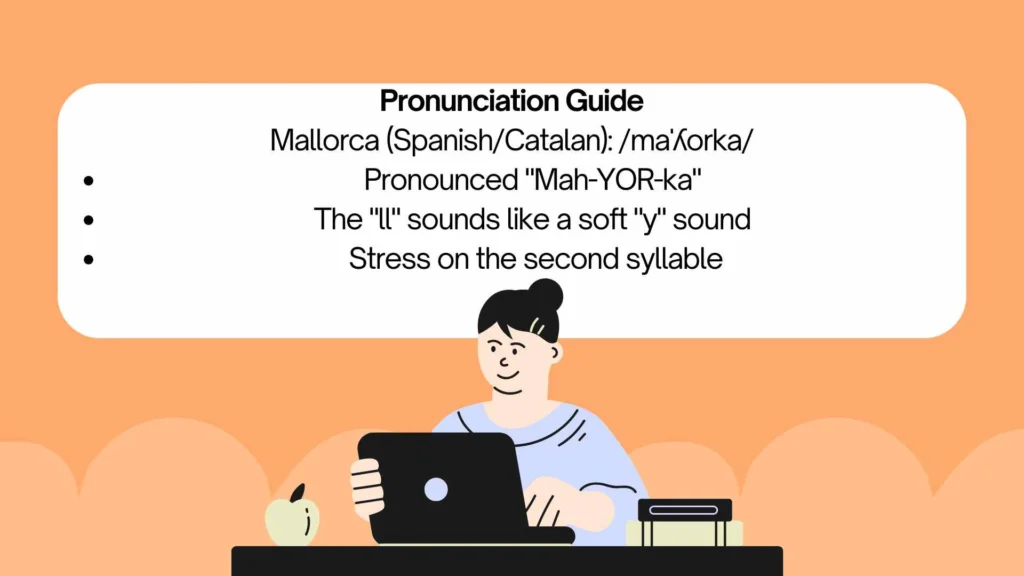
Mallorca (Spanish/Catalan): /maˈʎorka/
- Pronounced “Mah-YOR-ka”
- The “ll” sounds like a soft “y” sound
- Stress on the second syllable
Majorca (English): /məˈjɔːrkə/
- Also pronounced “Mah-YOR-ka”
- Despite the “j,” it’s pronounced with a “y” sound
Common Mistake: Many English speakers pronounce Majorca with a hard “j” (as in “major”), which is incorrect .
The Technical Differences
No Geographic Difference:
- Both spellings refer to the identical island
- Same location, same culture, same everything
The Linguistic Reason:
- The double “ll” in Spanish and Catalan is pronounced like a “y” sound
- Early British tourists struggled with this pronunciation
- To simplify, they replaced “ll” with “j” creating “Majorca”
The Cultural Aspect:
- Using “Mallorca” shows respect for local culture and language
- Some locals resent the anglicized spelling as it ignores their cultural identity
Correct Spelling & Common Typos
Correct:
- Mallorca (official, preferred)
- Majorca (anglicized, acceptable in English)
Common Typos:
- Mallorca (already correct)
- Majorka (confusing pronunciations)
- Mallorca (already correct)
Which to Use:
The official and culturally respectful choice is Mallorca. Majorca is still understood but becoming less common .
Mnemonic Devices
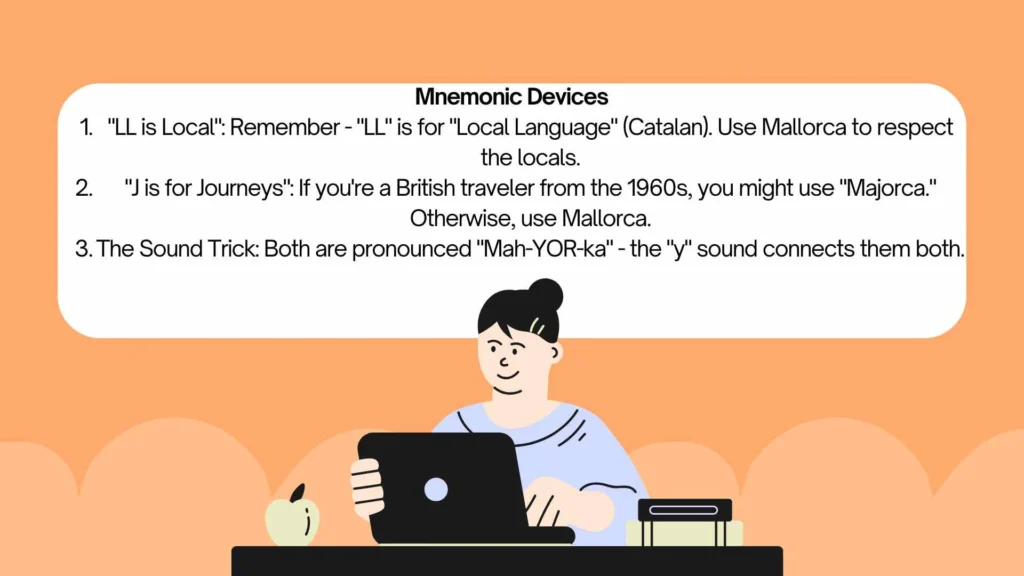
- “LL is Local”: Remember – “LL” is for “Local Language” (Catalan). Use Mallorca to respect the locals.
- “J is for Journeys”: If you’re a British traveler from the 1960s, you might use “Majorca.” Otherwise, use Mallorca.
- The Sound Trick: Both are pronounced “Mah-YOR-ka” – the “y” sound connects them both.
Regional Variations
British English:
- Historically used “Majorca”
- Modern usage increasingly shifting to “Mallorca”
- Many travel companies now use “Mallorca”
American English:
- Both spellings used
- “Mallorca” becoming more common
- Travel industry often uses local spelling
Spanish/Catalan:
- Only “Mallorca” is used
- Other spellings are considered incorrect
Singular and Plural Forms
Singular:
- “Mallorca is a beautiful island.”
- “Majorca is a popular tourist destination.”
Plural (referring to regions/areas):
- Not applicable as it’s a proper noun
Possessive:
- “Mallorca’s beaches are stunning.”
- “Majorca’s capital is Palma.”
Grammar Rules
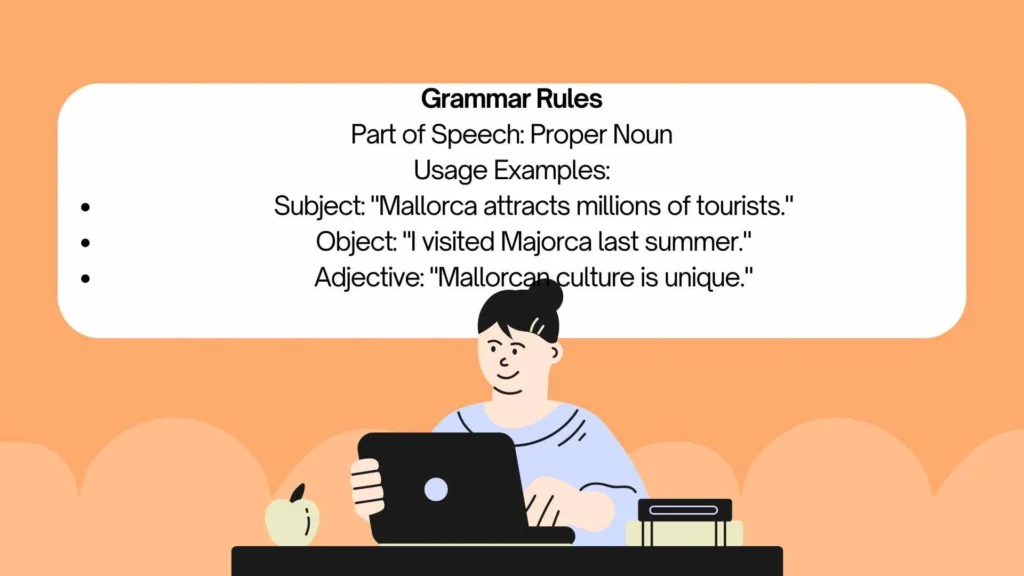
Part of Speech: Proper Noun
Usage Examples:
- Subject: “Mallorca attracts millions of tourists.”
- Object: “I visited Majorca last summer.”
- Adjective: “Mallorcan culture is unique.”
Synonyms and Antonyms
Synonyms:
- The Balearic Island
- Mediterranean paradise
- The largest Balearic island
Related Terms:
- Palma: The capital city
- Balearic Islands: The archipelago
- Menorca: The smaller neighboring island
Formal vs. Informal Usage
Formal Contexts:
- Government documents use “Mallorca”
- Academic writing prefers “Mallorca”
- “The government of Mallorca announced…”
Informal Contexts:
- Both acceptable in conversation
- “I’m going to Majorca for vacation.”
- “We’re flying to Mallorca tomorrow.”
Travel Industry:
- Increasingly using “Mallorca”
- Reflects modern preference for local names
Illustrative Examples
- Mallorca is the largest island in Spain’s Balearic archipelago.
- British tourists traditionally called the island Majorca .
- The capital of Mallorca is Palma de Mallorca.
- I booked my flight to Majorca for next summer.
- Locals prefer the spelling Mallorca .
- The pronunciation of Majorca is “Mah-YOR-ka.”
- Mallorca has stunning beaches and mountains.
- The name Majorca comes from Latin “insula maior.”
- Mallorca is increasingly used in international travel guides.
- The double “ll” in Mallorca sounds like a “y.”
- Majorca was popularized by British travel brochures.
- Using Mallorca shows respect for local culture.
Practice Section (15 MCQs)
- Which spelling is used locally in the Balearic Islands?
- a) Mallorca
- b) Majorca
- c) Both equally
- d) Neither
- What does “insula maior” mean in Latin?
- a) Beautiful island
- b) Larger island
- c) Smaller island
- d) Spanish island
- Which country popularized the spelling “Majorca”?
- a) United States
- b) Spain
- c) United Kingdom
- d) Germany
- How is “Mallorca” pronounced?
- a) Mah-YOR-ka
- b) Mah-JOR-ka
- c) Mal-LOR-ka
- d) May-JOR-ka
- The double “ll” in Spanish is pronounced like:
- a) L
- b) J
- c) Y
- d) H
- Which is the official language of Mallorca?
- a) Spanish
- b) Catalan
- c) English
- d) French
- Why did the British start using “Majorca”?
- a) It was the original name
- b) They couldn’t pronounce the double “ll”
- c) The locals asked them to
- d) It means the same thing
- Which spelling is preferred internationally today?
- a) Majorca
- b) Mallorca
- c) Both equally
- d) Neither
- The capital of Mallorca is:
- a) Madrid
- b) Barcelona
- c) Palma
- d) Valencia
- Mallorca is part of which country?
- a) France
- b) Italy
- c) Spain
- d) Portugal
- Which spelling appears on local road signs?
- a) Majorca
- b) Mallorca
- c) Both
- d) Neither
- Which is grammatically correct for use in Spanish?
- a) Mallorca
- b) Majorca
- c) Both
- d) Neither
- What is the smaller island called?
- a) Mallorca
- b) Menorca
- c) Majorca
- d) Ibiza
- Which pronunciation is incorrect?
- a) Mah-YOR-ka
- b) May-JOR-ka
- c) Ma-yor-ka
- d) Mah-yor-ka
- Using which spelling shows cultural respect?
- a) Majorca
- b) Mallorca
- c) Both
- d) Neither
Answer Key:
- a
- b
- c
- a
- c
- b
- b
- b
- c
- c
- b
- a
- b
- b
- b
Frequently Asked Questions
Q1: Is it Mallorca or Majorca?
Both spellings are correct. Mallorca is the official Catalan and Spanish spelling used locally, while Majorca is the Anglicized version commonly used in British English . Mallorca is increasingly preferred internationally.
Q2: Why do people call it Majorca?
The British popularized “Majorca” when mass tourism began in the 1950s and 60s. Travel brochures used this spelling because English speakers struggled with the double “ll” in Mallorca, which is pronounced like a “y” .
Q3: What does Mallorca mean in English?
Mallorca means “larger island” from the Latin “insula maior.” It was used to distinguish it from Menorca, which means “smaller island” .
Q4: How do locals pronounce Mallorca?
Locals pronounce it “Mah-YOR-ka” with the “ll” sounding like a soft “y.” It’s the same pronunciation whether you spell it Mallorca or Majorca .
Q5: Which spelling should I use?
Using “Mallorca” is recommended as it respects the local culture and language . While “Majorca” is still understood, locals prefer the Catalan spelling.
Conclusion
I hope this guide has clarified the difference between Mallorca and Majorca. Remember that both spellings refer to the same beautiful island, but Mallorca is the official and culturally respectful spelling . The name comes from the Latin “insula maior” meaning “larger island.” While British tourists popularized “Majorca” in the 1960s, modern usage increasingly favors the local spelling. Whether you choose Mallorca or Majorca, you’re talking about the stunning Mediterranean paradise that attracts millions of visitors each year.

Olivia Turner is a lifestyle and contemporary romance writer who focuses on positivity and everyday inspiration. Her stories are light, relatable, and filled with warmth, making them perfect for readers looking for uplifting content. Olivia draws inspiration from daily life and simple joyful moments.
📚 Books:
- Love & Coffee
- Chasing Happiness
- Moments That Matter
 Ethan Walker