Table of Contents
- Introduction
- Direct Explanation: What Half Staff or Half Mast Means
- Quick Comparison Table
- Deep Meanings & Definitions
- Historical Origin & Etymology
- Pronunciation Guide
- The Technical Differences Explained
- Correct Usage & Common Confusions
- Memory Tricks to Remember the Difference
- Regional Variations (US vs. UK English)
- Singular and Plural Forms
- Grammar & Parts of Speech
- Synonyms and Related Terms
- Formal vs Informal Usage
- Illustrative Examples
- Practice Section (15 MCQs)
- Frequently Asked Questions (FAQs)
- Conclusion
Introduction
I often notice people using “half staff” and “half mast” interchangeably without realizing that both terms carry specific historical and cultural meanings. This confusion appears frequently in news reporting, ceremonies, and even educational writing.
Understanding the difference is important because these phrases are tied to national mourning, respect, and formal protocol.
In this guide, I will break down both terms in a simple yet deeply informative way.
We’ll explore their meanings, origins, correct usage, and regional differences.
By the end, you’ll know exactly when to use each expression confidently and correctly.
Direct Explanation: What Half Staff or Half Mast Means
Half staff and half mast both refer to the practice of flying a flag halfway down a flagpole as a sign of mourning, respect, or distress. “Half staff” is commonly used on land, especially in the United States, while “half mast” is traditionally used in maritime contexts and in British English.
Quick Comparison Table
| Feature | Half Staff | Half Mast |
| Usage Location | Land | Ships / Maritime |
| Common Region | US English | UK English |
| Meaning | Flag lowered in respect | Flag lowered in respect |
| Core Context | Government buildings, schools | Naval ships, sea contexts |
Deep Meanings & Definitions
Half Staff
Half staff refers to a flag position where the flag is flown below the top of a pole to symbolize mourning or respect. It is widely used in American English.
Half Mast
Half mast has the same meaning but is traditionally used in maritime environments, where “mast” refers to the vertical pole on a ship.
Both terms symbolize:
- National mourning
- Respect for deceased leaders
- Remembrance of tragedies
Historical Origin & Etymology
Half Staff
- “Staff” comes from Old English stæf, meaning a pole or stick
- Adopted in American usage for land-based flagpoles
Half Mast
- “Mast” originates from Old Norse mastr, meaning ship pole
- Historically used in naval traditions dating back centuries
The distinction developed due to land vs sea environments, not meaning differences.
Pronunciation Guide
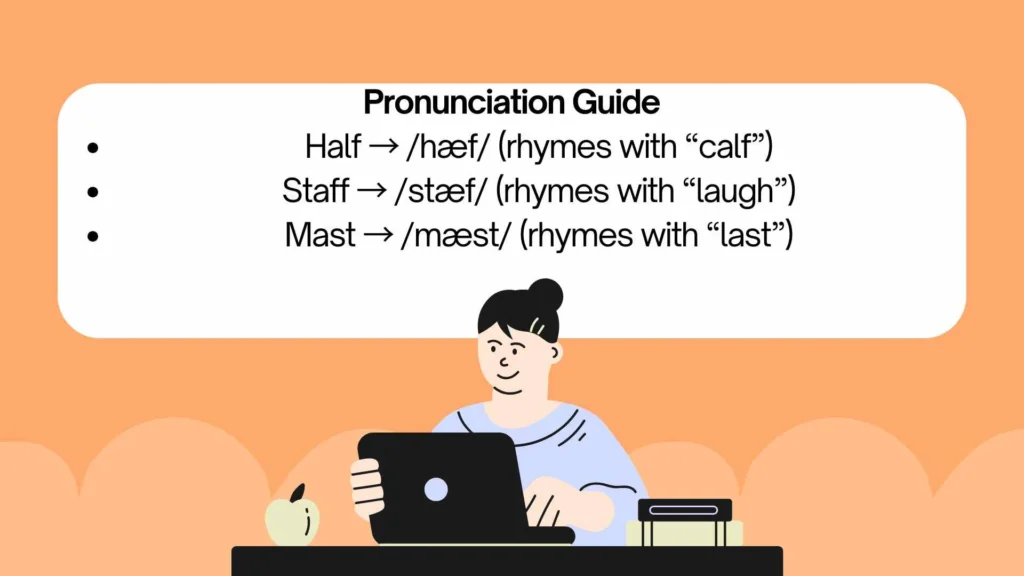
- Half → /hæf/ (rhymes with “calf”)
- Staff → /stæf/ (rhymes with “laugh”)
- Mast → /mæst/ (rhymes with “last”)
The Technical Differences Explained
Although both phrases mean the same symbolic act, their usage differs based on context and tradition:
Key Technical Distinctions:
- Half staff → land-based flags
- Half mast → ship-based flags
- US government officially prefers “half staff”
- UK and naval forces prefer “half mast”
Why the Confusion Happens:
- Both involve flags
- Both symbolize mourning
- Media often uses them interchangeably
Correct Usage & Common Confusions
Common Mistakes:
- Using “half mast” for land ceremonies in the US
- Using “half staff” for naval ships
- Assuming they are completely interchangeable
Why These Errors Occur:
- Lack of regional awareness
- Media generalization
- Similar symbolic meaning
Memory Tricks to Remember the Difference
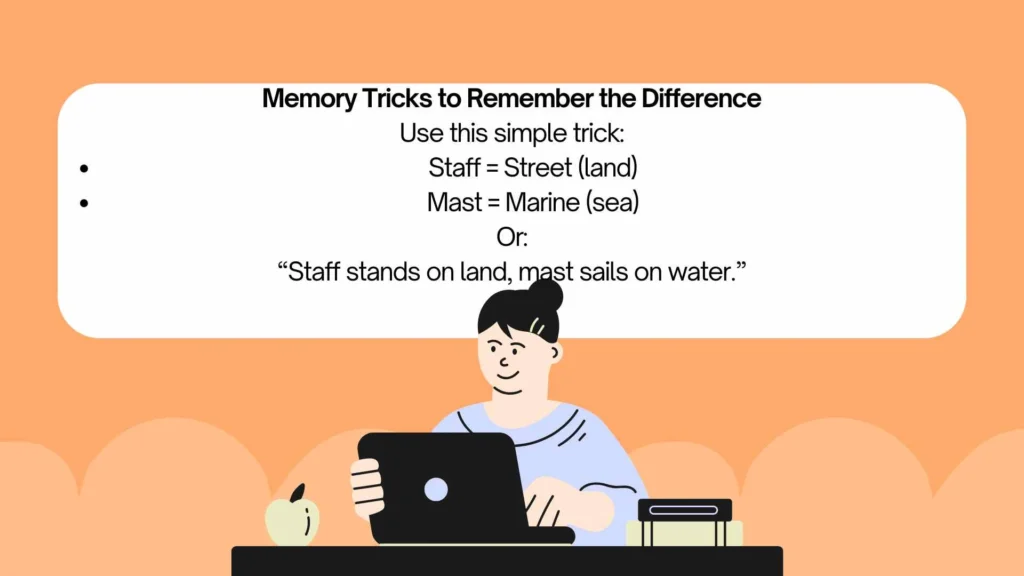
Use this simple trick:
- Staff = Street (land)
- Mast = Marine (sea)
Or:
“Staff stands on land, mast sails on water.”
Regional Variations (US vs. UK English)
United States:
- Official term: Half staff
- Used in presidential proclamations
United Kingdom:
- Preferred term: Half mast
- Used in royal and naval contexts
Canada & Australia:
- Mixed usage, but closer to UK tradition
Singular and Plural Forms
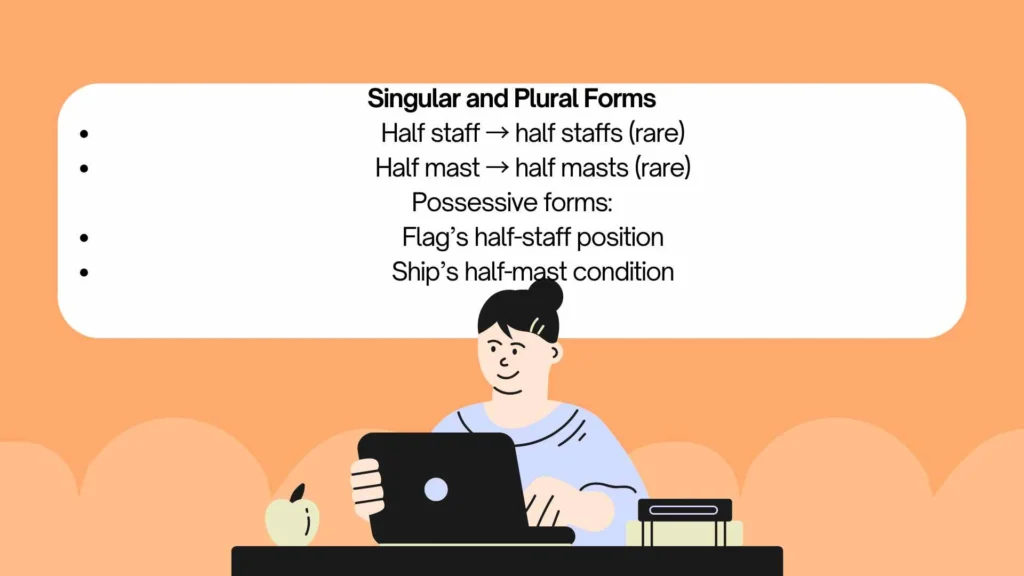
- Half staff → half staffs (rare)
- Half mast → half masts (rare)
Possessive forms:
- Flag’s half-staff position
- Ship’s half-mast condition
Grammar & Parts of Speech
- Half staff → noun phrase
- Half mast → noun phrase
- “Half” acts as an adjective modifying staff/mast
Example:
- “The flag is at half staff today.”
Synonyms and Related Terms
Synonyms:
- Lowered flag
- Mourning flag position
- Flag at half position
Related Terms:
- National mourning
- Remembrance ceremony
- Flag protocol
Antonyms:
- Full staff
- Full mast
- Flag at peak
Formal vs Informal Usage
Formal Usage:
- Government announcements
- Military protocols
- News reporting
Informal Usage:
- Conversations
- Social media posts
- Educational discussions
Illustrative Examples
- The flag was lowered to half staff after the tragedy.
- Naval ships flew flags at half mast during the ceremony.
- The president ordered all flags at half staff.
- The ship’s flag remained at half mast for three days.
- Schools observed the day with flags at half staff.
- The fleet returned with flags at half mast.
- The nation mourned with flags at half staff.
- The sailors adjusted the flag to half mast.
- Memorial Day often includes flags at half staff.
- The docked vessel displayed half-mast flags.
- Government buildings stood silent under half-staff flags.
- The naval base observed half-mast protocol.
Practice Section (15 MCQs)
- Half staff is mainly used in:
A) Ships
B) Land-based flags - Half mast refers to:
A) Naval flags
B) Building flags - Which country prefers “half staff”?
A) UK
B) USA - “Half mast” is used in:
A) Maritime contexts
B) Schools - Both terms mean:
A) Celebration
B) Mourning - Staff refers to:
A) Ship pole
B) Land pole - Mast refers to:
A) Naval pole
B) Chair - Flags are lowered for:
A) Respect
B) Decoration - Which is American usage?
A) Half mast
B) Half staff - Which is British usage?
A) Half staff
B) Half mast - The phrase indicates:
A) Victory
B) Mourning - Mast is associated with:
A) Ships
B) Buildings - Staff is associated with:
A) Sea
B) Land - The phrase is used in:
A) Sports only
B) Ceremonial events - Both phrases are:
A) Opposite meanings
B) Same meaning, different usage
Answer Key:
1-B, 2-A, 3-B, 4-A, 5-B, 6-B, 7-A, 8-A, 9-B, 10-B, 11-B, 12-A, 13-B, 14-B, 15-B
Frequently Asked Questions (FAQs)
1. Are half staff and half mast the same?
Yes, both mean flags lowered in mourning, but usage differs by context.
2. When should I use half staff?
Use it for land-based flags, especially in the United States.
3. When should I use half mast?
Use it for ships or maritime contexts, especially in British English.
4. Why are flags flown at half staff or mast?
To show respect during mourning or national tragedy.
5. Is one term more correct than the other?
No, both are correct depending on regional and contextual usage.
Conclusion
Understanding the difference between half staff and half mast helps you use language more accurately in formal and cultural contexts. While both expressions symbolize mourning and respect, their usage depends on whether the setting is land-based or maritime.
By mastering this distinction, you avoid common errors and communicate with greater precision.
Remember: language is not just about meaning—it’s about context.

James Anderson is a thriller and mystery author known for his suspenseful plots and unexpected twists. His storytelling keeps readers on the edge of their seats, blending intrigue with psychological depth. James has a talent for creating gripping narratives that captivate audiences from beginning to end.
📚 Books:
- The Hidden Truth
- Shadow Game
- Beyond the Lies
 Ethan Walker
 Olivia Turner