Table of Contents
- Introduction
- Direct Answer
- Quick Comparison Table
- Deep Meanings & Definitions
- Historical Origin & Etymology
- Pronunciation Guide
- The Technical Differences
- Correct Spelling & Common Typos
- Mnemonic Devices (Memory Tricks)
- Regional Variations (US vs UK English)
- Singular and Plural Forms
- Grammar Rules & Parts of Speech
- Synonyms and Antonyms
- Formal vs Informal Usage
- Illustrative Examples
- Practice Section (15 MCQs)
- Frequently Asked Questions (FAQs)
- Conclusion
Introduction
I’ve seen even advanced English learners hesitate when choosing between “leaves” and “leafs.” At first glance, both seem correct and technically, they are. But using the wrong one in the wrong context can instantly weaken your writing.
This confusion arises because English pluralization rules are not always consistent.
Understanding the difference is not just about grammar; it’s about precision and clarity.
In this guide, I’ll break down everything you need to know from linguistic roots to real-world usage.
By the end, you’ll never second-guess yourself again.
Direct Answer
“Leaves” is the correct plural form of the noun “leaf” (as in tree leaves), while “leafs” is a verb form meaning “to flip through pages.” Use “leaves” for plants and “leafs” only when referring to turning pages quickly.
Quick Comparison Table
| Aspect | Leaves | Leafs |
| Spelling Type | Plural noun | Verb (third person singular) |
| Meaning | More than one leaf (plant) | Turns pages quickly |
| Usage | Nature, trees, seasons | Books, magazines |
| Correct in Most Contexts | Yes | Rare |
Deep Meanings & Definitions
Leaves
- Plural of leaf
- Refers to flat green parts of plants or trees
- Used metaphorically for growth, change, or cycles
Examples:
- The leaves fall in autumn.
- Green leaves symbolize life.
Leafs
- Verb form of leaf
- Means: to flip or turn pages casually
Examples:
- She leafs through the magazine.
- He leafs through old notebooks.
Leaves or leafs meaning
- Like a tree changing with the seasons, “leaves” is the correct plural form of leaf.
- Like pages in a favorite book, leaves appear together in nature.
- Like feathers on a bird, leaves help a plant thrive.
- Like puzzle pieces, leaves complete the beauty of a tree.
- Like tiny umbrellas, leaves protect branches from harsh sunlight.
- Like green flags in the wind, leaves move with every breeze.
- Like nature’s artwork, leaves add color to every landscape.
- Like silent workers, leaves produce food for plants.
- Like family members, leaves grow from one strong tree.
- Like changing seasons, the meaning of leaves reflects growth and renewal.
Tree leaves or leafs
- Like branches holding treasures, tree leaves cover every limb.
- Like green blankets, tree leaves shade the ground below.
- Like tiny solar panels, tree leaves capture sunlight.
- Like dancers in the breeze, tree leaves move gracefully.
- Like fresh decorations, tree leaves brighten every season.
- Like protective shields, tree leaves guard delicate branches.
- Like nature’s confetti, tree leaves scatter in autumn.
- Like peaceful whispers, tree leaves rustle softly in the wind.
- Like cooling fans, tree leaves help trees stay healthy.
- Like signs of life, tree leaves show healthy growth.
Leaf singular or plural
- Like one apple and many apples, leaf is singular while leaves is plural.
- Like one flower and many flowers, leaf changes when there is more than one.
- Like one bird and many birds, grammar changes with quantity.
- Like one page in a notebook, one leaf stands alone.
- Like one star in the sky, a leaf represents a single item.
- Like one brick in a wall, one leaf is only one part.
- Like one raindrop before a shower, one leaf begins the collection.
- Like one key on a keyboard, one leaf refers to a single object.
- Like one step in a journey, one leaf starts the path.
- Like one smile in a crowd, one leaf stands out by itself.
Is leafs a word
- Like a common typo, leafs appears in writing but is usually incorrect as the plural of leaf.
- Like a mistaken turn on a road, leafs often leads to confusion.
- Like a spelling slip, leafs looks familiar but is not the standard plural.
- Like a wrong puzzle piece, leafs does not fit standard grammar.
- Like an outdated map, leafs can point readers in the wrong direction.
- Like a practice draft, leafs may appear before correction.
- Like a missed note in music, leafs sounds close but is not correct in most cases.
- Like a misplaced comma, leafs is a common writing mistake.
- Like an unfinished sketch, leafs needs correction to become leaves.
- Like a learning step, leafs reminds people to remember irregular plurals.
Leave or leaves holiday
- Like planning a trip, leave refers to time away from work.
- Like opening a vacation calendar, leave helps people enjoy holidays.
- Like pressing pause, leave gives time to rest.
- Like a recharge for a battery, leave restores energy.
- Like taking a deep breath, leave offers a welcome break.
- Like stepping off a busy road, leave creates personal time.
- Like closing a laptop after work, leave marks the start of relaxation.
- Like packing a suitcase, leave often begins a holiday.
- Like turning the page, leave starts a new experience.
- Like enjoying a weekend sunrise, leave brings fresh moments.
Left or leaves
- Like choosing the right key, left and leaves have completely different meanings.
- Like two roads crossing, left and leaves should not be confused.
- Like night and day, these words serve different purposes.
- Like a map and a tree, each word belongs to a different context.
- Like different tools in a toolbox, each word has its own use.
- Like different colors in a painting, each word adds unique meaning.
- Like separate chapters in a book, left and leaves tell different stories.
- Like different signs on a highway, they guide readers differently.
- Like different seasons, each word has its own role.
- Like separate doors in a hallway, left and leaves lead to different meanings.
Door leaves or leafs
- Like two halves of a gate, door leaves describe movable door panels.
- Like matching wings, door leaves open together.
- Like balanced scales, door leaves create symmetry.
- Like book covers, door leaves protect what is inside.
- Like theater curtains, door leaves open to welcome visitors.
- Like puzzle pieces, door leaves fit perfectly together.
- Like mirror images, door leaves often match in size.
- Like careful guardians, door leaves secure an entrance.
- Like open arms, door leaves create a welcoming space.
- Like strong partners, door leaves work together every day.
Leaves or leafs toronto maple leafs
- Like a famous team name, Toronto Maple Leafs intentionally uses Leafs instead of Leaves.
- Like a family tradition, the team keeps its historic spelling.
- Like a recognizable logo, the name stands out instantly.
- Like a classic landmark, the spelling reflects history.
- Like a treasured nickname, Leafs has become part of the team’s identity.
- Like a signature autograph, the spelling is unique to the franchise.
- Like a historic trophy, the name carries tradition.
- Like a well-known brand, the spelling is easy for fans to recognize.
- Like a lasting legacy, the name has remained unchanged for generations.
- Like a piece of sports history, Leafs is correct when referring to the Toronto hockey team.
Historical Origin & Etymology
Leaf → Leaves
- Originates from Old English “lēaf”
- Germanic roots
- Irregular plural formed by vowel change (f → v → ves)
This pattern is similar to:
- Wolf → Wolves
- Knife → Knives
Leaf (verb) → Leafs
- Verb usage developed later in English
- “Leaf through” became common in the 19th century
- Regular verb formation: adds -s in third person
Pronunciation Guide
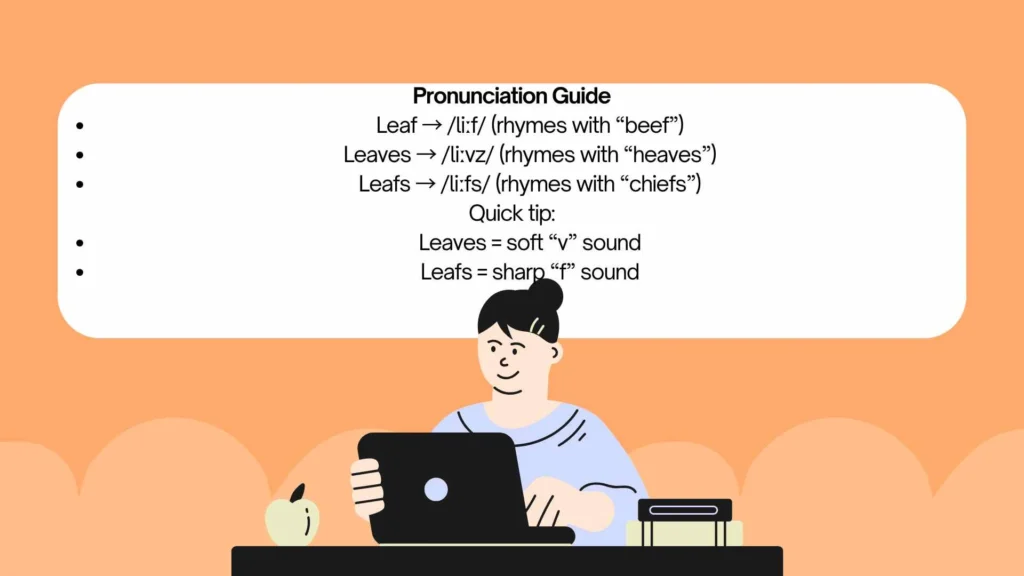
- Leaf → /liːf/ (rhymes with “beef”)
- Leaves → /liːvz/ (rhymes with “heaves”)
- Leafs → /liːfs/ (rhymes with “chiefs”)
Quick tip:
- Leaves = soft “v” sound
- Leafs = sharp “f” sound
The Technical Differences
The confusion arises because English uses two different grammatical systems here:
1. Irregular Plural Rule
- Leaf → Leaves
- F changes to V + ES
2. Regular Verb Rule
- Leaf → Leafs (adds “s”)
Linguistic Insight:
- Nouns often follow historical irregular patterns
- Verbs tend to follow predictable modern rules
This is why:
- Leaves = noun plural
- Leafs = verb form
Correct Spelling & Common Typos
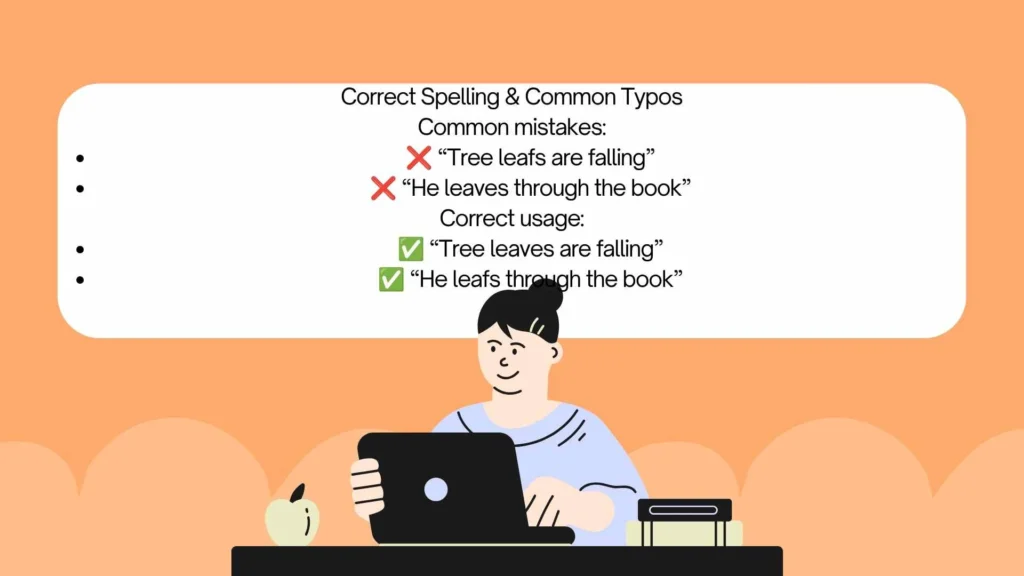
Common mistakes:
- ❌ “Tree leafs are falling”
- ❌ “He leaves through the book”
Correct usage:
- ✅ “Tree leaves are falling”
- ✅ “He leafs through the book”
Why errors happen:
- Overgeneralization of plural rules
- Confusion between noun and verb forms
Mnemonic Devices (Memory Tricks)
Trick 1:
“Leaves belong to trees, not books.”
Trick 2:
“If it grows, it’s leaves. If it flips, it’s leafs.”
Trick 3:
- V in leaves = vegetation
Regional Variations (US vs UK English)
Good news: there’s no major regional difference here.
Across:
- American English
- British English
- Canadian English
- Australian English
The rules remain consistent:
- Leaves = plural noun
- Leafs = verb
Singular and Plural Forms
Noun:
- Singular: leaf
- Plural: leaves
Possessive:
- Leaf’s (one leaf)
- Leaves’ (multiple leaves)
Verb:
- I leaf
- He leafs
- They leaf
Grammar Rules & Parts of Speech
Leaf (noun)
- Countable noun
- Example: A leaf fell
Leaves (plural noun)
- Subject or object
- Example: Leaves cover the ground
Leaf (verb)
- Action verb
- Example: I leaf through pages
Leafs (verb form)
- Third-person singular
- Example: She leafs through books
Synonyms and Antonyms
Synonyms (Leaves context):
- Foliage
- Greens
- Blades
- Plant matter
(Leafs context):
- Flip
- Browse
- Scan
- Skim
Antonyms:
- Leaves → roots, stems
- Leafs → focus, study deeply
Formal vs Informal Usage
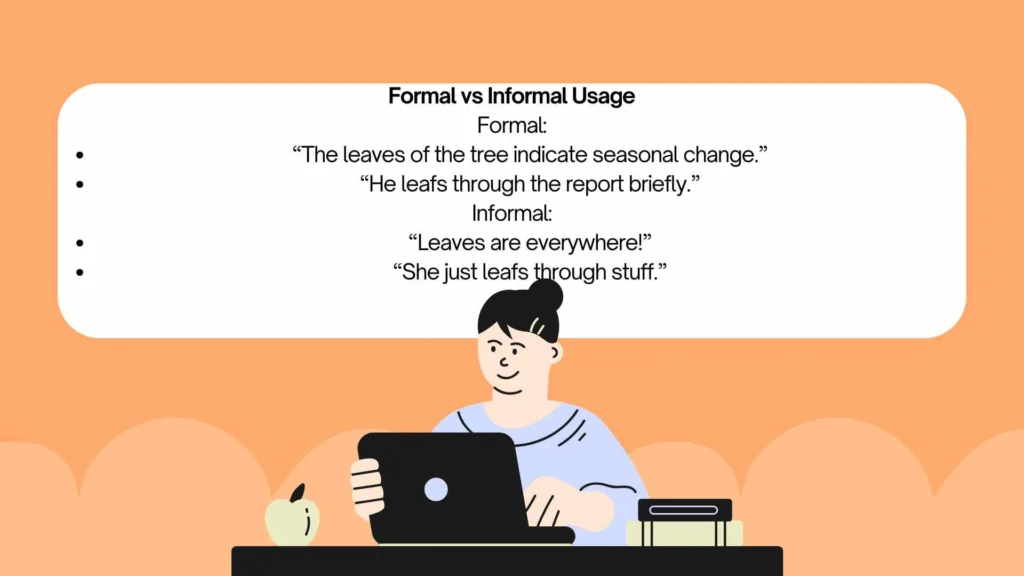
Formal:
- “The leaves of the tree indicate seasonal change.”
- “He leafs through the report briefly.”
Informal:
- “Leaves are everywhere!”
- “She just leafs through stuff.”
Illustrative Examples
- The leaves turn red in autumn.
- Dry leaves covered the ground.
- He leafs through the newspaper every morning.
- She leafs through her diary.
- Leaves provide shade and oxygen.
- The wind scattered the leaves.
- He quickly leafs through the book.
- Leaves fall during seasonal change.
- She leafs through fashion magazines.
- The tree lost all its leaves.
- He leafs through pages without reading deeply.
- Green leaves symbolize renewal.
Practice Section (15 MCQs)
1. The correct plural of leaf is:
A) Leafs
B) Leaves
C) Leafes
D) Leaf
2. “Leafs” is:
A) A plural noun
B) A verb
C) An adjective
D) A preposition
3. Choose correct sentence:
A) Tree leafs are green
B) Tree leaves are green
C) Tree leaf is green
D) Tree leafes are green
4. “He leafs through the book” means:
A) Reads deeply
B) Tears pages
C) Flips pages
D) Writes notes
5. Leaves are associated with:
A) Books
B) Trees
C) Cars
D) Phones
6. Leafs is used in:
A) Nature context
B) Reading context
C) Cooking
D) Travel
7. Correct pronunciation of leaves:
A) Leefs
B) Leevz
C) Leafs
D) Leef
8. Leaf → Leaves is:
A) Regular plural
B) Irregular plural
C) Verb form
D) Adjective
9. Which is incorrect?
A) Leaves fall
B) He leafs pages
C) Leafs fall
D) Leaves grow
10. Leafs belongs to:
A) Noun
B) Verb
C) Adjective
D) Article
11. Leaves indicates:
A) Action
B) Object
C) Description
D) Time
12. “Leafs” follows:
A) Irregular rule
B) Regular verb rule
C) No rule
D) Latin rule
13. Leaves sound like:
A) Chiefs
B) Heaves
C) Beliefs
D) Leafs
14. Leafs sound like:
A) Leaves
B) Chiefs
C) Heaves
D) Lives
15. Best tip:
A) Guess
B) Ignore rules
C) Know noun vs verb
D) Avoid word
Answer Key:
1-B, 2-B, 3-B, 4-C, 5-B, 6-B, 7-B, 8-B, 9-C, 10-B, 11-B, 12-B, 13-B, 14-B, 15-C
Frequently Asked Questions (FAQs)
Is “leafs” ever correct?
Yes, but only as a verb meaning to flip pages.
What is the plural of leaf?
The correct plural is leaves, not leafs.
Why does leaf become leaves?
Because of an irregular plural rule in English.
Can I use leafs for plants?
No, that is incorrect in standard English.
How do I remember the difference?
Think: Leaves grow, leafs flip.
Which is correct, leafs or leaves?
Leaves is the correct plural of leaf when talking about the green parts of a plant or tree. Leafs is only correct in special cases, such as the name of the Toronto Maple Leafs or when using leaf as a verb.
Is it leaves or leafs on a tree?
The correct phrase is leaves on a tree because leaves is the standard plural form of leaf in English. Using leafs for tree foliage is considered grammatically incorrect.
Is it two leaves or two leafs?
The correct expression is two leaves. Most nouns ending in -f change to -ves in the plural, making leaves the proper form in everyday English.
Why is it leafs not leaves?
In standard English, it is not leafs when referring to the plural of leaf. Leaves follows the traditional English plural rule, while leafs is only used in specific names, sports teams, or as a verb.
Is it Maple Leafs or maple leaves?
Maple Leafs is correct when referring to the famous hockey team because it is the team’s official name. Maple leaves is correct when talking about the leaves that grow on a maple tree.
What is going on with the Leafs?
When people say the Leafs, they are referring to the Toronto Maple Leafs hockey team. The nickname uses Leafs as part of the official team name, even though the normal plural of leaf is leaves.
Conclusion
The difference between leaves and leafs is a perfect example of how English blends history with logic.
While “leaves” dominates as the plural noun, “leafs” survives as a specialized verb form.
Understanding this distinction strengthens both writing accuracy and linguistic awareness.
Instead of memorizing rules blindly, focus on context nature vs action.
Once you grasp this, the confusion disappears completely.
Mastering small distinctions like this builds powerful communication skills over time.

James Anderson is a thriller and mystery author known for his suspenseful plots and unexpected twists. His storytelling keeps readers on the edge of their seats, blending intrigue with psychological depth. James has a talent for creating gripping narratives that captivate audiences from beginning to end.
📚 Books:
- The Hidden Truth
- Shadow Game
- Beyond the Lies
 Ethan Walker
 Olivia Turner