Table of Contents
- Introduction
- Direct Answer
- Quick Comparison Table
- Deep Meanings & Definitions
- Historical Origin & Etymology
- Pronunciation Guide
- The Technical Differences
- Correct Spelling & Common Typos
- Mnemonic Devices (Memory Tricks)
- Regional Variations (US vs. UK English)
- Singular and Plural Forms
- Grammar Rules & Parts of Speech
- Synonyms and Antonyms
- Formal vs. Informal Usage
- Illustrative Examples
- Practice Section (15 MCQs)
- Frequently Asked Questions (FAQs)
- Conclusion
Introduction
I’ve often seen writers pause when deciding between “nighttime” and “night time.” It looks like a small difference, but it can affect clarity, professionalism, and even SEO rankings.
At first, I thought they were interchangeable. But once I dug deeper into grammar rules and usage patterns, I realized there’s a subtle yet important distinction.
If you’re writing blogs, emails, academic content, or even social media captions, choosing the correct form matters more than you think.
In this guide, I’ll break down everything—from meaning and grammar to real-world usage—so you never hesitate again.
By the end, you’ll confidently know when to use nighttime and when night time fits better.
Direct Answer
“Nighttime” is a compound noun commonly used as a single word in modern English, especially in American usage. “Night time” is an older or less common variant. Both mean the period between evening and morning, but “nighttime” is the preferred standard form today.
Quick Comparison Table
| Feature | Nighttime | Night Time |
| Spelling | One word | Two words |
| Meaning | Period of night | Same meaning |
| Core Usage | Modern, standard usage | Less common, traditional form |
Deep Meanings & Definitions
What is “Nighttime”?
Nighttime is a compound noun referring to:
- The period between sunset and sunrise
- The darker part of the day associated with rest, sleep, or quiet
It is widely accepted as the standard modern spelling.
What is “Night Time”?
Night time is a two-word phrase that carries the same meaning but:
- Appears less frequently in modern writing
- May be used stylistically for emphasis or rhythm
Nighttime or night-time uk spelling
- The correct UK spelling is usually night-time because British English commonly uses a hyphen in many compound nouns.
- Many UK publishers prefer night-time in formal writing, books, and educational materials.
- You may also see nighttime in modern content, but it is much less common in British English.
- Always follow your style guide if your school, workplace, or publisher has one.
- Use one spelling consistently throughout the same document.
- British readers recognize night-time more naturally than the closed form.
- Some modern websites simplify it to nighttime, but traditional UK usage still favors the hyphen.
- Consistency matters more than mixing styles within one article.
- Choose night-time when writing for a UK audience.
- Knowing your audience helps you pick the most appropriate spelling.
Nighttime or night time reddit
- Reddit users often debate whether nighttime or night time looks more natural.
- Many people prefer nighttime because it feels cleaner and more modern.
- Others choose night time when they want to emphasize the two separate words.
- Most discussions agree that context and style guide matter more than personal preference.
- American users usually recommend nighttime as one word.
- British users frequently mention night-time instead of either option.
- Reddit conversations highlight that both forms appear online.
- Experienced writers encourage consistency instead of switching between spellings.
- Many commenters suggest checking dictionary guidance before publishing.
- The final choice often depends on your audience and writing style.
Nighttime or night time oxford dictionary
- Oxford recognizes compound words based on modern English usage.
- Oxford references help writers choose the most accepted spelling.
- British English often prefers night-time in Oxford-style writing.
- American English commonly uses nighttime as one word.
- Oxford encourages consistent spelling throughout a document.
- Dictionary examples show how the word fits naturally into sentences.
- Oxford updates entries as language changes over time.
- Writers trust Oxford because it follows real-world language use.
- Checking Oxford reduces grammar mistakes in formal writing.
- Oxford guidance supports clear and accurate communication.
Nighttime or night time grammar
- Grammar treats nighttime as a compound noun in American English.
- Many style guides accept night-time in British English.
- The two-word form appears less often in modern formal writing.
- Grammar focuses on consistency instead of mixing different spellings.
- Your audience should influence the spelling you choose.
- Compound nouns naturally evolve into one word over time.
- Formal writing usually follows dictionary recommendations.
- Informal writing allows slightly more flexibility.
- Good grammar creates clarity for every reader.
- Correct spelling improves your writing’s credibility.
Nighttime or night time examples
- Nighttime is my favorite time to read quietly.
- The streets become peaceful during nighttime.
- We enjoy long walks at nighttime.
- Children usually sleep through the nighttime.
- The temperature drops during nighttime hours.
- Stars shine brightly in the nighttime sky.
- Many animals become active at nighttime.
- I finish my journal every nighttime before bed.
- Nighttime brings calm after a busy day.
- The city looks beautiful at nighttime.
Nighttime or night time oxford
- Oxford style helps writers choose the correct spelling confidently.
- British Oxford usage commonly favors night-time.
- Oxford examples reflect natural English instead of outdated rules.
- Reliable dictionaries improve writing accuracy.
- Oxford encourages consistency across every paragraph.
- Professional writers often check Oxford before publishing.
- Oxford explains compound words clearly and simply.
- Readers trust content that follows respected references.
- Oxford guidance supports both clarity and readability.
- Following Oxford recommendations strengthens professional writing.
Daytime or day time
- American English usually writes daytime as one word.
- British English may use day-time in some traditional contexts.
- The two-word form day time appears less often today.
- Modern writing generally prefers the closed compound.
- Choose one style and use it consistently.
- Daytime refers to the period between sunrise and sunset.
- Most dictionaries list daytime as the standard form.
- Simple, consistent spelling improves readability.
- Readers understand daytime immediately.
- Following your style guide keeps your writing professional.
Nighttime or night time ap style
- AP Style generally prefers common modern spellings that readers recognize easily.
- Many AP-style publications use nighttime as one word.
- Journalists should follow the latest AP Stylebook for consistency.
- News writing values clarity above personal preference.
- Consistent spelling strengthens professional reporting.
- Editors expect writers to follow one style throughout an article.
- AP Style helps create uniform and easy-to-read content.
- Always match the spelling with your publication’s editorial rules.
- Avoid switching between nighttime and night time in the same piece.
- A consistent AP-style approach improves readability and trust.
Historical Origin & Etymology
- Night comes from Old English “niht”
- Time comes from Old English “tīma”
Originally, English used open compounds (two separate words).
Over time, frequent usage caused them to merge into closed compounds like nighttime.
This evolution reflects a common linguistic pattern:
Open → Hyphenated → Closed (night time → night-time → nighttime)
Pronunciation Guide
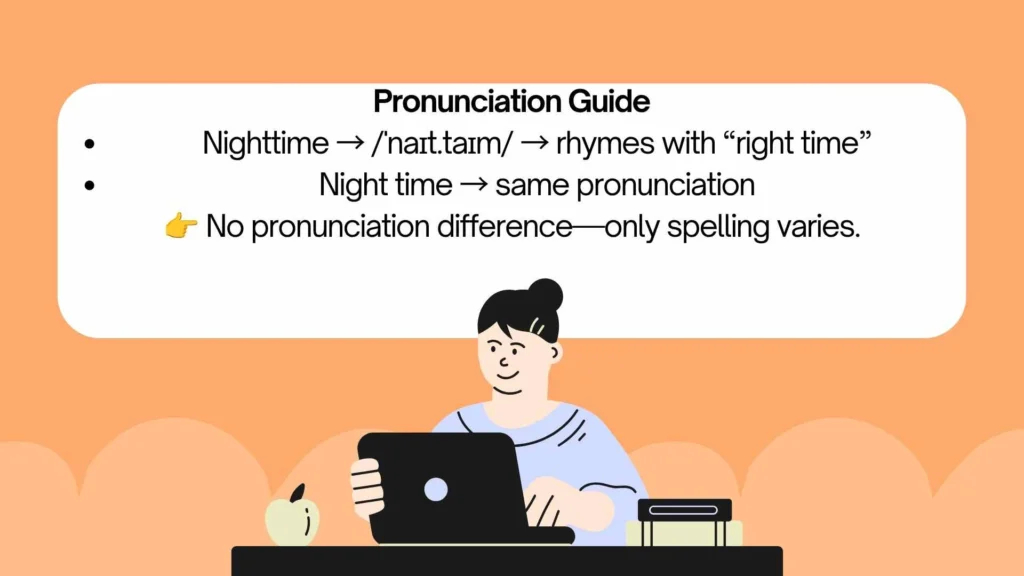
- Nighttime → /ˈnaɪt.taɪm/ → rhymes with “right time”
- Night time → same pronunciation
👉 No pronunciation difference—only spelling varies.
The Technical Differences
Why Both Exist
English evolves by combining frequently used word pairs.
“Nighttime” became dominant because:
- It’s faster to write
- It reflects modern usage patterns
- It aligns with other compounds like “daytime”
Linguistic Logic
- Closed compounds (nighttime) = more common, standardized
- Open compounds (night time) = older or stylistic
👉 Modern writing favors efficiency and consistency, hence “nighttime.”
Correct Spelling & Common Typos
Common Mistakes
- nightime ❌
- nigh time ❌
- night-time (hyphen overused) ❌
Why They Happen
- Confusion about compound words
- Influence from older writing styles
- Autocorrect inconsistencies
Correct Forms
- ✔ nighttime (preferred)
- ✔ night time (acceptable but less common)
Mnemonic Devices (Memory Tricks)
Use this simple rule:
“If it’s one concept, make it one word → nighttime.”
Or remember:
“Daytime and nighttime go together—both are one word.”
Regional Variations (US vs. UK English)
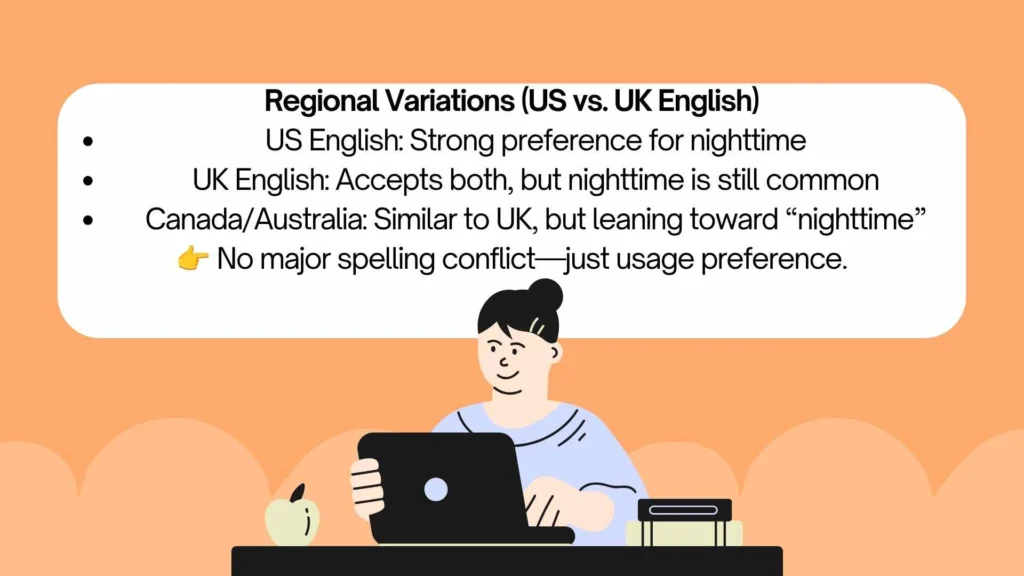
- US English: Strong preference for nighttime
- UK English: Accepts both, but nighttime is still common
- Canada/Australia: Similar to UK, but leaning toward “nighttime”
👉 No major spelling conflict—just usage preference.
Singular and Plural Forms
Nighttime
- Singular: nighttime
- Plural: nighttimes (rarely used)
- Possessive: nighttime’s
Night Time
- Singular: night time
- Plural: night times
- Possessive: night time’s
👉 Note: Plural forms are rarely needed in real usage.
Grammar Rules & Parts of Speech
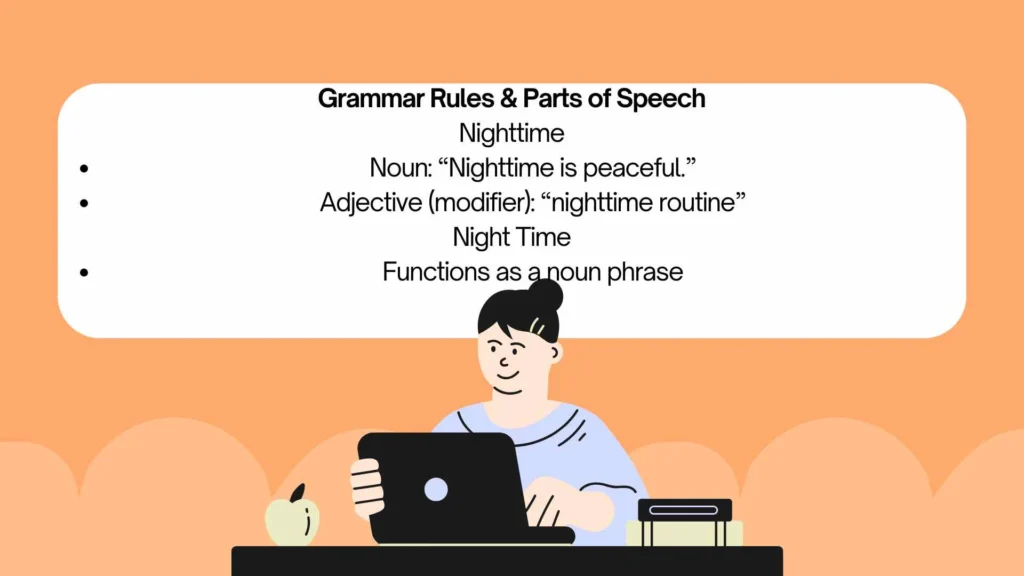
Nighttime
- Noun: “Nighttime is peaceful.”
- Adjective (modifier): “nighttime routine”
Night Time
- Functions as a noun phrase
Synonyms and Antonyms
Synonyms
- Evening
- Darkness
- Dusk (partial)
- Night
Antonyms
- Daytime
- Morning
- Daylight
Formal vs. Informal Usage
Formal Writing
- Use nighttime
- Preferred in:
- Academic writing
- Business communication
- SEO content
Informal Writing
- Both forms may appear
- “Night time” may be used for stylistic tone
Illustrative Examples
- I enjoy reading during nighttime.
- The city becomes quiet at nighttime.
- Her nighttime routine helps her sleep better.
- Nighttime is ideal for relaxation.
- He prefers working at night time.
- The forest looks mysterious at nighttime.
- Nighttime temperatures drop significantly.
- She follows a strict nighttime schedule.
- The baby wakes frequently at nighttime.
- Stars shine brightest at nighttime.
- Nighttime silence can be calming.
- Many animals are active during nighttime.
Practice Section (15 MCQs)
- Which is the preferred modern spelling?
A) Night time
B) Nighttime - “Nighttime” is a:
A) Verb
B) Noun - Which form is more common in US English?
A) Night time
B) Nighttime - “Night time” is:
A) Incorrect
B) Less common but acceptable - Which is a compound word?
A) Night time
B) Nighttime - “Nighttime routine” uses nighttime as:
A) Verb
B) Adjective - Which is older form?
A) Night time
B) Nighttime - Correct spelling:
A) nightime
B) nighttime - Which follows modern writing style?
A) Nighttime
B) Night time - Antonym of nighttime:
A) Darkness
B) Daytime - Nighttime refers to:
A) Morning
B) Night period - Which is more formal?
A) Nighttime
B) Night time - “Nighttime” evolved from:
A) Latin
B) Old English roots - Which is more concise?
A) Night time
B) Nighttime - Which is recommended for SEO writing?
A) Night time
B) Nighttime
Answer Key
1-B, 2-B, 3-B, 4-B, 5-B, 6-B, 7-A, 8-B, 9-A, 10-B, 11-B, 12-A, 13-B, 14-B, 15-B
Frequently Asked Questions (FAQs)
Is “nighttime” one word or two?
Both exist, but “nighttime” is the preferred modern spelling.
Is “night time” incorrect?
No, it’s correct but less commonly used today.
Which should I use in writing?
Use “nighttime” for clarity and professionalism.
Is there a difference in meaning?
No, both have the same meaning.
Why is “nighttime” more common now?
Because English favors shorter, compound forms for efficiency.
Is night time one word or two?
Both nighttime and night time are correct, but nighttime (one word) is the more common spelling in modern English. It is widely used in dictionaries, style guides, and everyday writing, while night time appears less often and is usually considered a variant spelling.
Is it nighttime or night time in the Oxford dictionary?
The Oxford English Dictionary lists nighttime as the standard spelling. While night time may still be understood, Oxford prefers the single-word form because it is the accepted modern compound noun in British and international English.
Is it night time or nighttime in British?
In British English, both nighttime and night time can be found, but nighttime is becoming more common in modern writing. Many British publishers and dictionaries now favor the one-word spelling for consistency and readability.
What is the difference between night and night time?
Night refers to the period of darkness between sunset and sunrise. Nighttime specifically emphasizes that period as a time or part of the day, often when talking about activities, routines, or conditions that happen during the night.
Does nighttime have two ts?
Yes. Nighttime is spelled with two t letters because it combines the words night and time. The correct spelling is nighttime, not nightime or any other variation.
Why do people say “nite” instead of “night”?
People use nite as an informal or creative spelling of night, especially in text messages, advertisements, social media, or casual conversations. However, night is the correct standard spelling and should be used in formal, academic, and professional writing.
Conclusion
Understanding the difference between nighttime and night time comes down to modern usage and linguistic evolution. While both forms are technically correct, nighttime has become the standard in contemporary English.
Using the right form improves clarity, professionalism, and readability especially in formal and digital writing.
The key takeaway is simple:
If you want to follow modern English conventions, stick with nighttime.
With this knowledge, you can now write confidently and avoid one of the most common small-but-important grammar mistakes.

James Anderson is a thriller and mystery author known for his suspenseful plots and unexpected twists. His storytelling keeps readers on the edge of their seats, blending intrigue with psychological depth. James has a talent for creating gripping narratives that captivate audiences from beginning to end.
📚 Books:
- The Hidden Truth
- Shadow Game
- Beyond the Lies
 Ethan Walker
 Olivia Turner