
Table of Contents
- Introduction
- Direct Answer
- Quick Comparison Table
- Deep Meanings & Definitions
- Historical Origin & Etymology
- Pronunciation Guide
- The Technical Differences
- Correct Spelling & Common Typos
- Mnemonic Devices
- Regional Variations
- Singular and Plural Forms
- Grammar Rules
- Synonyms and Antonyms
- Formal vs. Informal Usage
- Illustrative Examples
- Practice Section (15 MCQs)
- Frequently Asked Questions
- Conclusion
Introduction
I have noticed that one of the most common grammar questions in English is whether to use “seeked” or “sought” as the past tense of “seek.” This confusion arises because English has both regular and irregular verbs. While many verbs follow the simple “-ed” pattern, “seek” is irregular and follows a different rule. Mastering this distinction is essential for clear, professional writing. In this guide, I will explain the correct usage once and for all.
Direct Answer
The correct past tense and past participle of “seek” is sought. “Seeked” is incorrect and should never be used. “Sought” is the only acceptable form in standard English.
Quick Comparison Table
| Feature | Sought (Correct) | Seeked (Incorrect) |
| Spelling | S-O-U-G-H-T | S-E-E-K-E-D |
| Status | Standard, correct | Common error |
| Part of Speech | Verb (past tense/past participle) | Incorrect verb form |
| Usage | Past tense of “seek” | Not used in standard English |
| Regional Acceptance | All English varieties | None |
Deep Meanings & Definitions
Seek (Verb): To try to find or obtain something; to search for something.
Sought (Past Tense/Past Participle): The past tense and past participle form of “seek,” indicating the action of searching happened in the past.
Meanings in Context:
- Search for: “They sought shelter from the storm.”
- Attempt to obtain: “The company sought new investors.”
- Ask for: “She sought advice from her mentor.”
- Pursue: “He sought a career in medicine.”
Historical Origin & Etymology
Root Word:
- Old English: “sēcan” (to seek, pursue)
- Proto-Germanic: “sōkijaną”
- Proto-Indo-European: “sāg-” (to trace, seek)
Evolution:
- Old English: sēcan (present) → sōhte (past)
- Middle English: seken → soughte
- Modern English: seek → sought
Linguistic Pattern:
“Sought” follows the pattern of other irregular verbs where the vowel changes and “-ght” is added:
- Seek → Sought (like “teach” → “taught”)
- Bring → Brought
- Fight → Fought
- Think → Thought
Pronunciation Guide
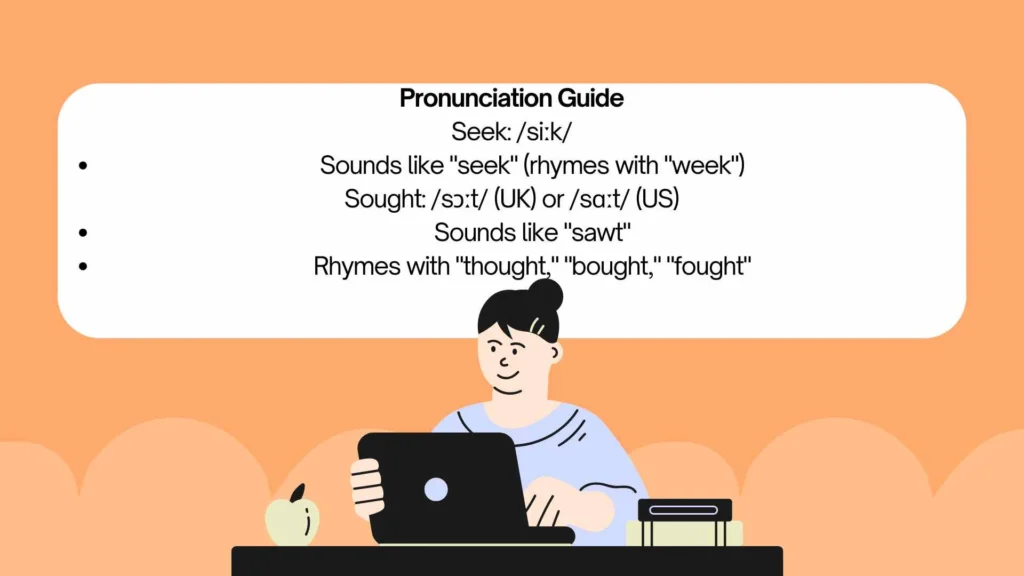
Seek: /siːk/
- Sounds like “seek” (rhymes with “week”)
Sought: /sɔːt/ (UK) or /sɑːt/ (US)
- Sounds like “sawt”
- Rhymes with “thought,” “bought,” “fought”
- NOT pronounced like “soot” or “suit”
The Technical Differences
Grammar Rule:
“Sought” is the irregular past tense form. “Seeked” follows the regular pattern but is incorrect.
Why “Seeked” is Wrong:
- “Seek” is an irregular verb
- Irregular verbs don’t follow the “-ed” pattern
- The correct form has been “sought” for centuries
Comparison with Similar Verbs:
- Bring → Brought (not “bringed”)
- Teach → Taught (not “teached”)
- Buy → Bought (not “buyed”)
- Fight → Fought (not “fighted”)
- Seek → Sought (not “seeked”)
Correct Spelling & Common Typos
Correct:
- Sought
Common Typos/Errors:
- Seeked (most common error)
- Seaked (mispronunciation-based)
- Sougt (missing ‘h’)
- Soaght (vowel confusion)
Memory Tip: The correct spelling has “ough” like “bought” and “thought.”
Mnemonic Devices
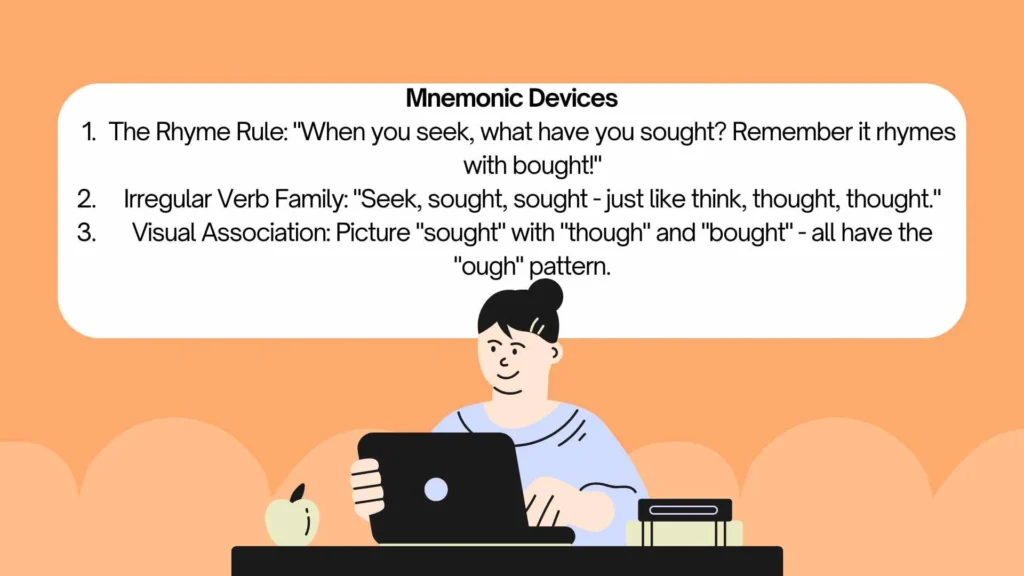
- The Rhyme Rule: “When you seek, what have you sought? Remember it rhymes with bought!”
- Irregular Verb Family: “Seek, sought, sought – just like think, thought, thought.”
- Visual Association: Picture “sought” with “though” and “bought” – all have the “ough” pattern.
- Memory Hook: “If you seek it today, you have sought it yesterday – no ‘e’ in sight!”
Regional Variations
No Regional Variation:
“Sought” is the correct past tense in all varieties of English:
- American English: Sought
- British English: Sought
- Canadian English: Sought
- Australian English: Sought
“Seeked” is universally considered incorrect across all regions.
Singular and Plural Forms
Verb Conjugations:
- Base form: seek
- Third person singular: seeks
- Past tense: sought
- Past participle: sought
- Present participle: seeking
Examples:
- Singular: “He sought help.”
- Plural: “They sought answers.”
- Past Participle: “She has sought advice.”
Grammar Rules
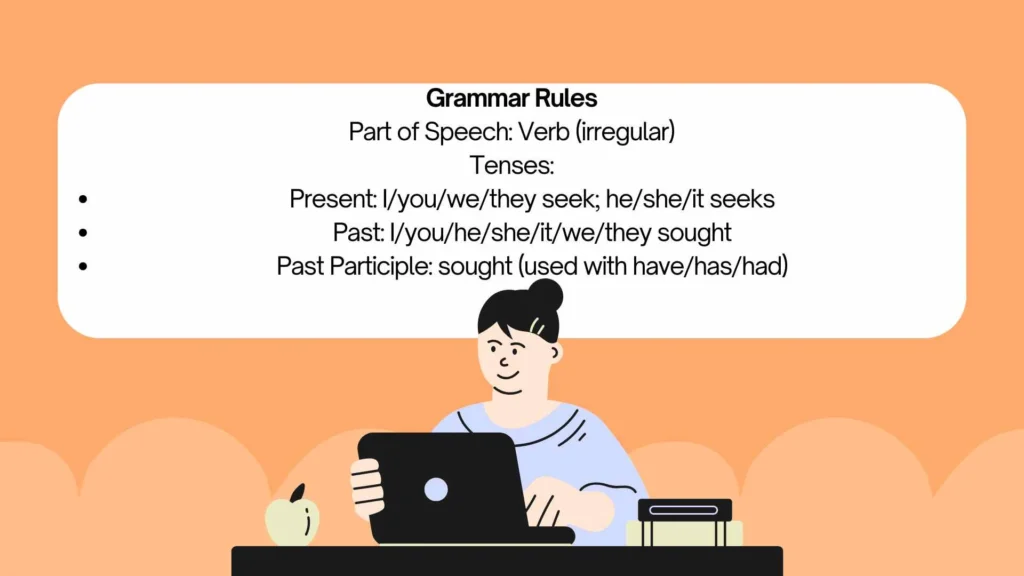
Part of Speech: Verb (irregular)
Tenses:
- Present: I/you/we/they seek; he/she/it seeks
- Past: I/you/he/she/it/we/they sought
- Past Participle: sought (used with have/has/had)
- Present Participle: seeking
Example Sentences:
- Past tense: “I sought a new job last year.”
- Past participle: “She has sought medical attention.”
- Present: “They seek opportunities daily.”
Synonyms and Antonyms
Synonyms:
- Searched
- Pursued
- Hunted
- Looked for
- Explored
- Inquired
- Investigated
Antonyms:
- Avoided
- Ignored
- Neglected
- Overlooked
- Refused
- Rejected
- Surrendered
Formal vs. Informal Usage
Formal Contexts:
“Sought” is used in both formal and informal contexts but is common in formal writing.
- “The committee sought public input before making a decision.”
- “The researchers sought funding for their project.”
Informal Contexts:
“Sought” is also used in informal speech and writing.
- “I sought advice from my friend.”
- “They sought shelter during the storm.”
Note: “Sought” is the only correct form in ALL contexts. “Seeked” should never be used.
Illustrative Examples
- She sought refuge from the storm in a nearby cave.
- The detective sought clues at the crime scene.
- They sought answers to life’s biggest questions.
- He sought forgiveness from his family.
- The company sought new markets in Asia.
- I sought advice from my professor before choosing my major.
- The explorers sought a route through the mountains.
- She has sought medical help for her condition.
- The government sought to improve education standards.
- They sought peace after years of conflict.
- He sought employment in the technology sector.
- The patient sought a second opinion from another specialist.
Practice Section (15 MCQs)
- What is the correct past tense of “seek”?
- a) Seeked
- b) Sought
- c) Seaked
- d) Sougt
- “Seeked” is:
- a) Correct in American English
- b) Correct in British English
- c) Always incorrect
- d) Used in informal speech
- Which word rhymes with “sought”?
- a) Suit
- b) Thought
- c) See
- d) Seek
- “She ___ advice from her mentor.” Choose the correct option.
- a) Seeked
- b) Sought
- c) Seeks
- d) Seeking
- Which verb follows the same irregular pattern as “seek”?
- a) Walk
- b) Talk
- c) Bring
- d) Play
- The past participle of “seek” is:
- a) Seeked
- b) Seeking
- c) Sought
- d) Seeks
- “They have ___ a solution.” Fill in the blank.
- a) Seeked
- b) Sought
- c) Seaking
- d) Seeks
- “Sought” rhymes with:
- a) Week
- b) Bought
- c) Beat
- d) Seat
- Which is the base form of “sought”?
- a) Seek
- b) Sought
- c) Seeking
- d) Seeks
- “The police ___ the missing person.” Choose the correct option.
- a) Seeked
- b) Sought
- c) Seaking
- d) Seeks
- How do you spell the past tense of “seek”?
- a) S-O-U-G-H-T
- b) S-E-E-K-E-D
- c) S-O-A-G-H-T
- d) S-E-A-K-E-D
- “Sought” is used in:
- a) American English only
- b) British English only
- c) All varieties of English
- d) Informal speech only
- Which is the correct sentence?
- a) He seeked a better job.
- b) He sought a better job.
- c) He seaked a better job.
- d) He sougt a better job.
- The Old English root of “seek” is:
- a) Sōhte
- b) Sēcan
- c) Secan
- d) Seecan
- “The organization ___ donations.” Which completes the sentence correctly?
- a) Seeked
- b) Sought
- c) Seeking
- d) Seeks
Answer Key:
- b
- c
- b
- b
- c
- c
- b
- b
- a
- b
- a
- c
- b
- b
- b
Frequently Asked Questions
Q1: Is “seeked” ever correct?
No. “Seeked” is always incorrect in standard English. The correct past tense and past participle of “seek” is always “sought.”
Q2: Why is it “sought” and not “seeked”?
“Seek” is an irregular verb that follows the pattern of other verbs where the vowel changes and “-ght” is added. This pattern has existed since Old English times.
Q3: Is “sought” used in American English?
Yes. “Sought” is used in all varieties of English, including American, British, Canadian, and Australian English.
Q4: What are similar irregular verbs?
Similar verbs include “bring” → “brought,” “teach” → “taught,” “think” → “thought,” and “fight” → “fought.”
Q5: Can “sought” be used as a noun?
No, “sought” is a verb form (past tense and past participle). It functions only as a verb in sentences.
Conclusion
I hope this guide has cleared up the confusion between “seeked” and “sought.” Remember that “sought” is the only correct past tense and past participle form of “seek.” “Seeked” is a common error that should be avoided in all types of writing, whether formal or informal. By understanding the irregular verb patterns in English, you can confidently use “sought” in your writing and speech. Keep this guide handy, and soon the correct usage will become second nature!

James Anderson is a thriller and mystery author known for his suspenseful plots and unexpected twists. His storytelling keeps readers on the edge of their seats, blending intrigue with psychological depth. James has a talent for creating gripping narratives that captivate audiences from beginning to end.
📚 Books:
- The Hidden Truth
- Shadow Game
- Beyond the Lies
 Ethan Walker
 Olivia Turner