Table of Contents
- Introduction
- Direct Answer
- Quick Comparison Table
- Deep Meanings & Definitions
- Historical Origin & Etymology
- Pronunciation Guide
- The Technical Differences
- Correct Spelling & Common Typos
- Mnemonic Devices
- Regional Variations
- Singular and Plural Forms
- Grammar Rules
- Synonyms and Antonyms
- Formal vs. Informal Usage
- Illustrative Examples
- Practice Section (15 MCQs)
- Frequently Asked Questions
- Conclusion
Introduction
I have observed that one of the most common points of confusion in physics and chemistry is understanding the difference between diamagnetic or paramagnetic materials. This distinction is fundamental to understanding how matter interacts with magnetic fields. Whether you are a student preparing for exams, a researcher in materials science, or simply curious about the world around you, mastering these terms is essential. In this guide, I will clarify these concepts with clear explanations and practical examples.
Direct Answer
Diamagnetic materials have all electrons paired and are weakly repelled by magnetic fields. Paramagnetic materials have unpaired electrons and are weakly attracted to magnetic fields. The key difference lies in electron configuration and magnetic susceptibility.
Quick Comparison Table
| Feature | Diamagnetic | Paramagnetic |
| Electron Configuration | All electrons paired | Unpaired electrons |
| Magnetic Response | Weakly repelled | Weakly attracted |
| Magnetic Susceptibility | Negative | Positive |
| Permanent Magnetic Moment | No | Yes |
| Examples | Copper, Silver, Water | Aluminum, Platinum, Oxygen |
Deep Meanings & Definitions
Diamagnetic Materials:
- Have no net magnetic moment because all electrons are paired
- Induced magnetization opposes the applied magnetic field
- Magnetic susceptibility is negative and temperature-independent
- Present in all materials but often masked by stronger effects
Paramagnetic Materials:
- Possess permanent magnetic moments due to unpaired electrons
- Magnetic moments align with applied field, creating net magnetization
- Magnetic susceptibility is positive and temperature-dependent
- Thermal energy randomizes moments, reducing alignment
Historical Origin & Etymology
Diamagnetic:
- Coined by Michael Faraday in 1845
- Greek roots: “dia” (through/across) + “magnetic”
- Describes materials that allow magnetic fields to pass through while opposing them
Paramagnetic:
- Also coined by Faraday in 1845
- Greek roots: “para” (beside/alongside) + “magnetic”
- Describes materials that align alongside magnetic fields
Pronunciation Guide
Diamagnetic: /ˌdaɪ.ə.mæɡˈnet.ɪk/
- Sounds like “DYE-uh-mag-NET-ik”
- Stress on the third syllable
Paramagnetic: /ˌpær.ə.mæɡˈnet.ɪk/
- Sounds like “PAIR-uh-mag-NET-ik”
- Stress on the third syllable
The Technical Differences
Electronic Origin:
- Diamagnetism: Arises from paired electrons whose opposite spins cancel magnetic moments
- Paramagnetism: Arises from unpaired electrons that create net magnetic moments
Magnetic Response:
- Diamagnetic: Opposes the applied field; repelled from stronger field regions
- Paramagnetic: Aligns with the applied field; attracted to stronger field regions
Temperature Dependence:
- Diamagnetic: Largely temperature-independent
- Paramagnetic: Decreases with increasing temperature (Curie’s Law)
Correct Spelling & Common Typos
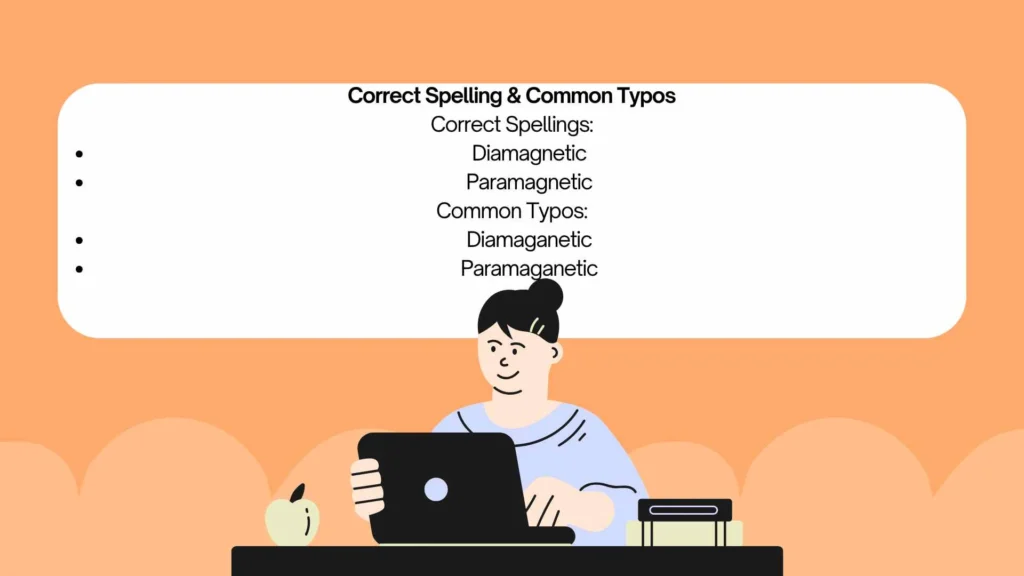
Correct Spellings:
- Diamagnetic
- Paramagnetic
Common Typos:
- Diamaganetic
- Paramaganetic
- Diamagentic
- Paramagentic
Memory Tip: Both contain “magnetic” with different prefixes: “dia-” (through) and “para-” (beside).
Mnemonic Devices
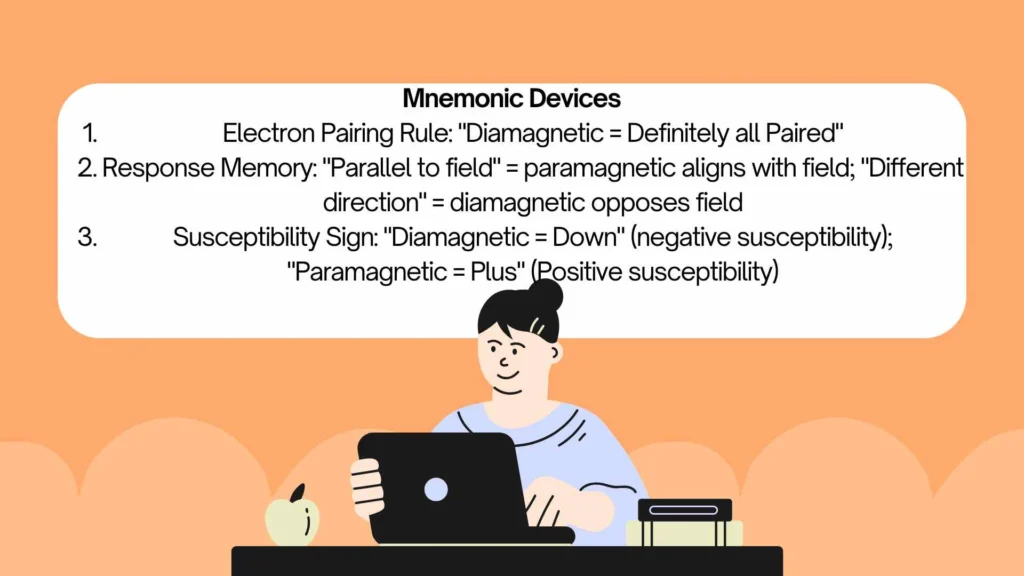
- Electron Pairing Rule: “Diamagnetic = Definitely all Paired”
- Response Memory: “Parallel to field” = paramagnetic aligns with field; “Different direction” = diamagnetic opposes field
- Susceptibility Sign: “Diamagnetic = Down” (negative susceptibility); “Paramagnetic = Plus” (positive susceptibility)
Regional Variations
No Regional Variation:
These scientific terms have consistent spelling across all English varieties:
- American English: Diamagnetic, Paramagnetic
- British English: Diamagnetic, Paramagnetic
- Canadian English: Diamagnetic, Paramagnetic
- Australian English: Diamagnetic, Paramagnetic
Singular and Plural Forms
Adjective Forms:
- Singular: diamagnetic, paramagnetic
- Plural: no plural forms (adjectives remain unchanged)
Noun Forms:
- Singular: diamagnet, paramagnet
- Plural: diamagnets, paramagnets
Possessive Forms:
- “The diamagnet’s response was measured”
- “The paramagnet’s susceptibility was calculated”
Grammar Rules
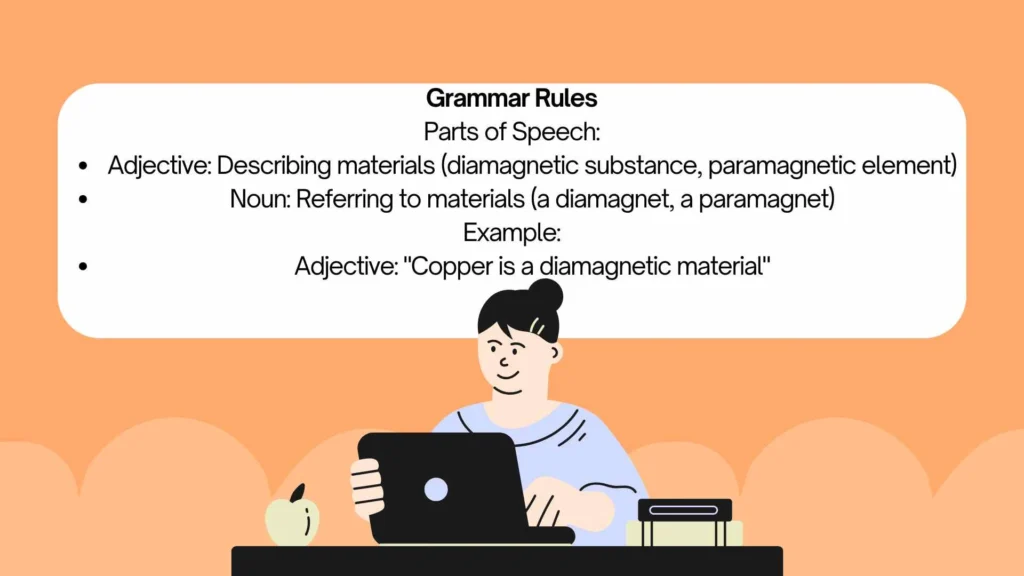
Parts of Speech:
- Adjective: Describing materials (diamagnetic substance, paramagnetic element)
- Noun: Referring to materials (a diamagnet, a paramagnet)
Example:
- Adjective: “Copper is a diamagnetic material”
- Noun: “Aluminum is a paramagnet”
Synonyms and Antonyms
Synonyms:
- Diamagnetic: Repelled, non-magnetic
- Paramagnetic: Attracted, weakly magnetic
Antonyms:
- Diamagnetic: Paramagnetic, ferromagnetic
- Paramagnetic: Diamagnetic
Related Terms:
- Ferromagnetic (strongly attracted, retains magnetism)
- Antiferromagnetic (no net magnetism)
- Ferrimagnetic (unequal opposing moments)
Formal vs. Informal Usage
Formal Contexts:
- Scientific papers, academic writing, technical reports
- Use precise terms with definitions
- Example: “The diamagnetic susceptibility of the sample was measured at 300K”
Informal Contexts:
- Educational content, general discussions
- Simpler explanations acceptable
- Example: “Diamagnetic materials are slightly pushed away by magnets”
Illustrative Examples
- Copper, silver, and gold are all diamagnetic materials.
- Aluminum and platinum are examples of paramagnetic elements.
- Diamagnetic substances have a negative magnetic susceptibility.
- Paramagnetic materials become magnetized in the direction of an applied field.
- Water is a diamagnetic substance.
- Oxygen is paramagnetic due to unpaired electrons.
- Diamagnetic materials are repelled by strong magnets.
- Paramagnetic materials are weakly attracted to magnetic fields.
- Bismuth exhibits the strongest diamagnetic properties.
- Platinum is one of the strongest paramagnetic materials.
- All materials show some diamagnetic behavior.
- Paramagnetic effects decrease with increasing temperature.
Practice Section (15 MCQs)
- Diamagnetic materials have:
- a) Unpaired electrons
- b) All electrons paired
- c) Strong magnetic attraction
- d) Positive susceptibility
- Paramagnetic materials are:
- a) Repelled by magnetic fields
- b) Attracted to magnetic fields
- c) Strongly magnetic
- d) Non-magnetic
- Magnetic susceptibility of diamagnetic materials is:
- a) Positive
- b) Negative
- c) Zero
- d) Large
- Which is an example of a diamagnetic material?
- a) Aluminum
- b) Platinum
- c) Copper
- d) Oxygen
- Which is an example of a paramagnetic material?
- a) Silver
- b) Gold
- c) Aluminum
- d) Water
- Paramagnetic materials have:
- a) Paired electrons only
- b) Unpaired electrons
- c) No electrons
- d) Strong magnetic domains
- Diamagnetic materials respond to magnetic fields by:
- a) Aligning with the field
- b) Opposing the field
- c) Strengthening the field
- d) Retaining magnetism
- Which material is paramagnetic?
- a) Copper
- b) Platinum
- c) Silver
- d) Gold
- The Greek prefix “dia-” in “diamagnetic” means:
- a) Beside
- b) Through/across
- c) Strong
- d) Weak
- Paramagnetism is caused by:
- a) Paired electrons
- b) Unpaired electrons
- c) Magnetic domains
- d) All electrons
- Which statement about diamagnetic materials is true?
- a) They have positive susceptibility
- b) They retain magnetism
- c) They are temperature-independent
- d) They align with fields
- Ferromagnetic materials differ from paramagnetic materials by:
- a) Having unpaired electrons
- b) Being attracted to fields
- c) Retaining magnetism
- d) Having paired electrons
- Paramagnetic susceptibility follows:
- a) Ohm’s Law
- b) Curie’s Law
- c) Faraday’s Law
- d) Newton’s Law
- Which is NOT diamagnetic?
- a) Water
- b) Quartz
- c) Aluminum
- d) Silver
- The correct spelling is:
- a) Diamagnetic
- b) Diamaganetic
- c) Paramagnetic
- d) Both a and c
Answer Key:
- b
- b
- b
- c
- c
- b
- b
- b
- b
- b
- c
- c
- b
- c
- d
Frequently Asked Questions
Q1: What is the main difference between diamagnetic and paramagnetic materials?
The main difference lies in electron configuration. Diamagnetic materials have all electrons paired and are repelled by magnetic fields, while paramagnetic materials have unpaired electrons and are attracted to magnetic fields.
Q2: How can you tell if a material is diamagnetic or paramagnetic?
You can determine this by examining the electron configuration. If all electrons are paired, the material is diamagnetic. If there are unpaired electrons, it is paramagnetic.
Q3: Are all materials either diamagnetic or paramagnetic?
All materials exhibit some diamagnetism, but paramagnetism only occurs when unpaired electrons are present. Some materials can also be ferromagnetic, which is a stronger effect.
Q4: Which is stronger, diamagnetism or paramagnetism?
Paramagnetism is typically stronger than diamagnetism. However, both are generally weak compared to ferromagnetism.
Q5: What are common examples of diamagnetic and paramagnetic materials?
Common diamagnetic materials include copper, silver, gold, water, and quartz. Common paramagnetic materials include aluminum, platinum, magnesium, and oxygen.
Conclusion
I hope this guide has clarified the distinction between diamagnetic and paramagnetic materials. Remember that diamagnetic materials have paired electrons, are repelled by magnetic fields, and have negative susceptibility. Paramagnetic materials have unpaired electrons, are attracted to magnetic fields, and have positive susceptibility. Understanding these fundamental differences is essential for anyone studying physics, chemistry, or materials science. With this knowledge, you can now confidently identify and discuss these important magnetic properties.

Olivia Turner is a lifestyle and contemporary romance writer who focuses on positivity and everyday inspiration. Her stories are light, relatable, and filled with warmth, making them perfect for readers looking for uplifting content. Olivia draws inspiration from daily life and simple joyful moments.
📚 Books:
- Love & Coffee
- Chasing Happiness
- Moments That Matter
 Ethan Walker