Table of Contents
- Introduction
- Direct Answer
- Quick Comparison Table
- Deep Meanings & Definitions
- Historical Origin & Etymology
- Pronunciation Guide
- The Technical Differences
- Correct Spelling & Common Typos
- Mnemonic Devices (Memory Tricks)
- Regional Variations (US vs. UK English)
- Singular and Plural Forms
- Grammar Rules & Parts of Speech
- Synonyms and Antonyms
- Formal vs. Informal Usage
- Illustrative Examples
- Practice Section (15 MCQs)
- Frequently Asked Questions (FAQs)
- Conclusion
Introduction
I’ve noticed that even advanced English learners and native speakers often hesitate when choosing between “which” and “that.” I used to second-guess myself too, especially in formal writing. The confusion isn’t random; it stems from subtle grammar rules that aren’t always taught clearly.
Mastering “which vs. that” isn’t just about correctness it improves clarity, precision, and professionalism in your writing. Whether you’re crafting essays, emails, or SEO content, using the right word can elevate your language instantly.
Let’s break it down in a way that finally makes sense.
Direct Answer
“That” is used in restrictive clauses (essential information), while “which” is used in non-restrictive clauses (extra information, usually with commas). If removing the clause changes the sentence’s meaning, use “that.” If it adds optional detail, use “which.”
Quick Comparison Table
| Feature | Which | That |
| Meaning | Adds extra, non-essential info | Defines essential information |
| Usage | Non-restrictive clauses | Restrictive clauses |
| Commas | Always used | Never used |
| Example | The car, which is red, is fast | The car that is red is fast |
Deep Meanings & Definitions
What is “That”?
“That” is a relative pronoun used to introduce restrictive clauses—information necessary to identify the subject.
- Example:
The book that you gave me is amazing.
(You must specify which book.)
What is “Which”?
“Which” is also a relative pronoun, but it introduces non-restrictive clauses—extra information that can be removed without changing the core meaning.
- Example:
The book, which you gave me, is amazing.
(We already know which book.)
Historical Origin & Etymology
“That”
- Originates from Old English “þæt” (thaet)
- Related to German “das”
- Initially used broadly for both restrictive and non-restrictive clauses
“Which”
- Derived from Old English “hwilc” meaning “what sort”
- Evolved through Middle English into its modern form
- Became more specialized over time for non-restrictive clauses
The strict distinction between which and that became popular in modern English style guides, especially in American usage.
Pronunciation Guide
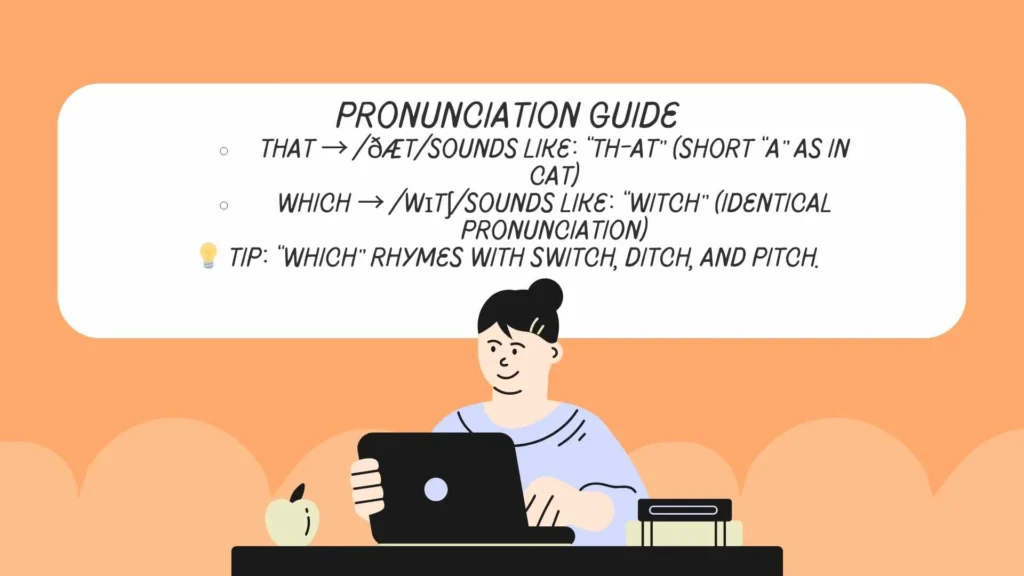
- That → /ðæt/
- Sounds like: “th-at” (short “a” as in cat)
- Which → /wɪtʃ/
- Sounds like: “witch” (identical pronunciation)
💡 Tip: “Which” rhymes with switch, ditch, and pitch.
The Technical Differences
The confusion arises from relative clause types:
1. Restrictive Clauses (Use “That”)
- Essential to sentence meaning
- No commas
- Limits or defines the noun
Example:
- The students that study hard succeed.
(Not all students—only those who study hard.)
2. Non-Restrictive Clauses (Use “Which”)
- Extra, optional information
- Always set off by commas
Example:
- The students, which study hard, succeed. ❌ (incorrect usage)
- Correct: The students, who study hard, succeed.
👉 Important: “Which” is mainly used for things, not people.
Correct Spelling & Common Typos
Common Mistakes:
- ❌ wich
- ❌ whitch
- ❌ tht
- ❌ thaht
Why They Happen:
- Phonetic confusion (“which” sounds like “witch”)
- Fast typing errors
- Lack of clarity in grammar rules
Mnemonic Devices (Memory Tricks)
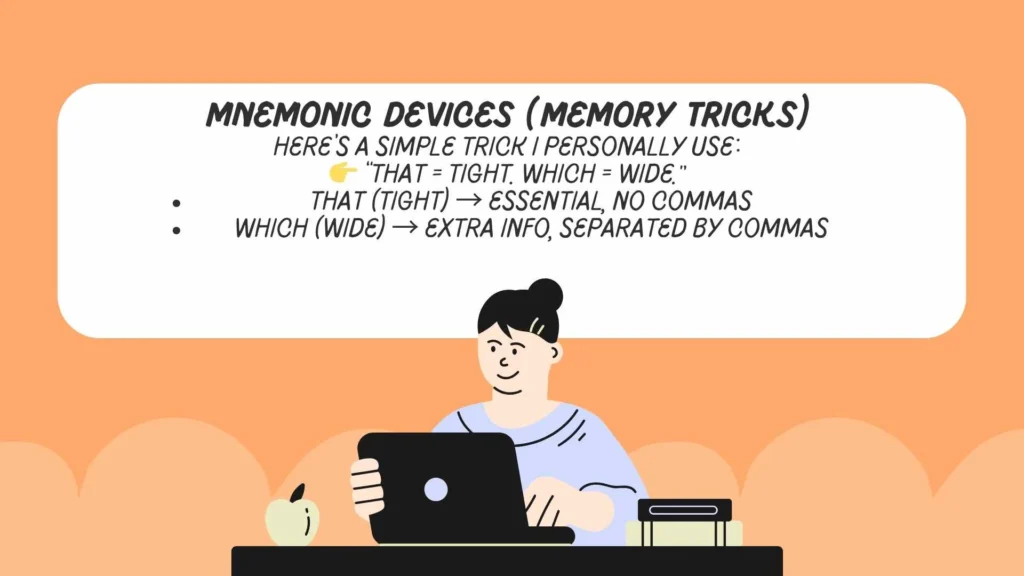
Here’s a simple trick I personally use:
👉 “That = Tight. Which = Wide.”
- That (tight) → essential, no commas
- Which (wide) → extra info, separated by commas
Or:
👉 “If you can remove it, use WHICH.”
Regional Variations (US vs. UK English)
American English
- Strong preference for strict distinction
- “That” = restrictive
- “Which” = non-restrictive
British English
- More flexible usage
- “Which” may appear in restrictive clauses
Canadian & Australian English
- Follow a mix, but lean toward American rules in formal writing
Singular and Plural Forms
Neither “which” nor “that” changes form for pluralization.
Examples:
- Singular: The car that is fast
- Plural: The cars that are fast
Possessive Form:
- Use whose instead
- Example: The house whose roof collapsed
Grammar Rules & Parts of Speech
Both “which” and “that” function as:
- Relative Pronouns
- Determiners (in some contexts)
Roles:
- Introduce relative clauses
- Connect dependent clauses to main clauses
Synonyms and Antonyms
Synonyms (contextual):
- Which → that, what, whichever
- That → which, who, whom
Antonyms:
Not direct opposites, but contrast forms:
- This / That
- These / Those
Formal vs. Informal Usage
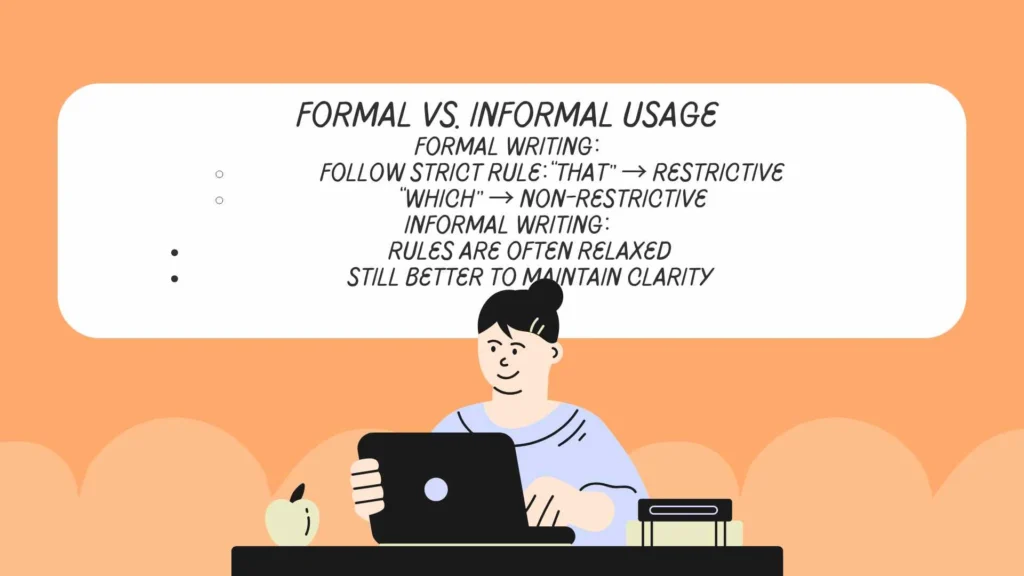
Formal Writing:
- Follow strict rule:
- “That” → restrictive
- “Which” → non-restrictive
Informal Writing:
- Rules are often relaxed
- Still better to maintain clarity
Business & Academic Writing:
- Always apply correct distinction
Illustrative Examples
- The movie that we watched was thrilling.
- The movie, which we watched yesterday, was thrilling.
- The car that broke down is mine.
- The car, which is old, broke down.
- The phone that you lost is expensive.
- The phone, which you lost, was new.
- The house that Jack built is famous.
- The house, which is huge, costs millions.
- The book that she wrote became a bestseller.
- The book, which she wrote last year, became popular.
- The dress that fits well looks great.
- The dress, which is blue, looks great.
Practice Section (15 MCQs)
Choose the correct option:
- The cake ___ I baked is delicious.
a) which
b) that - The cake, ___ I baked yesterday, is delicious.
a) which
b) that - The car ___ he bought is expensive.
a) which
b) that - The car, ___ is red, is expensive.
a) which
b) that - The book ___ you recommended is great.
- The book, ___ you recommended, is great.
- The house ___ needs repair is old.
- The house, ___ needs repair, is old.
- The laptop ___ I use is fast.
- The laptop, ___ I bought last year, is fast.
- The dress ___ she wore looked stunning.
- The dress, ___ was expensive, looked stunning.
- The phone ___ rang was mine.
- The phone, ___ rang loudly, was mine.
- The teacher ___ helped me was kind.
Answer Key:
- b
- a
- b
- a
- that
- which
- that
- which
- that
- which
- that
- which
- that
- which
- that
Frequently Asked Questions (FAQs)
1. Can “which” replace “that”?
Yes, but in formal writing, it’s better to follow the rule: “that” for essential, “which” for extra information.
2. Is it wrong to use “which” without commas?
In American English, yes (in formal contexts). In British English, it may be acceptable.
3. Can I use “that” for people?
Yes, but “who” is preferred:
- The person who called
- The person that called (less formal)
4. Why does this rule matter?
It improves clarity and avoids ambiguity in writing.
5. Is this rule required in SEO writing?
Yes clear grammar improves readability, rankings, and credibility.
Conclusion
Understanding the difference between “which” and “that” isn’t just a grammar exercise—it’s a powerful tool for clear communication. I’ve found that once you grasp the idea of essential vs. extra information, the confusion disappears.
Remember:
- Use “that” when the information is necessary
- Use “which” when it’s additional
With practice, this distinction becomes second nature. Keep applying the rules, test yourself, and your writing will become sharper, more precise, and more professional over time.

Ethan Walker is a non-fiction author and thought leader who writes about personal growth, productivity, and modern life challenges. His work focuses on helping readers simplify their lives, make better decisions, and achieve meaningful success. With a clear and practical writing style, Ethan provides valuable insights that inspire positive change and long-term improvement.
📚 Books:
- The Road to Clarity
- Moments of Truth
- Breaking the Limits
 Olivia Turner